Can TSMC keep dominating the AI boom when even record capacity expansion still cannot satisfy customer demand?

Why Is TSMC Rising While Peers Fall?
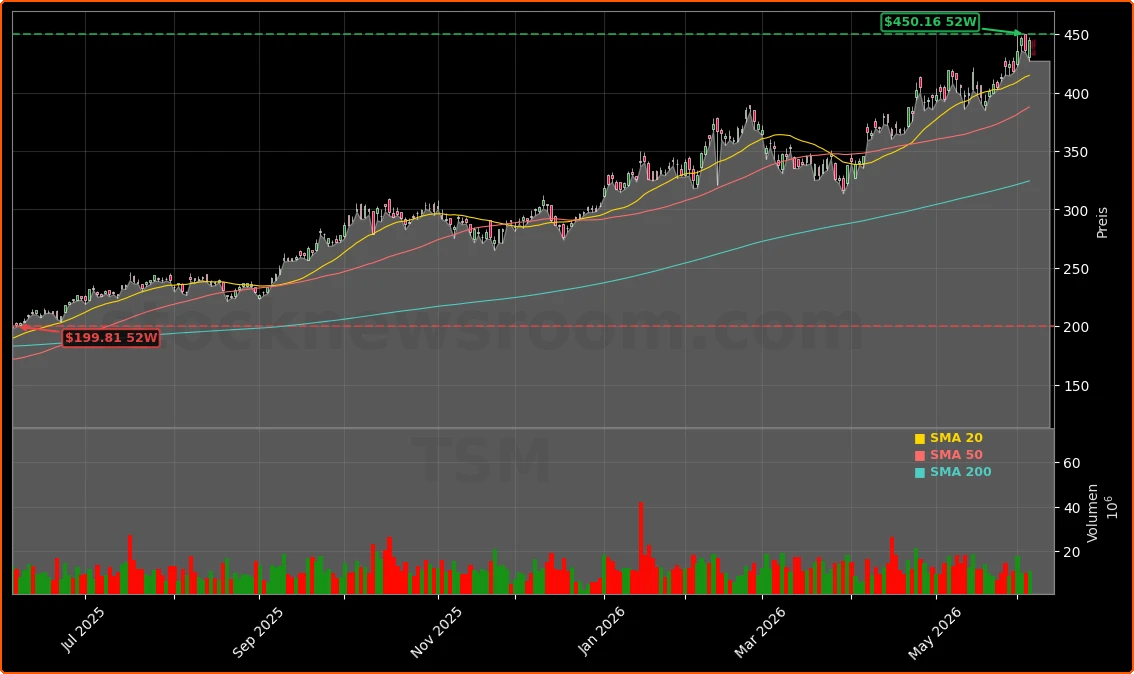
Taiwan Semiconductor Manufacturing Co. bucked a sharp sector-wide selloff on Friday, June 5, 2026 — rising 1.88% to $444.92 while Broadcom plunged 12.6% and Samsung Electronics dropped 6.4% in Seoul. The divergence highlights TSMC’s unique position: it’s not just a chipmaker, but the de facto infrastructure backbone for AI logic. While memory and networking chip suppliers face cyclical headwinds, TSMC AI Demand is driven by irreversible, multi-year data center buildouts from NVIDIA, Meta, and Apple. Its ability to deliver 2nm nanosheet chips at scale — now in mass production — keeps it irreplaceable, even as U.S. domestic capacity ramps slowly. As Goldman Sachs Asset Management strategist Tim Urbanowicz noted, TSMC is the ‘Fed of the global chip economy’ — setting the pace, not following it.
How Long Will TSMC AI Demand Outstrip Supply?
According to CEO C.C. Wei, the answer is ‘years.’ Speaking at the annual shareholder meeting and again at Computex, Wei confirmed that TSMC cannot fulfill all demand from U.S. hyperscalers — even with record capital expenditures and new fabs in Arizona and Japan. The bottleneck isn’t just wafer capacity: it’s the entire supply chain — from advanced packaging to specialized materials and skilled labor. TSMC is accelerating hiring and boosting employee bonuses by over 30% this year — a signal of internal strain, not slack. Crucially, Wei ruled out aggressive price hikes, citing stability as a strategic priority — a stark contrast to memory chipmakers enjoying 80% gross margins. This discipline reinforces long-term client trust, especially as NVIDIA and AMD deepen design partnerships.
What Does This Mean for U.S. Investors?
For Wall Street portfolios, TSMC AI Demand is now a core exposure — not a satellite play. With TSM up 42% year-to-date and the iShares MSCI Taiwan ETF up nearly 67%, U.S. investors are gaining AI upside through a less volatile, more diversified vehicle than pure-play logic chip stocks. Analysts at RBC Capital Markets maintain a ‘Top Pick’ rating on Taiwan Semiconductor Manufacturing Co., citing its ‘unassailable lead in sub-3nm logic’ and ‘structural pricing power without inflationary tactics.’ Meanwhile, Morgan Stanley raised its 12-month price target to $425, citing ‘higher-than-expected AI-driven wafer utilization’ and ‘stronger-than-anticipated 2nm yield ramp.’ Importantly, TSMC’s revenue growth forecast of over 30% for 2026 remains intact — outpacing the S&P 500’s 8–10% consensus — and its $1.1136 quarterly dividend marks a 7.2% increase year-over-year.
Is the Semiconductor Rotation a Threat or Opportunity?
The recent rotation from tech into financials and health care — which lifted the Dow Jones 1.73% while the Nasdaq 100 fell 0.53% — reflects tactical profit-taking, not a fundamental reversal. Broadcom’s miss exposed valuation sensitivity, but TSMC’s valuation is anchored in execution, not hype. Its 2026 forward P/E remains below that of Micron Technology (MU), even as TSMC delivers broader AI exposure across logic, packaging, and IP. As 24/7 Wall St. observed in its June 4 analysis, TSMC offers ‘long-term stability’ where Micron faces ‘cyclicality risk.’ Moreover, institutional buying continues: Avise Financial Cooperative Inc. added $733,000 in TSM shares last quarter, and Glassy Mountain Advisors increased its stake by 15.1%. That’s not chasing momentum — it’s allocating to infrastructure.
What’s Next for TSMC’s U.S. Expansion?
We won’t be able to fulfill demand from U.S. customers even as more capacity comes online. We’re working very hard to avoid bottlenecks, but rapid growth is leaving suppliers struggling to keep up.— C.C. Wei, CEO of Taiwan Semiconductor Manufacturing Co.
TSMC’s $40 billion Arizona investment is central to U.S. semiconductor policy — but CEO Wei bluntly stated domestic production ‘will take a very long time’ to meet hyperscaler needs. That delay reinforces near-term reliance on Taiwan fabs — and validates TSMC AI Demand as a multi-year theme, not a quarterly event. The company’s May monthly revenue report — due early next week — will offer the first real-time check on whether AI capex is sustaining momentum. With 2nm chips now shipping to Apple and NVIDIA, and 1.4nm in pilot production, the technology runway remains unchallenged. As Simply Wall St. noted, ‘TSMC’s role in high-end AI compute is not just entrenched — it’s accelerating.’