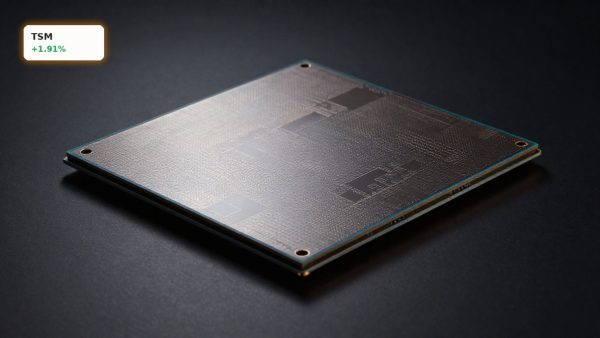
Can TSMC’s massive $100 billion US expansion justify its soaring valuation, or are investors starting to fear geopolitical risks?

How Did the Latest TSMC Earnings Beat Wall Street Estimates?
For the second quarter of 2026, Taiwan Semiconductor Manufacturing Co. delivered its fifth consecutive record-breaking quarter. Net income surged to NT$706.56 billion (approximately $22 billion USD), easily beating the LSEG SmartEstimates consensus of NT$632.64 billion. Revenue for the three-month period jumped 36% year-over-year to NT$1.27 trillion ($39.45 billion USD), coming in ahead of the NT$1.264 trillion expected by analysts.
The company’s profitability metrics were equally impressive. TSMC reported a gross profit margin of 67.7%, beating the consensus estimate of 67.1%, while its operating margin reached 60.3%. This exceptional performance was primarily driven by the massive global buildout of AI infrastructure. Advanced technologies, defined as 7-nanometer chips and smaller, accounted for a staggering 77% of TSMC’s total wafer revenue during the quarter. Specifically, 5-nanometer chips made up 33% of sales, 3-nanometer chips contributed 30%, and the newly ramping 2-nanometer node accounted for 3%.
Why Is Taiwan Semiconductor Raising Its Full-Year Outlook?
Following the blockbuster Q2 performance, management significantly upgraded its full-year guidance, a move that provides a strong tailwind for major US tech holdings. The company now expects full-year revenue growth to be slightly above 40% in US dollar terms, up from its previous forecast of more than 30% growth. For the upcoming third quarter, TSMC projects revenue to land between $44.6 billion and $45.8 billion USD, with a gross profit margin expected between 65% and 67%.
To support this rapid expansion and meet the insatiable demand from clients like NVIDIA, Apple, and Broadcom, the company is ramping up its capital expenditure. TSMC raised its 2026 capital spending budget to a range of $60 billion to $64 billion USD, up from the prior guidance of $52 billion to $56 billion USD. This massive investment plan is a highly positive signal for semiconductor equipment manufacturers like ASML, which acts as a key supplier of advanced lithography systems to the Taiwanese foundry.
What Do Massive US Investments Mean for Investors?
As geopolitical tensions remain a focal point for international investors, TSMC is aggressively expanding its global manufacturing footprint to diversify its supply chain. The company announced plans to invest an additional $100 billion USD in the United States, bringing its total projected investment in Arizona to $265 billion USD. This massive capital commitment will fund the construction of several cutting-edge chipmaking facilities and advanced packaging plants, with up to 10 foundries eventually planned for the US site.
While these international expansions in Arizona and Japan could introduce near-term cost pressures, Wall Street analysts view the long-term strategic benefits as vital. The rapid ramp-up of high-performance computing (HPC) applications—which saw revenue grow 20% quarter-on-quarter—is expected to easily offset minor cyclical weaknesses in the consumer smartphone and PC sectors. Major investment banks, including UBS, have noted that the higher capital expenditure targets reflect deep customer commitment and strong pricing power, strengthening the long-term investment case for the stock.
Related Coverage
Our June sales reinforce our view that AI and server processor demand will comfortably offset smartphone and PC weakness, strengthening the case for price increases.— Charles Shum, Analyst at Bloomberg Intelligence
For deeper context on the chipmaker’s recent financial trajectory, read our analysis of the preliminary sales figures in TSMC Earnings: Record Q2 Sales Signal Unstoppable AI Momentum, which highlighted the early signals of this quarter’s massive growth. Additionally, investors monitoring broader tech sector sentiment and valuation pressures can explore our report on Datadog Analyst Upgrade: Stock Drops -2.3% as Mizuho Raises Target to understand how Wall Street is reacting to software and cloud infrastructure spending.