Are blockbuster TSMC Earnings and record AI demand signaling the start of a lasting supercycle or the peak of investor optimism?

How do TSMC Earnings frame the AI trade?
Taiwan Semiconductor Manufacturing Co. has become one of the purest ways for U.S. investors to play the global AI infrastructure boom. The latest TSMC Earnings for Q1 2026, released on April 16, showed revenue of $35.9 billion, up 35.1% year over year, and earnings per share of $3.49, ahead of the $3.36 consensus. A standout gross margin of 66.2% topped guidance of 63% to 65%, underscoring the pricing power the company enjoys at leading‑edge nodes.
Management highlighted that AI‑related demand remains “extremely robust,” with accelerator revenue tracking a compound annual growth rate in the mid‑ to high‑50% range through 2029. High‑performance computing (HPC) now accounts for about 61% of total revenue, reflecting TSMC’s central role in powering the AI build‑out by hyperscale cloud providers. For U.S. investors, these TSMC Earnings reinforce the idea that the AI cycle is still in an early to mid‑innings phase rather than nearing exhaustion.
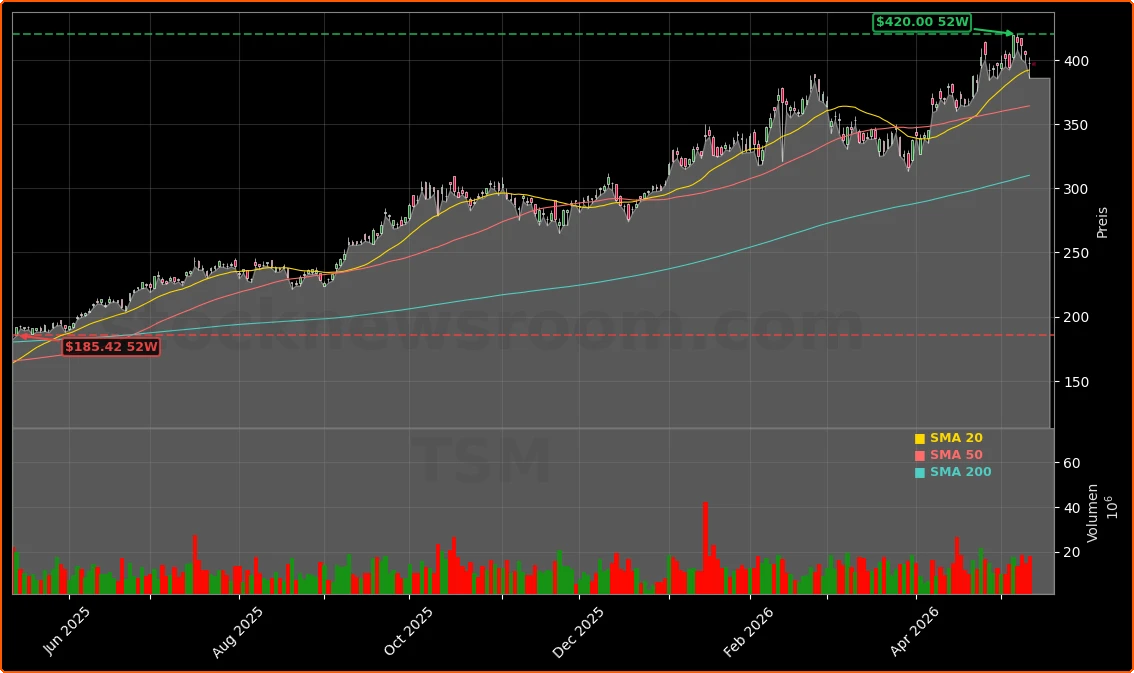
On the tape, shares have delivered a stunning roughly 132% gain over the past 12 months and about 33% year to date, making TSMC one of 2026’s megacap standouts. At $397.28, the stock trades roughly 5% below a recent 52‑week high around $420, with after‑hours trading at $396.47 indicating only mild profit‑taking despite the massive run.
What did guidance and capex signal?
The same TSMC Earnings update came with a significant upgrade to full‑year guidance. Management lifted 2026 revenue growth expectations to “above 30%” in U.S. dollar terms, effectively signaling confidence that AI demand and advanced-node capacity ramps can offset any softness in legacy segments. At the same time, TSMC now expects 2026 capital expenditures toward the high end of its $52 billion to $56 billion range, underscoring its commitment to staying ahead in process technology.
The company has already moved its N2 process into high‑volume manufacturing as of Q4 2025, with early yields described as healthy. While N2 and overseas fabs are expected to dilute corporate margins by roughly 4% to 6% in 2026, management believes that N3 technology should exceed the corporate average margin in the second half of the year. That should help preserve TSMC’s industry‑leading profitability even as it spends aggressively.
Monthly revenue trends back up the optimistic tone. April revenue reached about NT$410.7 billion, up 17.5% year over year, and cumulative revenue from January through April rose nearly 30%. These datapoints hint that the momentum visible in the last TSMC Earnings report is carrying into Q2, an important signal for investors watching for any cooling in AI infrastructure orders.
How is Wall Street valuing TSMC’s AI moat?
On Wall Street, bullishness remains the dominant stance. Research from 24/7 Wall St. currently pegs a 12‑month price target near $473.33, implying roughly 17% upside from recent levels and backing a “Buy” recommendation with a 90% confidence score. Their bull‑case scenario envisions the stock reaching around $552, a total return in the mid‑30% range, if AI capex proves as durable as expected and TSMC executes smoothly on N2 and its next‑generation A14 road map.
Analyst consensus is similarly upbeat: eighteen out of nineteen covering analysts rate the stock Buy or Strong Buy, with no Sell ratings reported. The core argument is straightforward: with roughly 72% global foundry market share at the leading edge, TSMC effectively sets the pace for advanced logic manufacturing. That positions it as a critical partner for AI leaders such as NVIDIA, Apple and other large chip designers who rely on its capacity and process technology.
From a technical perspective, the stock’s roughly 14‑day RSI around 60 suggests it is not yet in overbought territory despite the sharp rally, leaving room for further upside if sentiment stays constructive. For U.S. investors benchmarking against the S&P 500 and NASDAQ, TSMC has already delivered outsized alpha, but current TSMC Earnings and guidance have many believing there is still more to come.
What are the key risks for global investors?
Despite the upbeat TSMC Earnings picture, risks are material and must be factored into any U.S. portfolio decision. The first is concentration: with HPC and AI‑related demand representing about 61% of revenue, any pause in hyperscaler capex—whether driven by macro slowdown, over‑capacity, or a shift in architecture—would hit TSMC directly. A potential U.S. recession into 2027 could also lead cloud giants to moderate their more than $200 billion AI investment plans.
Second, the geopolitical backdrop around Taiwan remains a persistent overhang that is difficult to quantify in any discounted cash‑flow model. Investors effectively accept a geopolitical risk premium in exchange for exposure to the world’s most advanced manufacturing base. FX volatility and the financial burden of overseas expansion—backed by guarantees of over NT$500 billion for U.S. subsidiaries—add another layer of complexity.
Competition is also evolving. While TSMC still leads on process technology, rivals such as Samsung and Intel are investing heavily to close the gap. Meanwhile, some AI players are exploring in‑house chip manufacturing alternatives; for example, Elon Musk has floated plans for a dedicated TeraFab facility after discussions with TSMC and Samsung about pricing and risk sharing. At the same time, customers like Tesla and other high‑growth end‑markets will keep pushing for more capacity and better economics, testing TSMC’s pricing power over time.
Related Coverage
Investors who want a deeper dive into how the AI cycle is translating into share price momentum can read this analysis of TSMC’s recent 5% rally on surging AI chip demand. That piece discusses whether the latest spike in the stock is a one‑off or part of a much larger multi‑year AI supercycle, complementing the TSMC Earnings focus here and helping investors frame the long‑term opportunity.
AI-related demand continues to be extremely robust, and we see another step-up in computing intensity as applications evolve from generative to more agentic AI.— C.C. Wei, CEO of Taiwan Semiconductor Manufacturing Co.
TSMC Earnings underscore how central the company has become to the global AI build‑out, with strong margins, upgraded guidance, and robust demand pointing to continued growth. For American investors seeking leveraged exposure to AI infrastructure beyond U.S. names, Taiwan Semiconductor Manufacturing Co. offers a compelling, if geopolitically complex, option. The next few quarters of TSMC Earnings will show whether this AI supercycle can keep powering both the stock and the broader semiconductor sector higher.