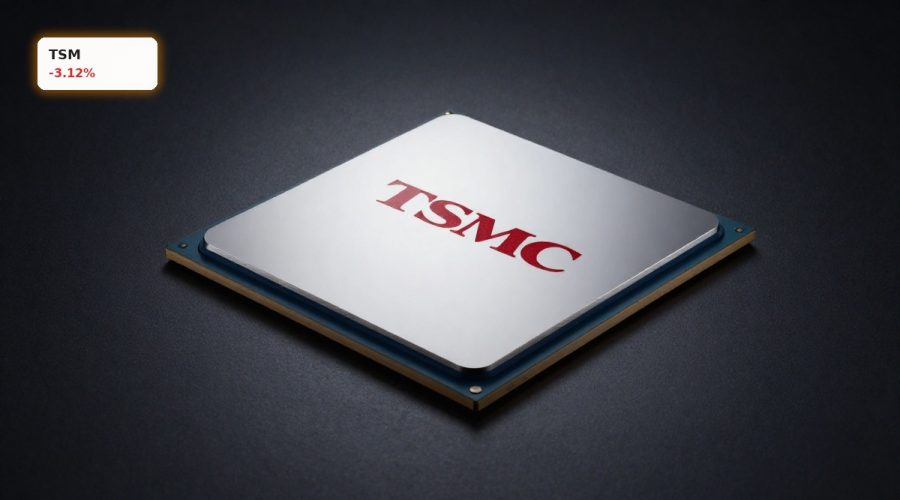
Can a single regulatory tweak in Taiwan really justify a TSMC Record while the stock slides 3.1% in New York?

How did Taiwan’s rule change spark a TSMC Record?
A seemingly technical regulatory tweak in Taipei has unleashed billions in potential demand for Taiwan Semiconductor Manufacturing Co. and helped drive a new TSMC Record on its home exchange. For years, Taiwan-based equity funds were capped at investing just 10% of their net asset value in any single company. Regulators have now relaxed that ceiling to 25% for companies that make up more than 10% of the Taiex index — a condition that only TSMC meets, given its dominant roughly 44% index weighting.
The impact was immediate. TSMC’s Taipei-listed shares jumped about 5.1% and closed at a record 2,185 Taiwan dollars after the rule came into force, underscoring how constrained domestic institutional demand had been. JPMorgan Chase analysts estimate that more than $6 billion of incremental capital could eventually flow into the stock as local funds rebalance, a sizable figure even for a company with a market capitalization above $2 trillion.
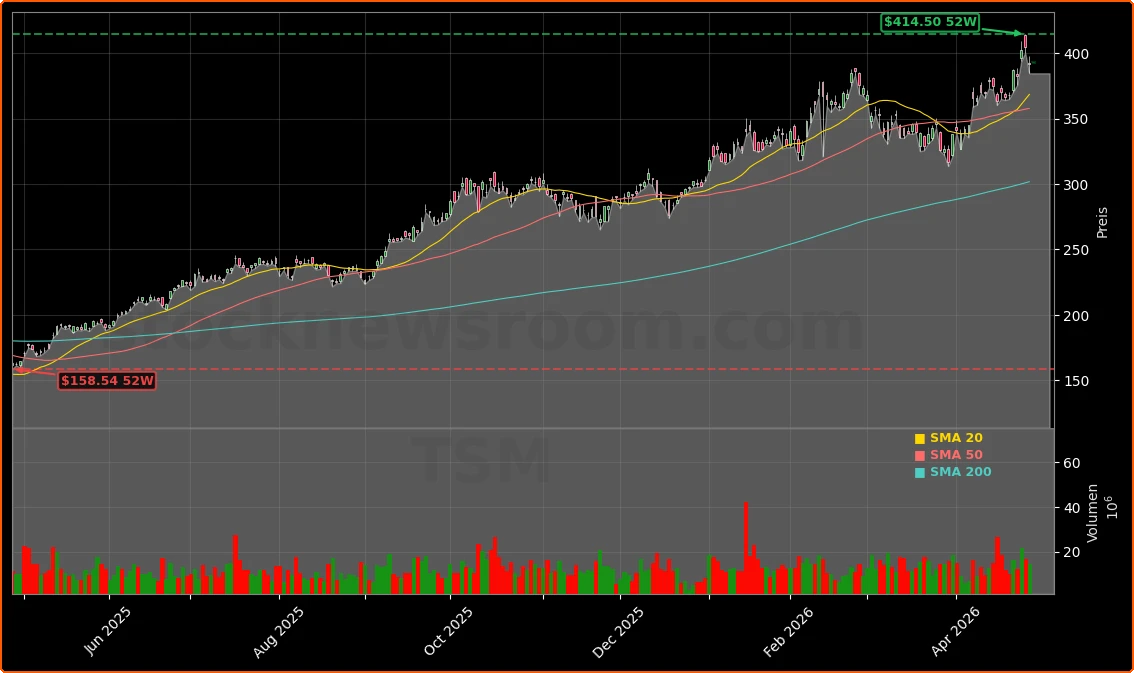
While U.S.-listed shares of TSM ended Tuesday down 3.12% at $392.34, with after-hours trading up 0.31% to $393.54, that weakness comes after a powerful rally. The ADRs have gained roughly 136% over the past 12 months and trade not far below their 52-week high around $414. With the TSMC Record in Taipei now confirmed, cross-market valuation gaps between local shares and New York–listed ADRs could continue to narrow.
What does the TSMC Record mean for Wall Street?
For U.S. investors, the Taiwan-driven TSMC Record is less about a one-day spike and more about structural demand and index concentration risks. As domestic funds in Taiwan raise their exposure, the company’s already heavy footprint in global benchmarks such as the MSCI Emerging Markets index could become even more pronounced, amplifying its influence on ETF performance. This makes TSMC an even closer peer to mega-cap chip names like NVIDIA and core hardware partners such as Apple.
The regulatory shift also helps close the long-standing discount of Taipei-listed shares to the typically richer valuations of TSM ADRs in New York. If that discount shrinks further, some U.S. traders may see less arbitrage opportunity, but long-term investors gain a cleaner read on underlying fundamentals instead of technical distortions. At the same time, the higher Taiex concentration heightens so-called “single-stock risk” for regional index investors, a factor U.S. portfolio managers will need to account for when assessing emerging-market allocations.
Options markets reflect the growing tension between optimism and caution. Year-to-date, TSM has rallied more than 30%, but large put positions have been opened, including sizable blocks in the $300 and $360 strikes with expirations in 2028 and 2027. Some institutional players appear to be hedging against a pullback toward the 200-day moving average, or at least protecting gains amid broader semiconductor sector volatility.
How strong is TSMC’s AI and earnings momentum?
Behind the latest TSMC Record is a run of standout financial performance driven by the AI supercycle. In the most recent reported quarter, revenue climbed about 35% year over year to a record roughly $35.6 billion, the first time the company’s quarterly sales have crossed one trillion New Taiwan dollars. Net income surged more than 58% versus the prior year, and the company’s gross margin exceeded 66%, beating its own targets.
In its Q1 2026 investor letter, Wedgewood Partners called TSMC a top contributor to portfolio returns, citing revenue growth of about 25% and management guidance for accelerating full-year 2026 growth of around 30% as demand for AI compute accelerators expands. March revenue alone was up 45% year over year and 31% month over month, reinforcing the view that AI infrastructure spending is still ramping. TSMC has increasingly bypassed traditional chip designers to work directly with cloud hyperscalers on custom silicon, helping match supply with demand and keep capital expenditures broadly aligned with revenue growth.
Management has also been able to push through price increases as utilization at leading-edge 3 nm and upcoming 2 nm nodes remains tight. According to company commentary, AI-related demand is outstripping available capacity, and the foundry is struggling to keep pace. That supply-demand imbalance has allowed TSMC to defend profitability even as it invests heavily in new fabs in Taiwan, the U.S. and other regions.
Can margins hold as 2 nm investments ramp up?
Despite the TSMC Record earnings and revenue figures, profitability is not without pressure. The aggressive rollout of its 2 nm technology — critical for next-generation AI accelerators, advanced smartphones and high-performance computing — is expected to dilute the company’s industry-leading gross margin by roughly two to three percentage points in 2026. Elevated capital spending and the complexity of early-node production tend to weigh on margins before volumes and yields normalize.
Still, compared with other chipmakers, TSMC’s position looks relatively insulated. The company has locked in multiyear supply contracts for key inputs such as helium for its Arizona fab plans and reportedly holds four to six months of inventory, giving it more buffer than many peers if supply chains tighten. That resilience is one reason large asset managers have kept TSMC as a core holding even after substantial share price gains.
On the Street, major firms including JPMorgan continue to highlight the stock as a central way to play the long-term AI buildout, often discussing it in the same breath as NVIDIA and high-end equipment suppliers. Some portfolio managers have trimmed positions simply because TSMC’s appreciation pushed its weighting above internal limits, not because of a deteriorating thesis.
How does TSMC compare to U.S. chip leaders?
For NASDAQ and S&P 500 investors, TSMC sits at the intersection of several themes: AI infrastructure, smartphone recovery and supply-chain diversification. While NVIDIA dominates GPU design and enjoys higher headline growth, it relies heavily on TSMC’s cutting-edge manufacturing capacity. Similarly, Apple depends on TSMC’s process leadership for its premium iPhone and Mac chips, tying Silicon Valley product cycles directly to the foundry’s technology roadmap.
Other U.S.-listed chipmakers are ramping capacity in the U.S. and Europe, but TSMC remains the clear leader at the most advanced nodes, where margins and strategic leverage are highest. That technological edge, combined with the fresh domestic capital unlocked by Taiwan’s reform, helps explain why the stock has outperformed many peers even amid sector pullbacks.
Related Coverage: Investors who want a deeper dive into valuation and income strategies around the current TSMC Record can look at this detailed analysis of Taiwan Semiconductor earnings and the 58% options yield boom warning. The article examines whether elevated options premiums on TSMC truly compensate for the risks or lure income-focused traders into a potential trap, and it offers additional context on how earnings strength interacts with derivatives markets.
Altogether, the latest TSMC Record in both operations and market structure underscores how central the company has become to the global AI and semiconductor ecosystem. For U.S. investors, the stock now sits at the crossroads of powerful growth drivers, concentration risks and rich valuations. The next few quarters of 2 nm ramp-up and AI demand will show whether TSMC can extend this TSMC Record run and remain a cornerstone holding for long-term portfolios.