
Is the new Intel Forecast signaling a true AI-driven turnaround or just another hype cycle before earnings hit the tape?

How is the Intel Forecast shifting before earnings?
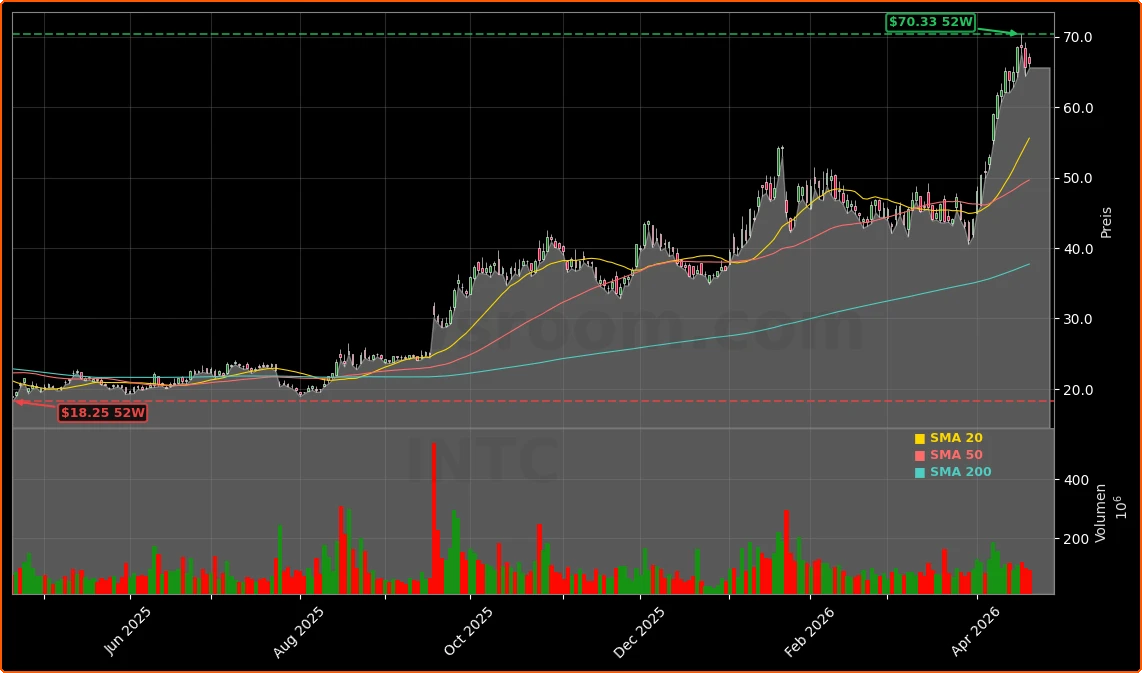
Intel Corporation (INTC) heads into Thursday night’s Q1 2026 report with momentum: the stock gained about 0.85% on Tuesday to close near $66, after briefly approaching its 52‑week high around $70. Analysts expect roughly $12.4 billion in revenue and just $0.01 in earnings per share, a sharp drop from $0.13 a year ago, but the market is looking far beyond these near‑term numbers.
The key to the current Intel Forecast is not backward‑looking PC demand but forward‑looking AI infrastructure spending. Intel shares have surged between 78% and 86% in 2026 alone, powered by surging orders from hyperscale cloud providers hungry for server CPUs to run increasingly complex AI agents. Despite a recent pullback, the stock has risen in 11 of the last 13 sessions as investors position ahead of earnings and a potential guidance upgrade.
That backdrop means Thursday’s commentary on AI orders, pricing, and capacity utilization may matter more than a one‑cent EPS beat or miss. For US investors in the NASDAQ and S&P 500, Intel’s performance has quietly become a major swing factor for broader tech sentiment beyond the better‑known AI winners like NVIDIA.
Why are BNP Paribas and HSBC turning positive on Intel?
The most dramatic change in the Intel Forecast comes from the analyst community. BNP Paribas upgraded Intel from Underperform to Neutral, hiking its price target from $34 to $60 after acknowledging that the AI‑driven CPU cycle has reshaped the outlook. Analyst David O’Connor highlights that “agentic AI is driving very strong demand for server CPUs with hyperscalers scrambling to secure supply,” putting Intel in a rare position of pricing power.
O’Connor now models Intel’s data center revenue rising 14% year over year in fiscal 2026 and another 8% in 2027, with EBITA swinging from a roughly $2.2 billion loss in FY25 to a $736 million profit in FY26 and accelerating toward $4.6 billion in FY27. Those numbers imply a sustained recovery in utilization at Intel’s fabs and improving margins as AI workloads fill capacity. While BNP still sees some downside from current share prices versus its $60 target, the tone has shifted from skepticism to acceptance that the AI cycle is real and powerful.
HSBC has gone even further, upgrading Intel from Hold to Buy and lifting its price target from $50 to an aggressive $95. Analyst Frank Lee argues that the server CPU business is the key near‑term catalyst and is not fully priced in. He expects the current server CPU shortage to extend into 2027, driving an estimated 20% year‑over‑year growth in shipments that year. For US portfolios, that HSBC call effectively places Intel in the same AI growth conversation as NVIDIA and other top AI infrastructure plays, rather than a legacy PC‑centric vendor.
What does agentic AI mean for Intel and competitors?
Agentic AI refers to AI systems that can autonomously plan, act, and interact across different applications, dramatically increasing compute intensity and persistence of workloads. Instead of sporadic inference tasks, hyperscalers are now running fleets of AI agents that continuously consume CPU and GPU resources. That shift is central to the current Intel Forecast because it boosts demand for not just accelerators, but also high‑core‑count server CPUs that handle orchestration, networking, and non‑GPU AI workloads.
This trend helps explain why Intel, often overshadowed by NVIDIA in the AI narrative, is now enjoying a server‑driven renaissance. KeyBanc Capital Markets, led by John Vinh, rates Intel Overweight with a $70 price target and argues that “the real cyclical recovery has yet to begin,” expecting AI infrastructure demand to support growth at least through 2027. While Advanced Micro Devices and ARM‑based solutions continue to chip away at x86 server share, the sheer size of AI‑related demand is allowing Intel to grow even in a more competitive landscape.
At the same time, Intel’s foundry ambitions are gaining credibility. The company is pushing its next‑generation 14A process node, with potential foundry customers already reviewing technical data. Successful design wins in late 2026 or early 2027 would add a new earnings leg to the Intel Forecast and could position the company as a genuine alternative to Taiwan’s manufacturing dominance for US and global chip designers, including potential deals with large system players like Apple and fast‑scaling AI users such as Tesla.
How does PC softness and valuation risk fit into the Intel Forecast?
The bull case is not without cracks. PC revenues face headwinds from a broader memory supply crunch, with industry volumes trending down double digits this year. Intel also continues to cede some server share to AMD and ARM architectures, keeping pressure on its long‑term competitive position. Some valuation models, such as InvestingPro’s fair‑value estimates, still flag a potential downside of more than 30% from current levels, a reminder that expectations are high after a 260% rally over the past year.
Still, the margin story is finally moving in the right direction. Intel’s decision to buy back Apollo Global’s 49% stake in its Irish fab underscores management’s confidence that AI‑driven utilization will remain strong. With fabs running near full capacity and chip prices rising, Intel is doing something it struggled with for years: expanding margins while funding a massive technology roadmap. For US investors, that combination of structural AI growth, improving profitability, and still‑rebuilding credibility is exactly what has pulled Intel back into the core of tech and semiconductor portfolios.
Related Coverage
For a deeper dive into whether earnings can keep up with the AI‑driven share price surge, readers can explore Intel Earnings -4.4%: Can a 260% AI Rally Survive the Crash Test?. That analysis examines how much of the recent rally is already pricing in a perfect turnaround and what risks could derail the bullish Intel Forecast if guidance or AI momentum disappoint in coming quarters.
Agentic AI is driving very strong demand for server CPUs with hyperscalers scrambling to secure supply.— David O’Connor, BNP Paribas analyst
In sum, the Intel Forecast now revolves around agentic AI, a structural server CPU shortage, and a foundry strategy that could add another profit engine by 2027. For US investors, Intel has re‑emerged as a key way to play the AI infrastructure build‑out across NASDAQ and S&P 500 portfolios. The upcoming earnings report and guidance will show whether this new narrative has enough fundamental backing to keep the rally alive and justify the increasingly optimistic targets on Wall Street.