
Can Snowflake’s bold Agentic AI push outweigh legal risks and fierce competition enough to justify today’s premium valuation?

How does Snowflake’s agentic AI pivot affect SNOW?
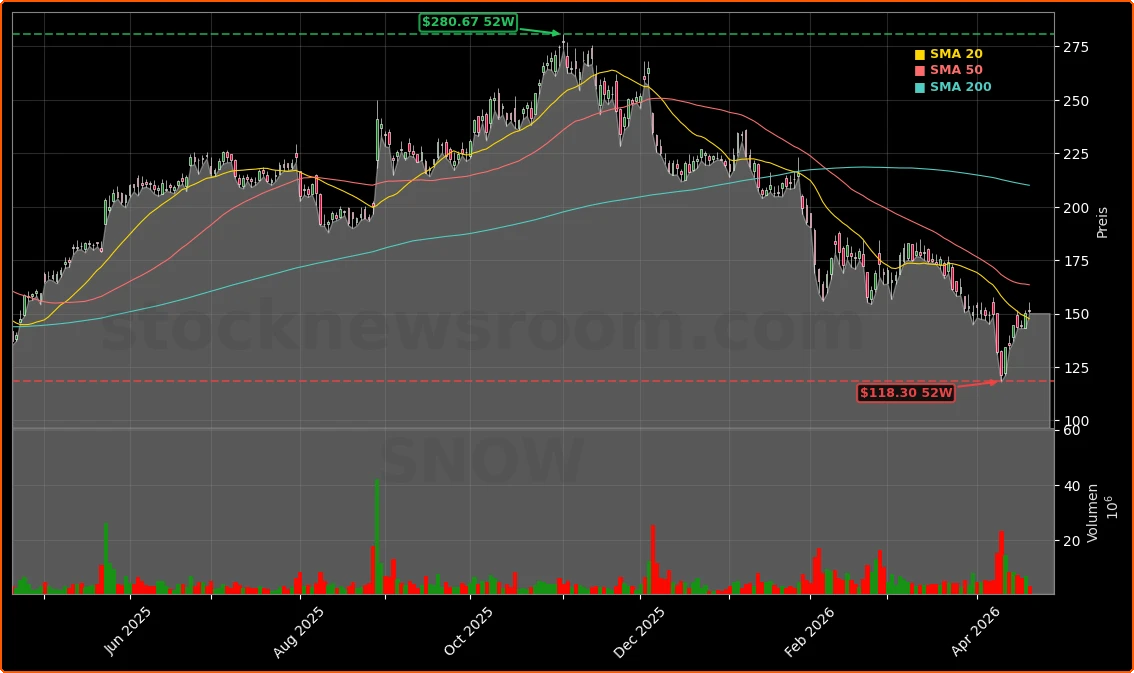
Snowflake Inc. is positioning itself as the “control plane” for the agentic enterprise, expanding Snowflake Intelligence and Cortex Code so AI agents can not only answer questions but take actions across business systems. For investors, this deepens the narrative that Snowflake is more than a data warehouse – it is trying to become a core AI platform, in the same conversation as hyperscalers and AI infrastructure names like NVIDIA. Shares edged up to about $151.35 on Tuesday, a modest gain of roughly 0.6% from the previous close, suggesting the market is cautiously optimistic but far from euphoric.
The Snowflake Agentic AI Strategy aims to convert Snowflake’s large installed base into higher-value, AI-driven workloads. More than 13,300 customers globally are already on the AI Data Cloud, and Snowflake says over 9,100 of them use its AI products weekly. If these users ramp agentic AI deployments into production, SNOW could unlock new, more durable revenue streams tied to automation and decision-making, not just raw data processing.
What is Snowflake Intelligence changing for users?
Snowflake Intelligence is evolving into a personal work agent that understands an organization’s governed data and operational context. New “Skills” will soon let business users describe workflows in natural language – preparing slide decks, running multi-step analyses, or sending follow-ups – which the agent then executes automatically. This is a more action-oriented vision than generic copilots, and central to the Snowflake Agentic AI Strategy.
The platform is also adding Model Context Protocol connectors for tools like Gmail, Google Calendar, Google Docs, Jira, Salesforce and Slack, allowing Snowflake Intelligence to operate across the applications employees already use. A forthcoming iOS mobile app will extend these capabilities on the go, while a deep-research mode uses an agentic architecture to generate cited, multi-step reports that can reason over structured data, unstructured content and external context. Over time, Snowflake Intelligence personalizes responses by learning user behavior and lets teams save reusable “artifacts” such as analyses and visualizations, effectively turning one-off work into institutional knowledge.
For US-based enterprises and portfolio managers, this moves Snowflake closer to the productivity-automation plays seen at Microsoft and Apple on the NASDAQ, but with a data-native angle. It also makes Snowflake more comparable to workflow-centric AI platforms deployed by large S&P 500 constituents, potentially strengthening customer lock-in if the tools deliver tangible ROI.
How does Cortex Code extend the Snowflake Agentic AI Strategy?
Cortex Code is Snowflake’s AI coding agent for builders, designed to work across complex, multi-system data environments. Since launching in late 2025, it has seen rapid uptake, with more than half of Snowflake customers actively using it to accelerate development. New capabilities stretch Cortex Code beyond Snowflake’s own environment to external systems such as AWS Glue, Databricks and Postgres, reinforcing the company’s “any data, anywhere” ambition.
In addition, Cortex Code now connects to other AI systems via MCP and Agent Communication Protocol, integrating into existing AI agents and workflows instead of forcing developers into a new silo. A Visual Studio Code extension and a Claude Code plugin bring Cortex Code directly into popular development environments, while a new Agent SDK in Python and TypeScript lets teams embed its capabilities into their own apps. Cloud Agents in Snowsight enable code execution in the browser with features like Plan Mode for previewing workflows and Snap & Ask for interactive work with charts and tables. All of this underpins the Snowflake Agentic AI Strategy by giving both data engineers and software teams a governed, AI-native development layer atop the AI Data Cloud.
What legal risks does the class action create for Snowflake?
In parallel with its AI announcements, Snowflake is contending with a securities fraud class action in the United States. The lawsuit covers purchasers of Snowflake Class A common stock between June 27, 2023 and February 28, 2024, and alleges that management made repeatedly positive statements about customer usage and product developments while failing to disclose that efficiency improvements, Iceberg Tables and tiered storage pricing were expected to hurt consumption and revenue. Plaintiffs argue that, as a result, prior commentary on demand and revenue growth lacked a reasonable basis and that investors suffered damage when the true impact was reflected in the stock price.
Rosen Law Firm, which is seeking lead plaintiffs ahead of an April 27, 2026 deadline, emphasizes its track record in securities litigation. While no class has yet been certified and Snowflake will contest the claims, the case adds to an already intense debate about whether usage-based cloud businesses are fully transparent about how product optimization affects top-line growth. For Wall Street, this legal overhang is another input when assessing the risk-reward profile of SNOW, especially given its premium valuation versus many software peers.
How should investors view valuation and competition?
SNOW’s current price near $151 leaves the stock well below prior peaks but still implies a rich multiple when set against slowing growth and ongoing net losses. Previous analysis highlighted Snowflake trading at over 100 times earnings on a non-GAAP basis, far above many software names and even richly valued AI beneficiaries like NVIDIA and Tesla. That premium relies heavily on the success of the Snowflake Agentic AI Strategy: investors are effectively paying today for the expectation that agentic AI workloads will drive durable, high-margin expansion.
Competition is also intensifying. Hyperscalers such as Microsoft Azure and Google Cloud are bundling their own AI data services, and data-platform rivals like Databricks are pushing aggressively into AI-driven analytics. If Snowflake fails to differentiate with its unified, governed AI Data Cloud and agentic architecture, customers may consolidate spending elsewhere. Conversely, the strong reference customers cited for Snowflake Intelligence and Cortex Code – including enterprises modernizing contact centers, manufacturing and fleet operations – suggest Snowflake is already moving AI from experimentation to production in mission-critical contexts.
Related Coverage: For a deeper dive into valuation risks, including Snowflake’s triple-digit earnings multiple and the tension between slowing growth, heavy losses and mounting legal issues, see this detailed Snowflake valuation warning analysis. That piece explores scenarios in which even successful AI execution might not fully justify the current premium and why some investors are demanding a wider margin of safety before adding SNOW to diversified US equity portfolios.
AI is changing how every company operates, and the platforms that win will make it easy to put AI into practice with the right data and guardrails.— Baris Gultekin, VP of AI, Snowflake
Fazit folgt.