
Can Meta’s aggressive AI build-out and soaring ad metrics really justify UBS pushing its price target all the way to $908?

How is Meta’s AI spend hitting the stock?
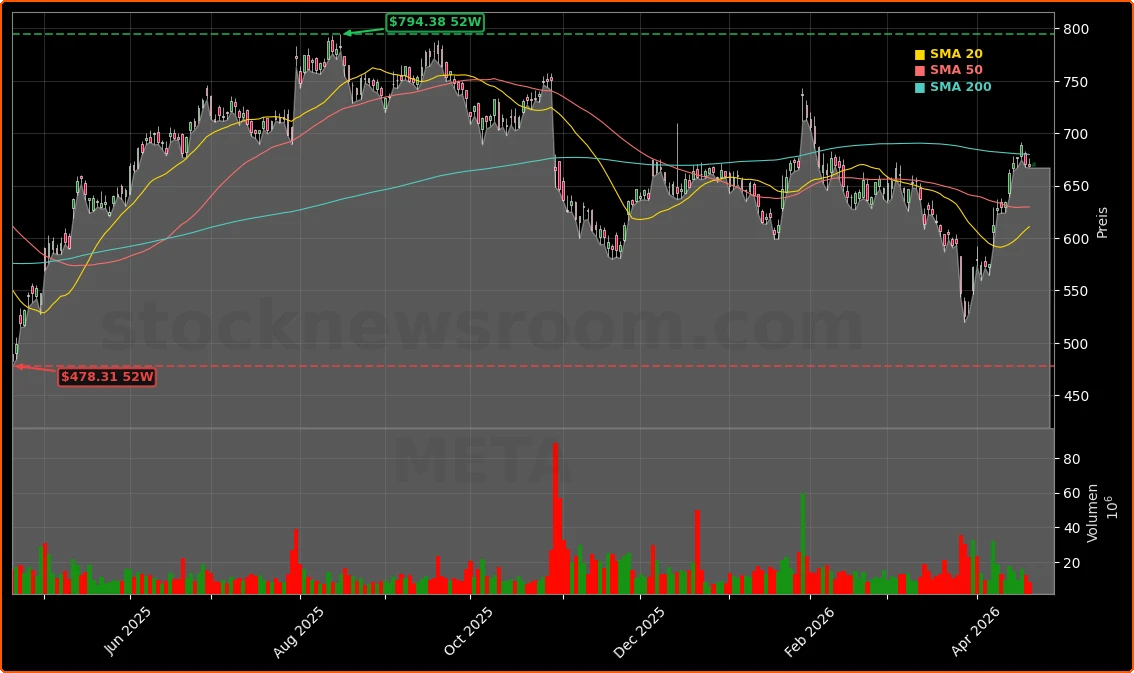
Meta Platforms closed around $668.84 on Tuesday, modestly below the prior close of $672.40, with after‑hours trading edging the stock to about $671.26. That leaves the name trading well under the latest $908 price target from UBS and below its recent 52‑week peak, giving the Meta AI Strategy narrative room to work before the stock would need to price in perfection. In the broader context of the NASDAQ 100 and S&P 500, Meta remains one of the key mega‑cap growth drivers, but its share price has been consolidating after a powerful multi‑year run.
Technical traders note that Meta has not yet set a fresh all‑time high and is oscillating in a trading range with about 20% between the upper and lower band. The upper boundary has repeatedly attracted sellers, but also offers a clear reference point for risk‑reward calculations. One prominent tech trader highlighted that going long near support when the NASDAQ 100 was significantly lower offered a favorable 1:1 or better risk‑return profile, arguing that the company’s actual earnings growth was not fully reflected in the valuation.
Why did UBS boost Meta’s price target?
UBS analyst Stephen Ju raised his Meta price target from $872 to $908 while reiterating a “Buy” rating. His call is built around the view that generative‑AI‑driven ad revenue is still accelerating, not plateauing. UBS models continued upward revisions to earnings per share and valuation multiples through 2026 as Meta’s AI tools improve targeting, conversion and ad pricing across Facebook, Instagram, WhatsApp, Threads and the broader app family.
Underlying ad metrics support that thesis. In Q4 2025, Meta’s ad impressions climbed 18% year over year while the average price per ad increased 6%. CFO Susan Li highlighted that a new runtime model across Instagram feed, Stories and Reels delivered a 3% increase in conversion rates and a 12% gain in ad quality. For UBS, these compounding gains are a tangible early payoff from the Meta AI Strategy and suggest durable competitive advantages in digital advertising.
Not all of Wall Street is equally aggressive. Bank of America recently trimmed its Meta target to $820 but kept a bullish stance, citing near‑term ad‑spend risks even as it acknowledges the long‑term AI opportunity. The upcoming Q1 2026 earnings report on April 29 will serve as a key catalyst to test whether UBS’s more optimistic view or BofA’s caution on spending trends is closer to the mark.
How is Meta AI Strategy reshaping infrastructure?
Meta AI Strategy goes far beyond software tweaks and ad models. The company has committed tens of billions of dollars to ensure access to cutting‑edge compute. It recently agreed to spend $21 billion with CoreWeave and up to $27 billion with Nebius, securing high‑end NVIDIA GPU capacity at a time when demand far outstrips supply. These long‑term contracts often include take‑or‑pay‑like provisions, making Meta a prized customer for so‑called “neocloud” providers while it scales its own in‑house infrastructure.
At the same time, Meta is ramping up its custom AI accelerator chips to reduce dependence on third‑party silicon over the long run. That strategy mirrors moves at other hyperscalers like Apple, NVIDIA itself and cloud giants, which are all racing to balance control, cost and performance. For Meta, the Meta AI Strategy increasingly centers on owning the full stack—from foundational models to the energy‑hungry data centers that power them.
What does the new Tulsa data center mean?
In a high‑profile step, Meta has broken ground on a new data center in Tulsa, Oklahoma, valued at more than $1 billion. The facility at Fair Oaks Innovation Park will span over 2 million square feet, create more than 1,000 construction jobs at peak and around 100 permanent operational roles. It will be Meta’s first data center in Oklahoma, its 28th in the United States and its 32nd globally, underscoring how central physical infrastructure has become to the Meta AI Strategy.
The Tulsa build‑out is part of CEO Mark Zuckerberg’s push to invest hundreds of billions of dollars into AI over time, even as environmental and consumer groups raise concerns about energy usage and water intensity. Meta has pledged to cover the full cost of water and wastewater services for the site, an important political and ESG consideration as states compete to attract hyperscale data‑center investments.
How aggressive is Meta inside its own workforce?
Meta’s AI ambitions extend inside the company’s walls. Internal memos described a new tracking system being rolled out on U.S. employees’ work computers that records mouse movements, keystrokes, clicks and periodic screenshots from certain work‑related applications. The captured workflow data will be used to train Meta’s AI agents to better handle real‑world tasks, such as navigating drop‑down menus or using keyboard shortcuts—an explicit effort to build more capable autonomous workplace assistants.
Alongside these efforts, Meta has introduced Muse Spark, its first major proprietary high‑end AI model since Scale AI CEO Alexandr Wang joined Meta and took over the Meta Superintelligence Labs unit. Muse Spark is designed to power the Meta AI assistant app and desktop experience and is slated for integration into Facebook, Instagram, WhatsApp and Messenger. Internally, Meta rebuilt much of its AI infrastructure in the last nine months to support smaller, faster models that can still handle complex questions in areas like science, math and health. Strategically, the company is shifting from a pure open‑source approach with earlier Llama versions toward a more closed, premium model aimed squarely at rivals like OpenAI, Anthropic and Google—and, by extension, at the AI offerings emerging from Tesla and other Big Tech names.
Related Coverage
For a deeper dive into how cost cuts intersect with Meta AI Strategy, readers can explore Meta Platforms Layoffs: -2.3% Shock as AI Pivot Deepens, which examines whether the latest global layoffs can sustainably fund Meta’s massive AI investments without undermining employee morale and investor trust.
Overall, Meta AI Strategy now spans massive data‑center construction, long‑term cloud commitments, proprietary models like Muse Spark and even controversial employee monitoring to feed training data. For U.S. investors, the stock’s pullback from recent highs, combined with UBS’s $908 target and still‑growing ad metrics, keeps the risk‑reward profile compelling if execution holds. The next earnings report and ongoing AI product rollouts will show whether Meta can convert its infrastructure blitz into sustained profit growth and justify Wall Street’s increasingly AI‑driven expectations.