Are Halliburton Earnings and a fresh 4% stock surge signaling the start of a new upcycle in oilfield services?

How did Halliburton Earnings shape the stock move?
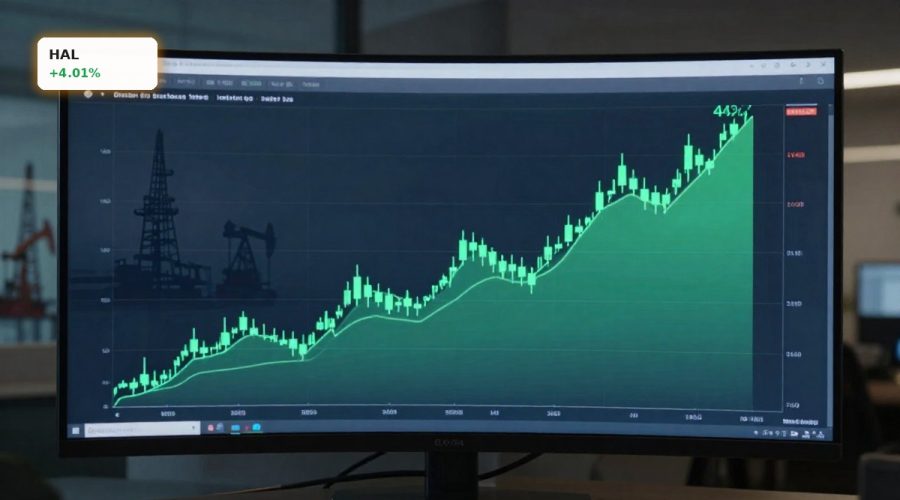
Halliburton Company (HAL) recently reported a quarter that investors could live with: not spectacular, but clearly solid. Revenue came in at about $5.4 billion, roughly flat versus the prior year, underscoring how the company is holding its ground despite pockets of regional weakness. Adjusted earnings per share landed at $0.51, supported by a net income figure of roughly $461 million and an operating margin near 13%. Those Halliburton Earnings, combined with a constructive tone on the outlook, helped underpin a move higher in the share price, which has already climbed more than 30% this year. With HAL recently changing hands at around $38.15, up 4.01% from the previous close of $36.68, the market appears willing to reward consistent cash generation and a clear capital-return framework even as macro headlines around oil and geopolitics remain volatile.
Where is Halliburton making its money?
The core message from the latest quarter is that Halliburton’s global footprint matters. The Completion and Production segment, which includes hydraulic fracturing services for U.S. shale producers, saw a 3% decline in North America. That weakness reflects a cooler North American fracking environment, where producers have been disciplined on spending and some activity has been disrupted by geopolitical tensions, including conflict in the broader Middle East region. Yet the softness at home was largely offset by resilient performance overseas. The Drilling and Evaluation segment, especially in international markets, provided the ballast Halliburton needed. Management highlighted that international activity, particularly outside the core Middle East, continued to perform well and in some cases outpaced expectations. This geographic diversification has been a critical factor for investors comparing Halliburton to peers like NVIDIA or Apple in their own sectors, where global demand helps cushion regional slowdowns.
What signals came from management on North America?
Despite a slight decline in net income versus the prior-year period, the tone from the executive suite was cautiously optimistic. Halliburton’s CEO described “clear signs and early phases of recovery in North America,” suggesting that the current slowdown in U.S. shale could be closer to a cyclical trough than a new downtrend. The company acknowledged that conflict-related disruptions in and around the Middle East are weighing on results, estimating a drag of roughly $0.07 to $0.09 per share. Even so, management indicated that international performance has more than compensated for this headwind, and reiterated Halliburton’s position as a market leader in U.S. oilfield services. Analysts at Stifel, for example, have highlighted the company’s strong exposure to the U.S. market and its scale advantages, framing HAL as a key way to play any eventual rebound in North American completions activity once operators step up drilling and fracking budgets again.
How strong is Halliburton’s cash flow and capital return?
Beyond headline Halliburton Earnings, investors on Wall Street are heavily focused on cash generation and capital deployment. Free cash flow in the quarter reached about $123 million, giving the company room to continue rewarding shareholders while investing selectively in growth. Halliburton spent roughly $100 million on share repurchases in the first quarter and confirmed its $0.17 per-share quarterly dividend. That combination of buybacks and dividends effectively returns a meaningful portion of free cash flow to shareholders, a strategy that resonates with U.S. portfolio managers who favor disciplined capital allocation across the energy space. Compared with integrated majors like Exxon Mobil or Chevron, Halliburton’s yield is more modest, but the additional buyback component provides leverage to earnings growth. For investors who already own cyclical names such as Tesla alongside more defensive growth stories, HAL offers another way to balance portfolios with exposure to energy services and commodity-linked cash flows.
How does Halliburton stack up versus other energy plays?
We are seeing clear early signs of recovery in North America while our international operations continue to perform ahead of expectations.— Halliburton Chief Executive Officer
Within the oilfield-services universe, Halliburton competes with global heavyweights yet remains particularly levered to North American activity. That positioning can make the stock more volatile than diversified benchmarks like the S&P 500 or NASDAQ, but it also creates upside torque if U.S. shale recovers more strongly than expected. Strategists at major banks, including Citigroup and Morgan Stanley, have previously emphasized that leading service providers with strong balance sheets and international reach should benefit disproportionately from a sustained upcycle in upstream spending. For many U.S. investors, Halliburton now sits at the intersection of three themes: stable near-term Halliburton Earnings, a credible path to stronger margins if North American fracking ramps up, and continued capital returns that help smooth the ride. Against that backdrop, some portfolio managers may view recent share-price strength not as the end of the move, but as confirmation that the market is beginning to price in a medium-term recovery scenario.