
Can the Uber Lucid Robotaxi alliance turn a struggling EV maker into a core pillar of Uber’s autonomous ride-hailing future?

How does the Uber Lucid Robotaxi deal move the stocks?
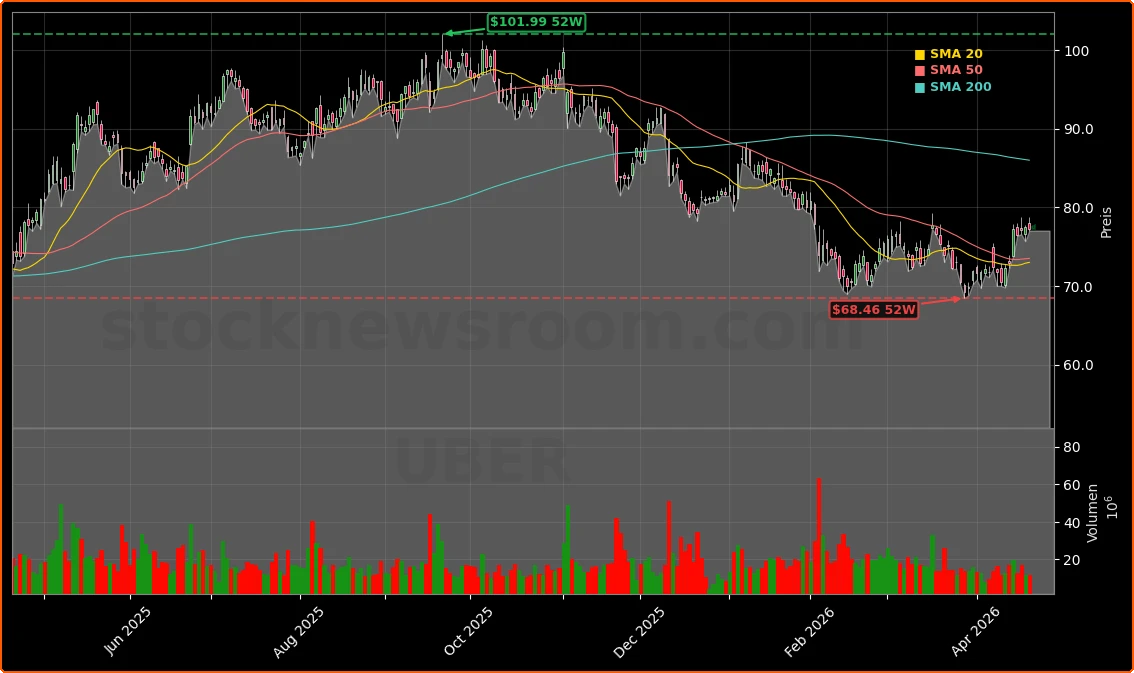
Uber Technologies, Inc. (UBER) shares eased 0.30% to $77.26 on Tuesday’s regular session before ticking slightly higher after hours to $77.70, reflecting a cautious but constructive reaction to the deeper tie-up with Lucid Group (LCID). Lucid climbed to $7.11 at the close, up 5.33%, and extended gains in late trading to $7.23, as equity investors recalibrated the company’s survival odds now that a strategic partner is stepping in with cash and demand.
For Uber, the market move is modest relative to the strategic implications. The company is effectively pre-ordering at least 35,000 premium EVs and committing up to $500 million in total financing to Lucid, a bold push into autonomous and EV-first ride-hailing at a time when rival Tesla continues to tout its own robotaxi plans. For Lucid, the deal offers both capital and line-of-sight demand but comes with added dilution and pressure to execute in a market that has punished underperforming EV names.
What exactly is Uber buying into at Lucid?
Uber has disclosed an 11.52% equity stake in Lucid, folded into a broader $1.05 billion funding package. Within that stack, Uber is committing an additional $200 million, lifting its total exposure to $500 million alongside a $550 million capital injection from Ayar Third Investment Company, an affiliate of Saudi Arabia’s Public Investment Fund, and a $300 million underwritten public offering. That layered structure underscores both Lucid’s funding needs and Uber’s determination to secure high-end EV supply for a future robotaxi network.
The cornerstone of the industrial part of the agreement is Uber’s plan to purchase at least 35,000 Lucid vehicles for a global autonomous-capable fleet over time. The Uber Lucid Robotaxi platform is envisioned as a premium, long-range EV alternative that could sit above UberX in price but potentially below today’s chauffeured luxury tiers once autonomy reduces driver-related costs. For Lucid, this creates a path to higher plant utilization and recurring fleet orders instead of relying solely on cyclical consumer demand for luxury sedans and SUVs.
Can Lucid’s balance sheet handle the robotaxi challenge?
Despite Tuesday’s bounce, Lucid remains pinned close to its 52-week low of $6.75 and far below the $33.70 high, reflecting a 70.91% drop over the past 12 months. The stock trades roughly 19.5% below its 20-day simple moving average and 31.6% under its 100-day SMA, a configuration that signals sellers still control both short- and intermediate-term trends. Momentum indicators echo the picture: Lucid’s relative strength index sits at 27.61, in oversold territory, which often precedes sharp but potentially short-lived relief rallies.
Technically, traders are watching $7.50 as a key support region and $10 as a critical resistance “line in the sand” where prior rebounds have stalled. The heavy capital raise attached to the Uber Lucid Robotaxi collaboration keeps dilution front and center for existing shareholders, yet it also extends Lucid’s cash runway ahead of its May 5 earnings report, where analysts expect a wider EPS loss of about $-2.34 but revenue growth to roughly $404.8 million from $235.1 million a year earlier. Execution against the 35,000-vehicle ambition will be the main narrative investors track into that release.
How does leadership change affect Lucid’s execution risk?
Lucid is layering a CEO transition on top of its funding wave and operational pivot. Silvio Napoli has been named CEO, while Marc Winterhoff remains COO, a structure designed to tighten operational focus around manufacturing scale-up, cost discipline, and the Uber fleet ramp. This leadership handoff raises the bar for near-term proof points: investors want to see concrete milestones in plant throughput, margin trajectory, and delivery schedules linked specifically to Uber’s fleet commitments.
Against peers, Lucid remains a high-risk, high-upside EV play. While Tesla continues to integrate autonomy hardware and software in-house and companies like NVIDIA supply the AI compute backbone for many autonomous platforms, Lucid is betting that pairing its long-range battery technology with Uber’s demand funnel and software ecosystem can carve out a profitable niche. Still, any sign of slippage on production or cost targets could quickly overshadow the optimism now surfacing around the Uber Lucid Robotaxi roadmap.
Where does this leave Uber vs. other mobility players?
For Uber, the Lucid partnership slots into a broader strategy to transition its network toward EVs and ultimately autonomous ride-hailing. The company is now competing not only with traditional rivals like Lyft but also with integrated hardware-software players such as Apple in mobility services and Tesla in self-driving fleets. Uber’s advantage remains its massive two-sided marketplace and data on demand patterns across cities worldwide, which can be leveraged once autonomous-capable Lucid vehicles enter service at scale.
The deal also follows other aggressive moves, including expansion in delivery and potential M&A in Europe. The earlier analysis of Uber’s European strategy in Uber Delivery Hero Acquisition Boom Meets $10B Robotaxi Bet highlighted how acquisitions and AI investments could accelerate Uber’s robotaxi ambitions. The Lucid partnership now adds a premium EV manufacturing pillar under that strategy, reinforcing the thesis that Uber is building a multi-pronged autonomy and AI platform rather than a simple ride-hailing app.
Related Coverage
Investors looking to understand Uber’s broader robotaxi roadmap should revisit how its European expansion and AI initiatives fit into the story. The article Uber Delivery Hero Acquisition Boom Meets $10B Robotaxi Bet explores whether the Delivery Hero move is a side bet or the foundation of Uber’s next growth wave, offering useful context for how the new Lucid alliance might be integrated into a larger global strategy.
In sum, the Uber Lucid Robotaxi deal marks a turning point for both companies: Uber secures a premium EV partner for its future autonomous fleet, while Lucid gains capital and an anchor customer to support its scale-up. For investors, the combination raises both the upside potential and the execution bar, making upcoming Lucid earnings and Uber strategy updates key catalysts. If both management teams deliver on production, technology, and deployment milestones, this robotaxi partnership could become a defining element of the next phase of mobility on Wall Street.