Can the latest AI-driven surge in AMD’s share price justify the rich valuation investors are now willing to pay?

How does AI demand shape the Advanced Micro Devices Forecast?
Advanced Micro Devices AI-Nachfrage und Analystenprognosen have moved to the center of the semiconductor story on Wall Street. Strong AI demand is driving tight supply across accelerators, CPUs, optics, and memory, and AMD is positioned as one of the main beneficiaries alongside Intel and against market leader NVIDIA. The Philadelphia Semiconductor Index has rallied for 15 straight sessions, often setting fresh records, and AMD has outpaced even that strong backdrop with a year-to-date surge of more than 30%.
AI infrastructure build-outs, catalyzed by agent-based AI systems that gained traction earlier this year, are expected to fuel at least another year of robust spending. That backdrop supports the bullish Advanced Micro Devices Forecast now circulating among major brokers, which see AMD transitioning from a cyclical PC and gaming vendor to a structural data center and AI powerhouse. Investors are increasingly treating AMD as a direct way to play hyperscaler capex on both training and inference workloads.
Where does AMD stock stand technically now?
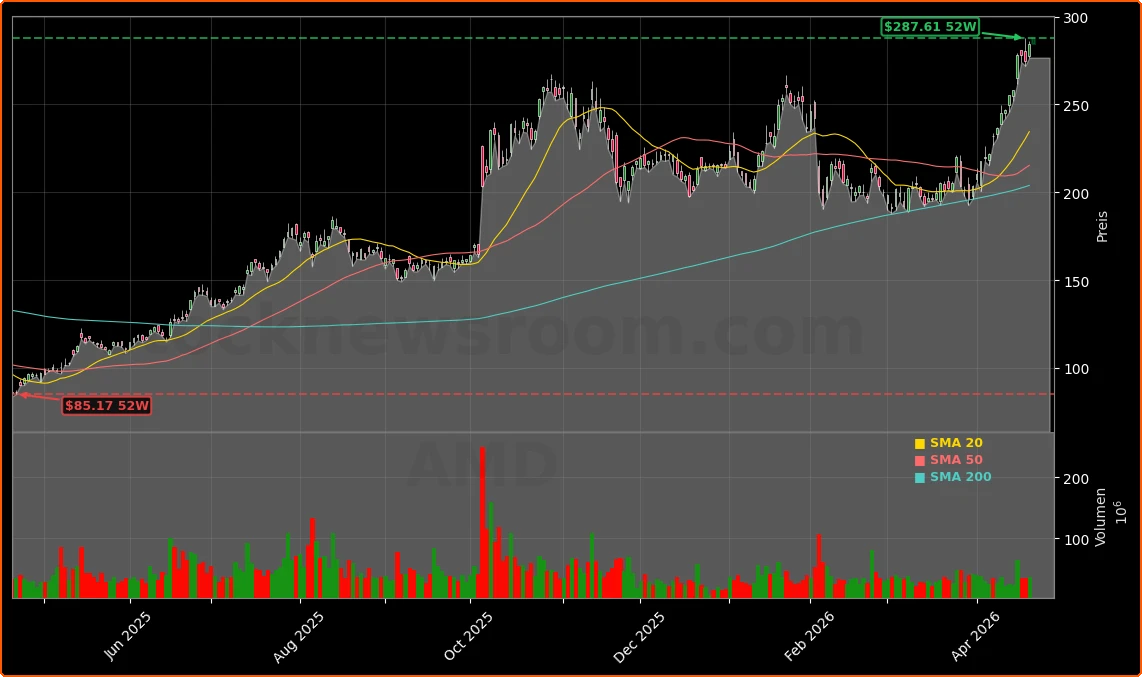
At $284.49 at the close on Tuesday and $287.67 in late trading, AMD is pressing the upper end of its 52-week range and trading close to recent record highs. The stock sits roughly 22% above its 20-day simple moving average and nearly 30% above its 100-day line, underscoring a powerful short- and intermediate-term uptrend. Momentum is red-hot: the relative strength index near 78 signals overbought conditions, meaning swing traders should be prepared for quick pullbacks even within a broader uptrend.
Key technical levels are in clear focus. On the upside, resistance remains clustered near $287.50–$295, an area where previous rallies have stalled and where some technicians expect initial profit-taking. On the downside, support is seen around $230–$270, zones that align with moving averages and prior consolidation. Given AMD’s heavy weight in the iShares Semiconductor ETF (SOXX) and other thematic funds, further inflows into AI and chip ETFs could continue to provide mechanical buying support on dips.
How are analysts updating the Advanced Micro Devices Forecast?
Street estimates reflect how aggressively the Advanced Micro Devices Forecast has shifted over the last year. For the upcoming May 5 earnings report, consensus now calls for earnings per share of about $1.18, up from $0.96 a year ago, on revenue of roughly $9.86 billion versus $7.44 billion year over year. That implies strong double-digit top-line growth as AI accelerators and data center CPUs ramp.
The stock carries a premium valuation around 105x trailing earnings, well above many semiconductor peers, yet major brokerages largely maintain positive stances. Stifel recently reiterated its Buy rating and raised its price target to $320, implying mid-teens upside from current levels and highlighting upside from AI accelerators. Bernstein lifted its target to $265 with a Market Perform rating, flagging sector imbalances but still acknowledging AMD’s AI-driven growth. Citigroup trimmed its target to $248 while remaining Neutral, citing valuation concerns and execution risks around product ramps.
Other firms echo this mix of enthusiasm and caution. Wells Fargo continues to highlight AMD as a favored semiconductor name tied to AI expansion and data center demand, while some independent analysts, including on platforms like Seeking Alpha, have moved to more cautious stances on fears that the stock may be running ahead of fundamentals. The result is an Advanced Micro Devices Forecast curve that is steep but also more controversial, with more of the bull case now embedded in the price.
How does AMD stack up against AI and chip competitors?
For US investors, a key part of the Advanced Micro Devices Forecast is how it competes against entrenched rivals. AMD’s Instinct MI300 accelerator line and upcoming MI450 architecture are designed to claw share from NVIDIA in AI data centers, while the next-generation 6th Gen EPYC “Venice” server CPUs aim to extend AMD’s gains in high-margin enterprise sockets. Agreements with cloud and AI players such as Meta, Oracle, and OpenAI underscore that AMD is already embedded in leading-edge infrastructure builds.
At the same time, Intel is attempting a resurgence in both foundry and data center, with Morgan Stanley recently lifting its target ahead of earnings on optimism around new partnerships, even as AMD remains a direct competitive threat. Big Tech customers like Apple and Tesla are also designing more of their own silicon, which could limit long-term CPU and GPU opportunities even as they boost near-term AI infrastructure demand. Against this landscape, AMD’s premium multiple reflects a belief that it can sustain share gains and carve out a durable second pole in AI compute next to NVIDIA.
Related Coverage
Investors looking for a deeper dive into how AI has powered AMD’s recent stock surge can review our prior analysis in Advanced Micro Devices AI Strategy Fuels +7.8% Rally. That article examines whether AMD’s AI roadmap is strong enough to support a double-digit move in the face of NVIDIA’s dominance in data center GPUs and how shifting market share dynamics could influence AMD’s next leg higher.
In summary, the current Advanced Micro Devices Forecast rests on the assumption that AI demand will remain robust enough to support rapid revenue growth and justify a triple-digit earnings multiple. For US investors, AMD now represents a high-beta, AI-focused lever on the NASDAQ and S&P 500 tech complex rather than a traditional cyclical chip name. The next earnings report and AI product traction over the coming quarters will be crucial in determining whether this Advanced Micro Devices Forecast proves conservative or overly optimistic.