Is the new Datadog AI Report a quiet warning that AI’s real risk now lies in fragile infrastructure, not smarter models?

How is Datadog framing the AI bottleneck?
Datadog, Inc. positions its new State of AI Engineering 2026 study as a wake-up call for enterprises and investors who have focused primarily on model quality and benchmarks. The Datadog AI Report concludes that AI is now hitting operational rather than algorithmic limits: as usage grows, systems are failing not because models are weak, but because the surrounding infrastructure is fragile.
Datadog’s telemetry shows that nearly 69% of organizations are already running three or more AI models in production, typically mixing providers such as OpenAI, Google Gemini, and Anthropic Claude. At the same time, around 5% of AI model requests fail in production, with almost 60% of those failures linked to capacity constraints such as GPU saturation, rate limits, or overwhelmed routing layers. For customer-facing AI features, that failure rate can translate directly into churn, lost revenue, and reputational damage.
The report likens today’s AI wave to the early era of cloud computing, when programmability surged faster than operational discipline. Datadog argues that, just as cloud observability became core infrastructure a decade ago, AI observability is now poised to form a new mandatory layer in the stack.
What does this mean for Datadog and its peers?
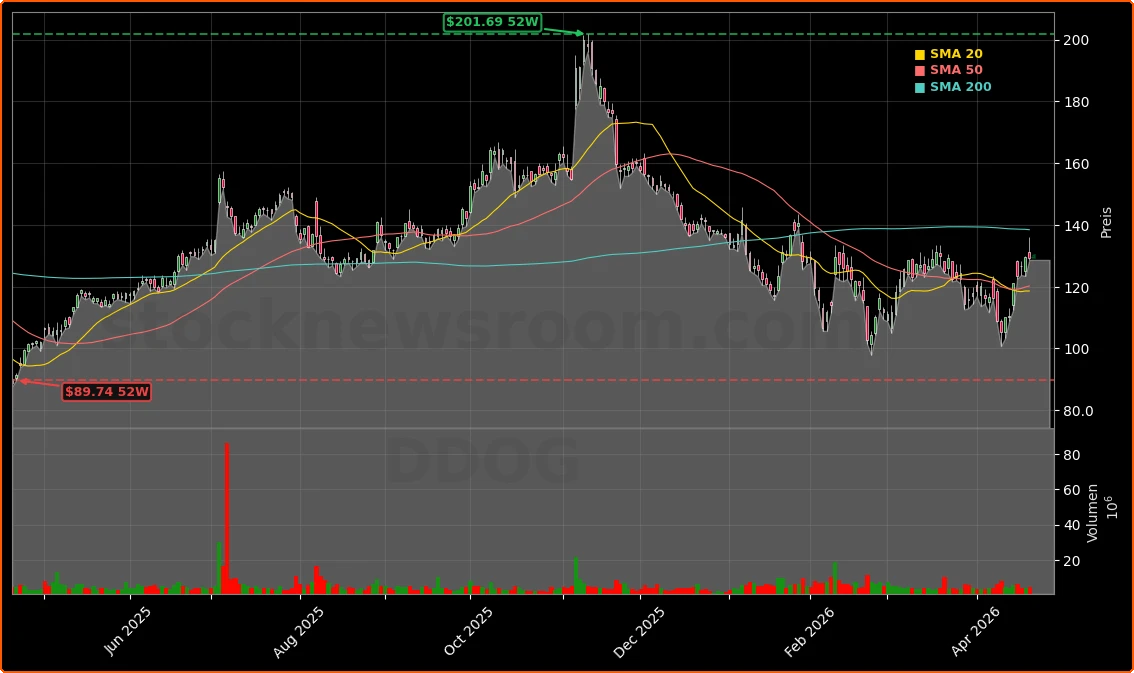
On Wall Street, DDOG shares closed regular trading at $129.29 on Tuesday, down 0.35% on the day, before ticking up to $130.20 in after-hours trading on NASDAQ. The stock remains well below its 52-week high, leaving room relative to bullish analyst targets even after a strong multi-quarter run driven by AI narratives across the software sector.
The Datadog AI Report arrives as software and cloud names with AI exposure trade at a premium, from hyperscalers like Microsoft to platform players such as NVIDIA and observability specialists like Datadog itself. The report’s central thesis — that operational complexity, not model quality, will determine winners — plays directly into Datadog’s long-term strategy to be the unified monitoring and security plane for modern applications, including AI agents and LLM-based workflows.
For investors comparing AI-exposed software stocks on the NASDAQ and S&P 500, the report underscores that value may accrue not only to model providers but also to the tools that keep those models reliable in production. That positions Datadog in the same conversation as broader infrastructure ecosystems built around AI accelerators from NVIDIA and application platforms like Vercel, rather than purely consumer-facing AI apps.
How is AI usage changing under the hood?
The Datadog AI Report details several shifts that raise both costs and operational risks. First, multi-model usage has become standard: OpenAI remains the most widely used provider with roughly 63% share in observed environments, but Google Gemini and Anthropic Claude have each expanded their presence, increasing by roughly 20 and 23 percentage points respectively over the last year. This diversification improves resilience and feature coverage but creates complex routing and policy challenges.
Second, agent frameworks have doubled in adoption year over year. These tools accelerate development of AI agents that can call tools, APIs, and other models, but they also introduce many more moving parts: orchestrators, vector databases, retrieval pipelines, and feedback loops. Failures increasingly stem from this system design — such as fragmented workflows, excessive retries, or misconfigured routing — rather than from any single LLM.
Third, the volume of data sent per request is climbing fast. Datadog reports that the average token count per request more than doubled for median users and quadrupled for heavy users. That not only raises cloud and model costs but also magnifies the impact of any performance or capacity bottleneck, making GPU utilization and rate-limit management mission-critical metrics.
How are analysts and insiders positioning around DDOG?
Analysts remain broadly constructive on DDOG despite recent volatility. Canadian Imperial Bank of Commerce recently cut its price target to $215 from $240 but maintained an “outperformer” rating, implying close to 70% upside from current levels. RBC Capital has reiterated a Buy rating with a $161 target, while other firms, including Guggenheim and Stifel, have highlighted Datadog’s AI-driven growth strategy and new capabilities such as its MCP Server for AI agent integration.
Insider activity has been active but largely driven by pre-arranged trading plans. CEO Olivier Pomel exercised options and sold roughly $4.7 million in Class A shares in April under Rule 10b5-1 programs, while directors Amit Agarwal and Shardul Shah also sold modest blocks of stock through long-standing plans. These transactions reduce near-term float overhang uncertainty but have not altered the core thesis for institutional holders who view Datadog as a long-duration compounder in observability and security.
For U.S. investors, the Datadog AI Report adds a qualitative layer to those quantitative ratings: it helps explain why demand for observability tools could remain resilient even if overall software budgets slow, as enterprises prioritize stabilizing AI systems already in production.
What is the investment takeaway from the Datadog AI Report?
The Datadog AI Report ultimately argues that “how you operate AI may matter more than the models you choose” at scale. In practice, that suggests a multi-year need for platforms that provide real-time visibility from GPU utilization to model behavior and agent workflows, along with governance and security controls that satisfy auditors and regulators.
Against that backdrop, Datadog is investing aggressively in AI observability features that extend its existing infrastructure monitoring, APM, and security offerings into LLM and agentic workloads. The company is betting that as AI usage resembles complex microservices rather than simple APIs, customers will prefer unified, cross-stack platforms over point tools.
The companies that win won’t just build better models — they’ll build operational control around them.— Yanbing Li, Chief Product Officer, Datadog
For Wall Street, the report reinforces a broader AI narrative: while headline-grabbing models often come from Big Tech or pure-play LLM providers, sustainable returns may hinge on the less glamorous plumbing that keeps those models online, efficient, and compliant. If Datadog can convert its Datadog AI Report insights into differentiated products and share gains, DDOG could remain a core way for investors to gain exposure to the operational backbone of the AI economy.