Is the Uber Delivery Hero Acquisition a quiet side bet or the opening move in Uber’s next big European and AI expansion wave?

What exactly is the Uber Delivery Hero Acquisition?
Uber Technologies Inc. has acquired an additional 13.6 million shares of Delivery Hero from long-time shareholder Prosus, paying EUR 20 per share for a roughly 4.5% stake. This lifts Uber’s total holding to about 7% of Delivery Hero’s outstanding capital, giving the U.S. mobility group a more meaningful seat at the table of one of Europe’s largest food-delivery platforms. While this is not a full takeover, the Uber Delivery Hero Acquisition step formalizes a tighter strategic alignment after Uber already invested about $300 million in newly issued Delivery Hero stock in 2024.
Delivery Hero, which operates food delivery and quick-commerce services in around 65 countries, sees the enlarged stake as a strong signal of confidence. CEO Niklas Östberg called Uber’s higher commitment a “meaningful endorsement” of the company’s platform and long-term vision. For U.S. investors, the move adds another layer to Uber’s already complex mix of ride-hailing, delivery and emerging autonomous-vehicle initiatives.
How does the deal reshape the European delivery landscape?
The new stake comes at a time when Delivery Hero is still digesting asset sales and regulatory setbacks. A planned 2024 sale of its Taiwan business to Uber for nearly $1 billion fell apart when the Taiwanese competition authority rejected the transaction. In March 2026, Delivery Hero instead agreed to sell the unit to Singapore-based Grab for $600 million on a cash- and debt-free basis. Against this backdrop, the Uber Delivery Hero Acquisition of shares from Prosus, which cuts Prosus’ stake from about 27% to 22%, adds intrigue to an already complicated shareholder structure.
Equity analysts see more questions than answers. Barclays analyst Andrew Ross called the stake increase an “interesting development” but emphasized that Prosus still needs to reduce its holding further, keeping uncertainty high. Jefferies analyst Giles Thorne was particularly surprised, having previously considered a Prosus takeover of Delivery Hero more likely before the sale. He now rules out a near-term Prosus deal and does not expect a full Uber bid either, even as the European Union debates loosening merger rules to create stronger regional champions capable of competing with U.S. and Chinese giants like NVIDIA and Apple.
What does it mean for Uber’s stock and AI spending?
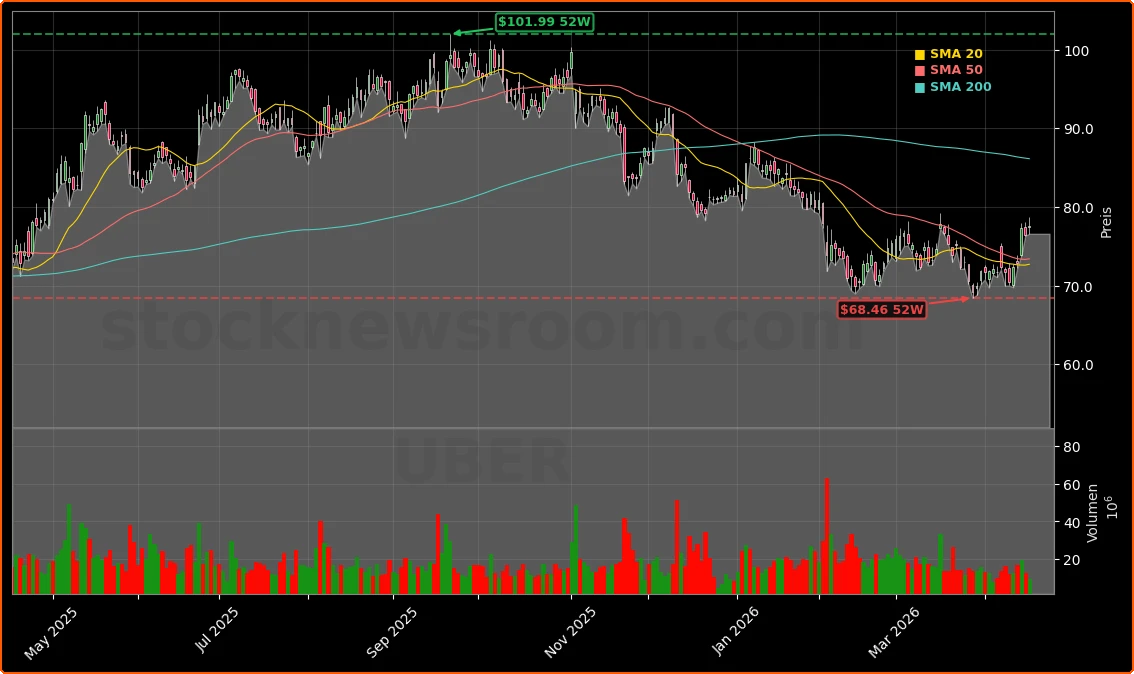
The Uber Delivery Hero Acquisition lands as Uber’s share price works through a consolidation phase. At $77.55, the stock is up about 1.40% on the day and trades in the lower half of its 52-week range between $68.46 and $101.99, well below last year’s high. Technically, Uber sits about 6.5% above its 20-day simple moving average, signaling improving short-term momentum, but remains roughly 1.5% below its 100-day SMA, where rallies have stalled near resistance around $78.50. Support has been forming near $68.50.
Fundamentally, the question is whether Uber’s capital deployment into Delivery Hero and robotaxis will translate into durable earnings power. Uber has earmarked close to $10 billion for its autonomous-vehicle strategy, including about $2.5 billion in equity investments and $7.5 billion to scale a future robotaxi fleet via partnerships with Lucid, Pony.ai, WeRide and Baidu. That puts it on a different capital-intensity trajectory than asset-light software names, and aligns it more with hardware-linked innovators such as Tesla. At the same time, rising AI and R&D costs are a growing pressure point: Uber’s research and development expenses climbed 9% to $3.4 billion in 2025, and management expects further increases as usage of AI tools like Anthropic’s Claude Code surges.
How are analysts on Wall Street positioned?
Despite the higher spending, Wall Street remains broadly constructive. The stock carries a consensus Buy rating, with an average price target near $106.52, implying substantial upside from current levels. Wells Fargo recently reiterated an Overweight rating while trimming its target to $95, signaling continued confidence but a more cautious risk-reward profile. BTIG has maintained a Buy rating with a $100 target in multiple notes this year, underscoring the belief that Uber’s global platform, spanning rides, delivery and advertising, can still unlock operating leverage.
Heading into the confirmed May 6, 2026 earnings date, analysts expect earnings per share of $0.71, down from $0.83 a year earlier, even as revenue is projected to grow from $11.53 billion to $13.28 billion. That combination reflects margin pressure from elevated investment and AI costs, but also underscores robust top-line expansion. At a price-to-earnings multiple of roughly 16.2x based on forward estimates, Uber looks reasonably valued versus faster-growing but more richly priced NASDAQ software peers, while still offering exposure to secular themes like on-demand services and autonomous mobility.
Related Coverage
For a deeper dive into Uber’s autonomous ambitions beyond the Uber Delivery Hero Acquisition, investors can review this analysis of Uber’s $500 million Lucid robotaxi partnership, which explores whether the AV push is a transformative growth driver or a new source of valuation risk. To put Uber’s AI spending and defense of data advantages into a broader tech context, it is also worth reading how another high-profile name is positioning: our coverage of Palantir’s AI defense strategy and Pentagon-focused growth story outlines what durable AI-driven revenue might look like for platform companies.
We are back to the drawing board on AI costs, even as we see significant long-term efficiency upside from automation.— Praveen Neppalli Naga, Uber Chief Technology Officer
In sum, the Uber Delivery Hero Acquisition strengthens Uber’s strategic foothold in European food delivery just as it doubles down on robotaxis and AI-driven automation. For investors, the combination promises scale and diversification but also higher execution risk and elevated capital needs. The upcoming May earnings report and any further clarity on European competition policy will be key in determining whether Uber’s multi-front bet justifies the bullish analyst targets or keeps the stock range-bound.