

Can the new Citigroup Wealth Platform and its global UMA push finally turn big-bank wealth management into a truly scalable, fee-driven machine?

How does Citigroup’s market move set the stage?
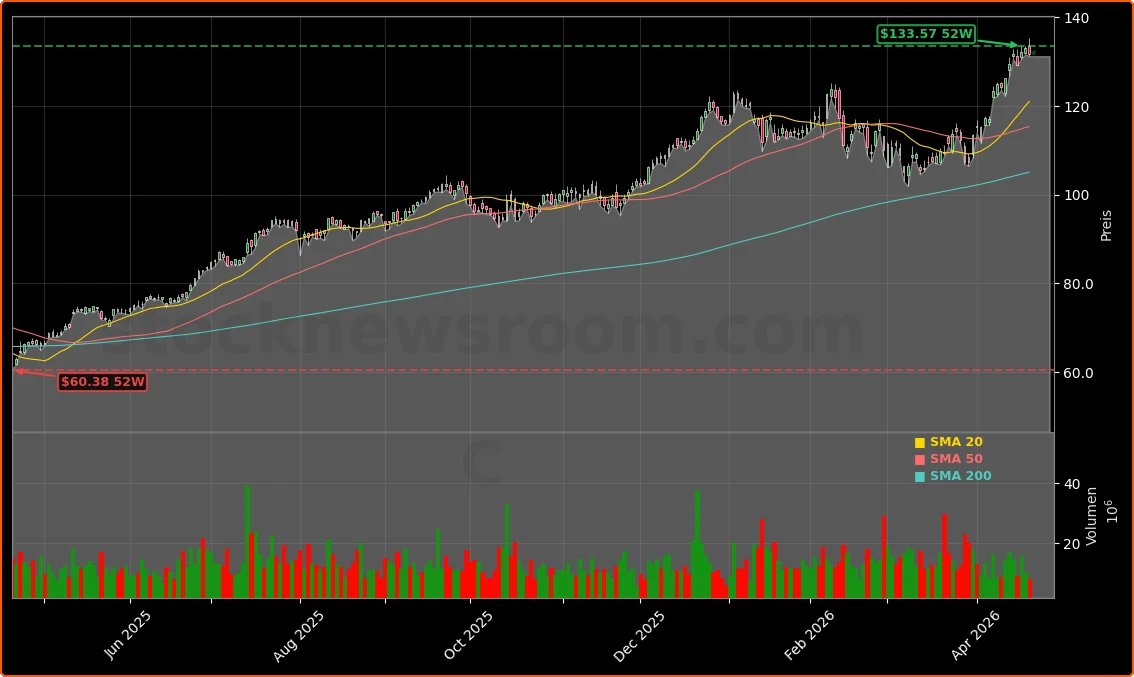
Citigroup Inc. shares traded at $131.68 at Tuesday’s close, down 1.36% from the prior day’s close of $133.50, with after‑hours quotes edging up to $132.38 (+0.53%). The pullback comes after a strong run in major U.S. bank stocks and follows a period in which investors have rewarded balance‑sheet discipline and fee‑driven businesses over pure loan growth. Against that backdrop, the Citigroup Wealth Platform and the new UMA program are meant to deepen recurring advisory revenues and differentiate the bank in high‑margin wealth management, an area where peers like Apple and NVIDIA have also been courting affluent clients indirectly through financial‑services partnerships and ecosystem plays.
The timing is notable for Wall Street: as trading and investment banking remain cyclical, large banks are leaning on fee‑based wealth incomes to stabilize earnings. With the UMA rollout targeted for the fourth quarter of 2026, the initiative is unlikely to move near‑term guidance, but it aligns with management’s message that the franchise is being rebuilt around global networks and scalable platforms.
What exactly is Citigroup Wealth Platform offering?
The core of the Citigroup Wealth Platform in this phase is a Global UMA Program that will serve Citi Private Bank, Wealth at Work, and Citigold & Citigold Private Client segments across North America, Latin America, EMEA and APAC. Instead of clients holding separate accounts for ETFs, mutual funds, separately managed accounts and alternative investments, the UMA aggregates these under a single account structure, governed by one agreement and one fee schedule.
Key features include multi‑currency investing, access to both traditional and alternative assets, and the ability to use onshore and offshore structures under the same advisory umbrella. The platform also integrates internal home‑office portfolios and capital‑markets views from Citi’s Chief Investment Office, effectively pushing CIO asset‑allocation calls into a unified implementation engine. For globally mobile U.S. clients—expatriates, cross‑border executives and business owners—this multi‑jurisdictional design could be a differentiator versus more regionally focused offerings from domestic rivals.
Client‑facing benefits are framed around simplification and transparency: streamlined account opening, a 360‑degree view of holdings in one place, and enhanced performance and risk reporting. That fits the broader trend across Wall Street where wealth managers from Tesla‑linked robo partners to traditional wirehouses are racing to provide portal‑based, household‑level views of assets and liabilities.
How do Advyzon and BlackRock fit into the build?
Citigroup selected Advyzon Enterprise Solutions and Advyzon Investment Management after a competitive search for a turnkey asset management platform that could handle multi‑currency, multi‑jurisdiction portfolios at scale. Advyzon’s technology stack brings model management, manager marketplace access, tax overlay and direct indexing, trading, portfolio modeling, rebalancing, billing and reporting into a single architecture. The platform is heavily engineering‑driven, with artificial‑intelligence‑enabled workflows aimed at automating repetitive portfolio tasks and surfacing insights for advisors.
On the investment side, the Citigroup Wealth Platform will be integrated with Citi Portfolio Solutions powered by BlackRock, a relationship under which Citigroup handed management of roughly $80 billion in global private‑client assets to the asset‑management giant in late 2025. BlackRock’s research, portfolio‑construction tools and risk analytics—rooted in its Aladdin technology—are meant to sit behind the scenes while Citi advisors remain the client‑facing relationship owners.
Keith Glenfield, Head of Investment Solutions for Citi Wealth, said the partnership with Advyzon will allow clients to access the power of “One Citi” through a more personalized and transparent program, while Advyzon founder and CEO Hailin Li emphasized that the unified platform will tie together prospecting, account opening, household‑level UMA management, client reporting and custodial functions in one scalable system trusted by thousands of wealth firms.
What does this mean for U.S. investors and competitors?
For U.S. shareholders, the Citigroup Wealth Platform is another proof point that management is leaning into fee‑based, capital‑light businesses at a time when regulators are scrutinizing risk‑weighted assets and funding costs. Rival wealth players like Morgan Stanley and Bank of America have long touted UMA and household‑level platforms; Citi’s move is about matching or leapfrogging those capabilities with a globally integrated approach that can serve dollar‑based and non‑dollar portfolios equally.
Competitive pressure is not just coming from banks. Fintechs and big‑tech ecosystems are blurring the lines between payments, brokerage and advisory. Apple’s high‑yield cash offerings, fractional trading at retail brokers and the retail reach of platforms aligned with NVIDIA‑driven AI tools have reset client expectations around user experience, personalization and low fees. By embedding AI‑assisted workflows and tax‑optimized direct indexing into a multi‑currency UMA, Citi is trying to capture that same demand at the upper‑wealth tiers, where ticket sizes are larger and switching costs are higher.
Investors should also note the link to cards and consumer partnerships. Citigroup recently enhanced its co‑branded AT&T Points Plus Card, adding savings and rewards on telecom bills. While separate from the Citigroup Wealth Platform, such products underscore a strategy to connect everyday spending with long‑term financial relationships, potentially feeding affluent customers into the wealth funnel over time.
Related Coverage
Recent earnings have already shown how powerful the restructuring story can be when markets cooperate. An in‑depth look at the latest results highlights how cost cuts and strategic refocusing are flowing through to the bottom line. Investors can explore that context in more detail in Citigroup Earnings +3.2%: Record Profit Surge Stuns Wall Street, which analyzes whether Jane Fraser’s overhaul is turning the bank from a perennial laggard into a genuine Wall Street winner.
Clients will be able to access the power of ‘One Citi’ and the breadth of our investment capabilities in a simplified and personalized investment program.— Keith Glenfield, Head of Investment Solutions, Citi Wealth
The Citigroup Wealth Platform and its new global UMA are therefore more than just another tech project: they are a strategic bet that scalable, AI‑driven advisory can anchor the bank’s next phase of fee growth. For investors, the key question is whether client adoption and net inflows will be strong enough to shift the revenue mix meaningfully toward wealth over the coming years. The initial rollout in late 2026 will be the first real test—and if Citi executes well, the platform could become a core pillar of long‑term value creation.