Can Northrop Grumman’s booming bomber and missile programs offset a sharp share-price drop after its latest earnings report?

How did Northrop Grumman Earnings surprise the market?
In its latest reported first quarter, Northrop Grumman Corporation posted revenue of about $9.88 billion, up roughly 4.4% from $9.47 billion a year earlier. Earnings per share climbed to around $6.14, almost doubling from $3.32 in the prior-year period, when results were weighed down by a one‑time charge of about $477 million tied to higher manufacturing costs on the B‑21 program. The improvement underscores how sensitive Northrop Grumman Earnings are to large, complex development projects and the associated cost curves.
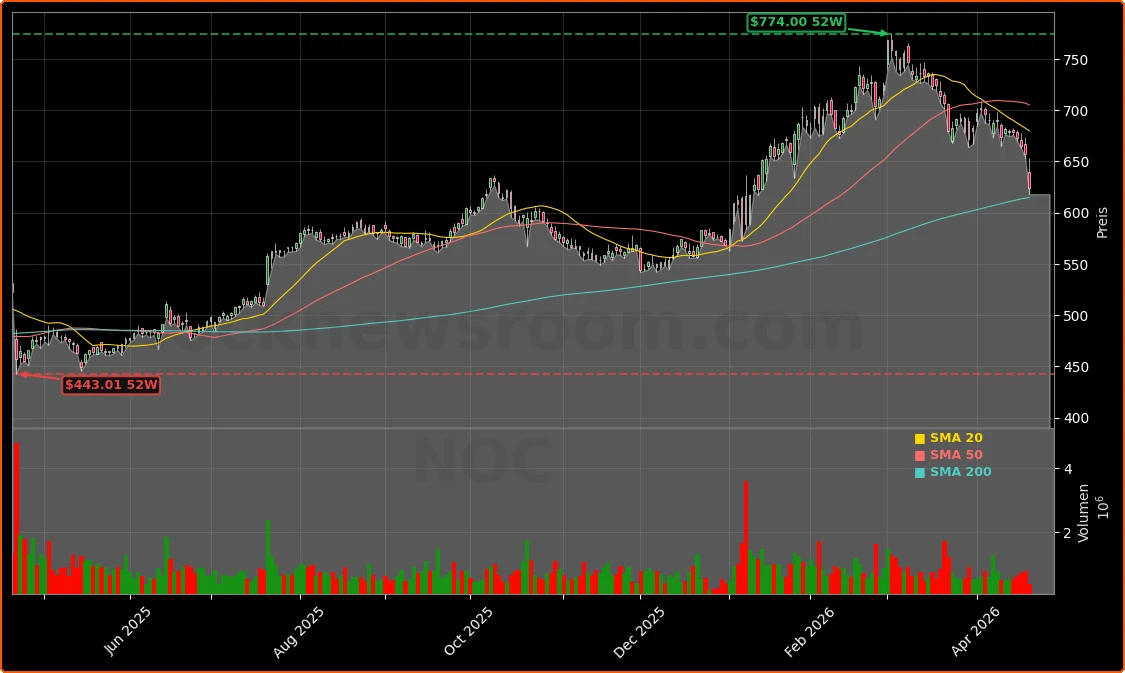
Despite the beat versus prior-year metrics, the company opted to maintain rather than raise its medium‑term outlook, reiterating a 2026 sales forecast of $43.5 billion to $44 billion. For short‑term traders, that decision was underwhelming given the strong quarter, helping explain why NOC shares recently traded around $623.78, down roughly 5% from the prior close of $656.50. For long‑only investors, however, the combination of improving profitability and reaffirmed long‑term guidance suggests management sees the current trajectory as sustainable, not just a one‑off spike.
What is driving growth at Northrop Grumman?
The clearest growth engines behind recent Northrop Grumman Earnings have been its aeronautics and defense systems segments. Sales in aeronautics rose about 17% to $3.28 billion, fueled by strong demand for advanced aircraft, most notably the B‑21 Raider, the U.S. Air Force’s next‑generation stealth bomber. In February, Northrop agreed with the Air Force to expand B‑21 production capacity by approximately 25% and accelerate deliveries, with the first aircraft slated to be handed over in 2027. The Air Force is committed to buying at least 100 aircraft, each estimated to cost about $692 million in 2022 dollars including support, training and engineering changes.
Meanwhile, the defense systems segment posted an estimated 10% increase in organic sales to $1.9 billion, reflecting a ramp‑up in the Sentinel program and stronger demand for tactical solid rocket motors. Sentinel is the land‑based leg of the U.S. nuclear triad, replacing Boeing’s aging Minuteman III ICBMs that have been in service since 1970. Northrop recently highlighted “substantial progress” on Sentinel, pointing to a first flight target in 2027 and initial operational capability in the early 2030s. These long‑cycle programs give institutional investors rare multi‑decade revenue visibility, a key differentiator versus more cyclical industrial names.
How do geopolitical risks and peers shape the outlook?
Rising global conflicts and the need to replenish weapons stockpiles have become a structural tailwind for the entire U.S. defense complex. Pentagon efforts to rebuild munitions and deter threats linked to Iran and other flashpoints are supporting multi‑year procurement plans. That macro backdrop has lifted valuations across large contractors, putting Northrop Grumman Corporation in the same conversation as peers like Lockheed Martin, General Dynamics and Raytheon’s parent RTX for U.S. equity portfolios.
Northrop is also tightening its integration into the broader space and missile‑warning ecosystem. For example, Kratos Defense & Security Solutions recently secured a U.S. Space Force contract with a potential value of about $446.8 million for the Resilient Missile Warning and Tracking program, where Northrop Grumman participates as a partner. That positioning aligns Northrop with high‑growth areas such as space‑based sensors and resilient command‑and‑control networks, themes that are increasingly on the radar of growth‑oriented investors who already favor names like NVIDIA and Apple in the technology space.
Compared with consumer‑facing growth stories such as Tesla or diversified tech platforms like Apple, defense stocks trade more on budget trajectories, contract execution and program risk. The latest Northrop Grumman Earnings show the company converting those drivers into tangible growth, but investors must still weigh political risk and potential pressure on future defense budgets.
What should investors watch after Northrop Grumman Earnings?
For the next leg of the story, institutional investors will be watching three levers: margin progression on B‑21 and Sentinel, cash conversion, and the pace of new awards in space and missile defense. The 25% planned expansion in B‑21 capacity and the gradual Sentinel ramp both underpin medium‑term revenue, but execution will determine whether margins expand or get squeezed by cost inflation and supply‑chain constraints.
On Wall Street, focus is also on capital allocation. With shares off recent highs and trading below earlier peaks in the 52‑week range, buyback activity and dividend policy could become more prominent in the bull‑bear debate around Northrop Grumman Earnings. Large‑cap defense contractors are often compared with cash‑rich technology names like NVIDIA on free‑cash‑flow yield and capital returns, not just earnings multiples.
While specific recent analyst rating moves from major investment banks such as Goldman Sachs, Morgan Stanley, Citigroup or RBC Capital Markets have not been highlighted in the latest publicly available information, the fundamental setup—defensive demand, long‑dated contracts and improving profitability—gives analysts ample reason to keep the stock in focus as a core defense holding within diversified S&P 500 portfolios.