Can blockbuster GE Aerospace Earnings and a record order book outweigh a sharp pre-market drop in the stock?

How did GE Aerospace Earnings surprise Wall Street?
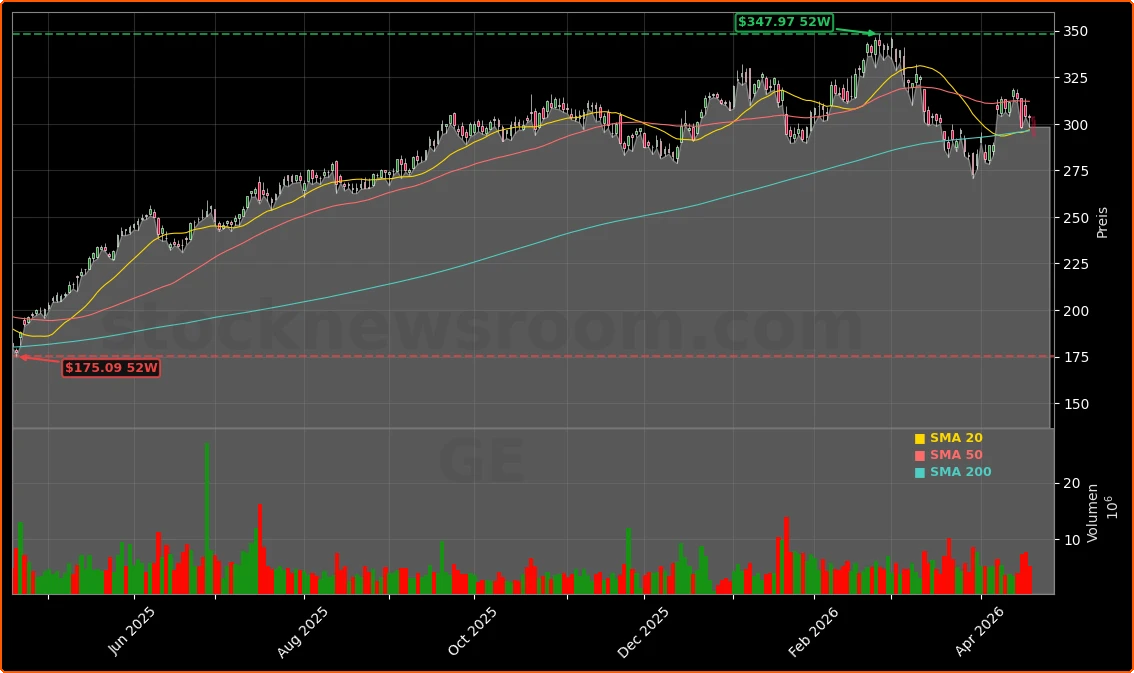
General Electric Company / GE Aerospace opened Tuesday’s session under pressure despite a clean Q1 beat. The stock recently closed at $304.26 and trades around $293.46 in pre-market action, down roughly 3.3%, leaving it below both its 50-day and 200-day moving averages but still well off its 52‑week lows. That reaction comes even though GE Aerospace Earnings delivered adjusted EPS of $1.86, comfortably above the FactSet consensus of about $1.60 per share.
On a GAAP basis, net income from continuing operations came in at roughly $1.93 billion, or $1.83 per share, roughly flat year over year as higher operating profit was offset by mix and below-the-line items. Revenue rose about 25% to $12.39 billion, with another data provider citing a similar top line of $12.392 billion. Both figures point to broad-based strength across GE’s commercial engines, services and defense operations.
Notably, commercial engines and services adjusted revenue climbed about 34%, powered by a sustained rebound in global air travel and heavier shop visits for existing fleets. Defense and propulsion technology revenue grew roughly 19% to $3.21 billion, solidly ahead of expectations. Total engine deliveries increased 43%, while total orders nearly doubled, surging 87% to $23 billion—a key bullish datapoint for long-term holders.
What does guidance say about the rest of 2026?
Beyond the headline beat, investors focus on what GE Aerospace Earnings imply for the remainder of 2026. Management reaffirmed its full‑year outlook for low double‑digit revenue growth, adjusted EPS of $7.10–$7.40, operating profit of $9.85–$10.25 billion and free cash flow of $8.0–$8.4 billion. Importantly, the company indicated performance is trending toward the high end of these ranges, a constructive signal given macro uncertainty.
Those targets already factor in several challenging assumptions: elevated Brent crude oil prices through the third quarter before easing toward year-end, lingering disruption from jet fuel availability, slightly lower global GDP expectations, and only flat to low single‑digit growth in airline departures for 2026. Management’s guidance explicitly does not assume a global recession, but it does embed a cooler traffic backdrop than 2025.
For Wall Street, the question is whether that guidance band is conservative. Some analyst aggregates still sit slightly above the range—FactSet’s consensus sees about $7.49 of adjusted EPS—leaving modest downside to estimates but solid growth versus 2025. Several research houses, including Goldman Sachs and Morgan Stanley, have reiterated Buy or Overweight views in recent weeks with a median price target around the mid‑$300s, while Quiver Quantitative data point to an average target near $351.50. That suggests room for upside if execution and demand trends stay intact.
How does GE Aerospace stack up against RTX and Northrop?
Tuesday’s earnings slate put GE in direct comparison with U.S. aerospace peers. RTX and Northrop Grumman both topped estimates, underscoring sector-wide strength tied to commercial recovery and rising defense budgets. RTX reported adjusted EPS of $1.78 on $22.1 billion in sales and raised its 2026 guidance, while Northrop delivered EPS of $6.14 with 4% revenue growth and reaffirmed its own full‑year outlook.
Relative to these names, GE Aerospace’s 25–29% revenue growth and 34% commercial engines and services expansion stand out as among the fastest in large‑cap U.S. industrials. The war in Iran, elevated defense spending—highlighted by a proposed $1.5 trillion U.S. defense budget for fiscal 2027—and depleted missile stockpiles in multiple theaters are driving incremental demand for propulsion technology and munitions work, areas where GE competes head‑to‑head with RTX and others.
GE is also gaining strategic visibility as the Pentagon seeks to expand domestic weapons production capacity. Discussions about leveraging GE’s commercial manufacturing footprint for drones and missile systems underline its dual role as both a civil aviation and defense supplier. That positioning could help the company secure larger, longer‑duration contracts, though it may raise capital allocation trade‑offs between civil and military programs. For diversified U.S. investors balancing exposure across industrials, these dynamics make GE an increasingly central player alongside NVIDIA in AI infrastructure, Tesla in EVs and Apple in consumer tech as macro bellwethers.
Is the stock weakness a chance after strong GE Aerospace Earnings?
Despite the strength in GE Aerospace Earnings, the stock is consolidating after a powerful multi‑year run. Shares are down about 0.2% on Monday’s close and roughly 1–2% year to date heading into Tuesday, lagging the broader S&P 500 and notable mega‑caps like Apple and NVIDIA, which continue to drive index-level gains. Pre‑market trading around $293 places the stock below its 200‑day moving average and well under a recent technical buy point near $348.48.
For portfolio managers, this mix of robust fundamentals, high‑quality backlog—commercial services alone sit near $170 billion—and short‑term technical pressure often flags an “opportunity versus trap” debate. Bulls can argue that today’s dip reflects profit‑taking and slightly conservative guidance rather than any deterioration in demand. Bears may counter that valuation already prices in much of the multi‑year recovery, especially as global air traffic growth normalizes and higher oil prices compress airline margins.
Hedge fund flows and insider activity have been mixed in recent quarters, with some insiders monetizing gains while institutions selectively add. Quiver Quantitative data show that, despite these cross‑currents, GE still carries a broad Buy or Overweight consensus with targets implying double‑digit percentage upside from current levels if management delivers on the high end of its 2026 framework.
Related Coverage
For a deeper dive into how sentiment can sometimes disconnect from fundamentals at this company, readers may want to revisit the analysis in “General Electric Aerospace -3.1%: Sentiment vs. Fundamentals”, which examined a prior pullback and asked whether it signaled a real warning or a temporary shakeout. On the airline side of the aviation value chain, “Lufthansa Cityline shutdown -3.4%: Shock cost gamble” explores restructuring at a major European carrier, providing useful context for how airline cost pressures and fleet decisions can ripple back into engine makers like GE.
Overall, the latest GE Aerospace Earnings reinforce the company’s status as a key global aerospace and defense supplier with strong momentum in both commercial and military markets. For U.S. investors, the combination of high‑end guidance, record orders and a temporary share pullback keeps the stock firmly on the watchlist ahead of the next quarterly report. Whether the current consolidation breaks higher will likely depend on continued air travel strength, defense budget follow‑through and management’s ability to convert its massive backlog into sustained cash flow growth.