
Can an eye‑popping Oracle Forecast built on AI data centers and OpenAI demand really power the stock toward a $400 target?

How does the Oracle Forecast fit today’s market move?
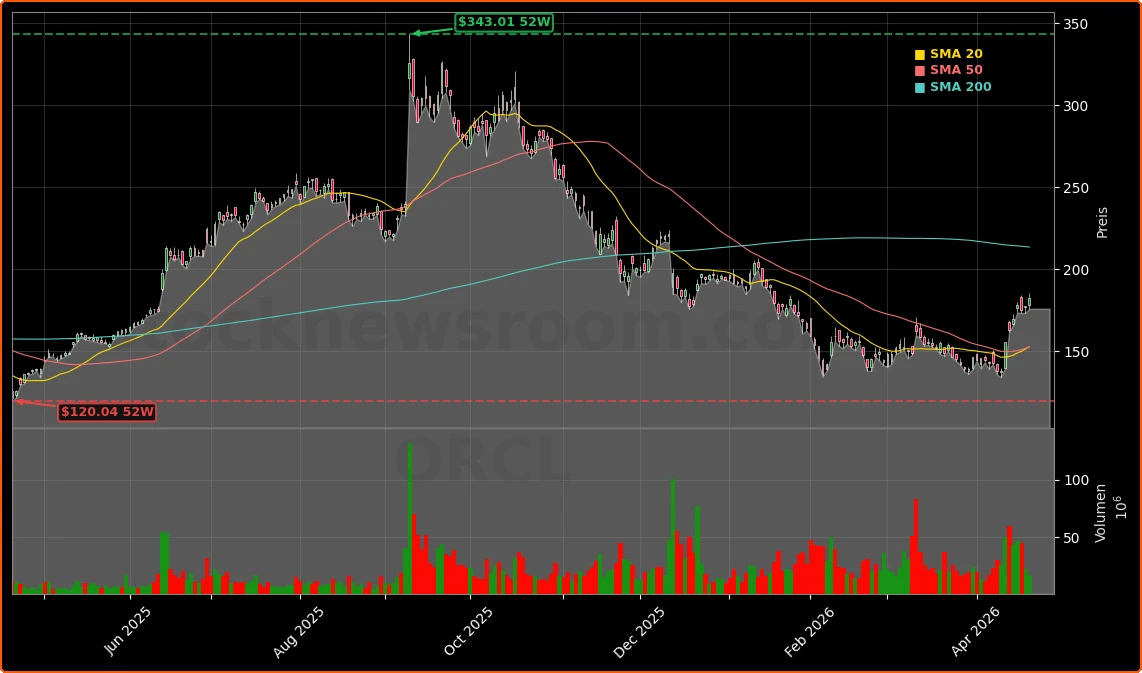
Oracle Corporation is edging higher as broader risk appetite returns to Wall Street after Monday’s geopolitical jitters. The stock has rebounded roughly 14% over the past five trading days and now changes hands at $182.52, still far below its September 2025 peak near $345 but comfortably above key technical support around $177. From a chart perspective, shares sit about 18% above the 20-day simple moving average and just under 5% above the 100-day, while remaining roughly 16% below the 200-day trend line — a setup many technicians view as early-stage recovery rather than a fully priced AI winner.
Against that backdrop, the Oracle Forecast from Guggenheim looks particularly bold. DiFucci has named Oracle his “Best Idea” for 2026, arguing that the company is being left behind by investors who “simply aren’t doing the math” on its contracted backlog and upcoming data-center revenue ramp. The stock’s 44%-plus 12‑month gain shows long-term holders have still been rewarded, but the disconnect between price and prior highs provides ample room for upside if the bullish thesis plays out.
Why are analysts so focused on Oracle and OpenAI?
At the heart of the bullish Oracle Forecast is a stunning backlog number. Oracle’s remaining performance obligations (RPO) reached about $553 billion in its latest reported quarter, up more than 300% year over year and far beyond a typical “pipeline.” Much of this relates to long-term cloud and AI infrastructure contracts, which will convert into revenue over several years.
One anchor customer is OpenAI, the maker of ChatGPT. DiFucci estimates that OpenAI could ultimately account for just under 30% of Oracle’s total revenue — a concentration level that clearly introduces risk but also underscores Oracle’s importance in the AI compute stack alongside hyperscalers like Microsoft Azure and GPU suppliers such as NVIDIA. The analyst argues that funding rounds at OpenAI have partly de‑risked its ability to pay, easing credit concerns tied to that exposure.
Other research desks are watching from a more neutral distance. Recent commentary from Zacks and TradingView notes that Oracle’s AI and cloud momentum, plus its RPO, give it an edge versus ServiceNow and other enterprise software rivals, but most ratings there sit closer to “Hold” than to Guggenheim’s high-conviction stance. For now, DiFucci’s $400 target remains at the top of the Street’s Oracle Forecast range.
Is Oracle’s AI capex strategy sustainable?
To support its AI data-center buildout, Oracle is in the middle of an aggressive capital spending cycle, with roughly $50 billion in capex expected this fiscal year alone. Management has reportedly cut between 20,000 and 30,000 jobs over recent quarters as it reallocates resources toward AI-ready infrastructure and multi‑cloud networking, including an expanded partnership with Amazon Web Services and large financing facilities for new server farms.
This strategy has pushed trailing free cash flow into negative territory and increased debt, a combination that has made some investors nervous and contributed to the stock’s drawdown from its highs. However, bulls, including MarketBeat’s recent analysis, contend that the margin pressure is a “feature, not a bug,” signaling heavy construction ahead of a wave of contracted revenue coming online once facilities are fully utilized.
That is where the “cash-flow waterfall” in the Oracle Forecast comes in. DiFucci expects a sharp inflection in free cash flow in Oracle’s fiscal 2029 and 2030 years as AI infrastructure contracts begin generating high-margin usage revenue at scale. Crucially for traders who don’t want to wait four years, he believes the line of sight into that ramp will become visible within the next 12 months, giving Wall Street a reason to re‑rate the stock well before the cash actually hits the balance sheet.
How does Oracle stack up against U.S. cloud peers?
For U.S. investors comparing AI plays across the S&P 500 and Nasdaq, Oracle sits in a hybrid bucket between traditional software vendors and infrastructure providers. Unlike Apple or Tesla, which are consumer-facing and hardware-heavy, Oracle is leveraging its legacy database and enterprise software cash cows to fund a transition into a multi‑cloud IaaS and SaaS platform. Recent healthcare initiatives, including Oracle Health’s digital check‑in solution aligned with U.S. federal CMS goals, further diversify the story and embed the company in critical regulated industries.
Competition remains intense. ServiceNow, Microsoft, Salesforce and others are all racing to embed generative AI into workflows. A recent Zacks-driven comparison on TradingView suggested that Oracle currently holds an edge versus ServiceNow on valuation and backlog visibility, though it also acknowledged Oracle’s higher leverage and execution risk. At the same time, insider selling — such as Chief Legal Officer Stuart Levey’s pre‑planned $2.6 million stock sale after the latest rebound — may give some short‑term traders pause, even if it does not change the long‑term Oracle Forecast.
Related Coverage
Investors who want a deeper dive into the AI angle can read more in Oracle AI Investments: 25% Rally Shock for Investors, which examines whether the company’s massive AI spending truly justifies recent price action or if markets are underestimating associated risks. That analysis explores how the same capex and backlog data driving today’s Oracle Forecast could either propel a sustained re‑rating or set up a sharp reversal if execution falls short.
We think there is going to be a cash flow waterfall in fiscal 29, which will be really interesting when that happens.— John DiFucci, Guggenheim Securities
In sum, the current Oracle Forecast hinges on whether Wall Street embraces the idea of a 2029–2030 cash-flow waterfall justified by a $553 billion AI and cloud backlog and deep ties to OpenAI. For U.S. portfolios seeking AI exposure beyond headline names like NVIDIA, Oracle remains a high‑beta, high‑execution‑risk candidate that could benefit significantly if DiFucci’s $400 thesis plays out. The next year of contract disclosures, capex trends and margin signals will be crucial in determining whether this long‑duration bet belongs in more than just aggressive growth accounts.