
Can Oracle’s massive AI backlog outweigh rising debt and cash burn when Oracle Earnings finally put the numbers under the spotlight?

What Do Oracle Earnings Reveal About AI Revenue Timing?
Oracle Corporation’s upcoming fiscal Q4 2026 earnings report — due June 10 — arrives at a critical juncture. While revenue from Infrastructure-as-a-Service (IaaS) surged 84% year over year to $4.888 billion in Q3 FY2026, the real question is timing: when does the $553 billion backlog translate into consistent top-line growth and margin expansion? Deutsche Bank analysts note Oracle is entering the ‘inflection point’ of its cloud buildout, a phase expected to pressure free cash flow and operating margins over the next two years. That tension — between record RPO and negative $24.7 billion trailing free cash flow — makes Oracle Earnings a pivotal catalyst for software sector sentiment on the NASDAQ.
How Are Analysts Pricing Oracle’s $160B AI Buildout?
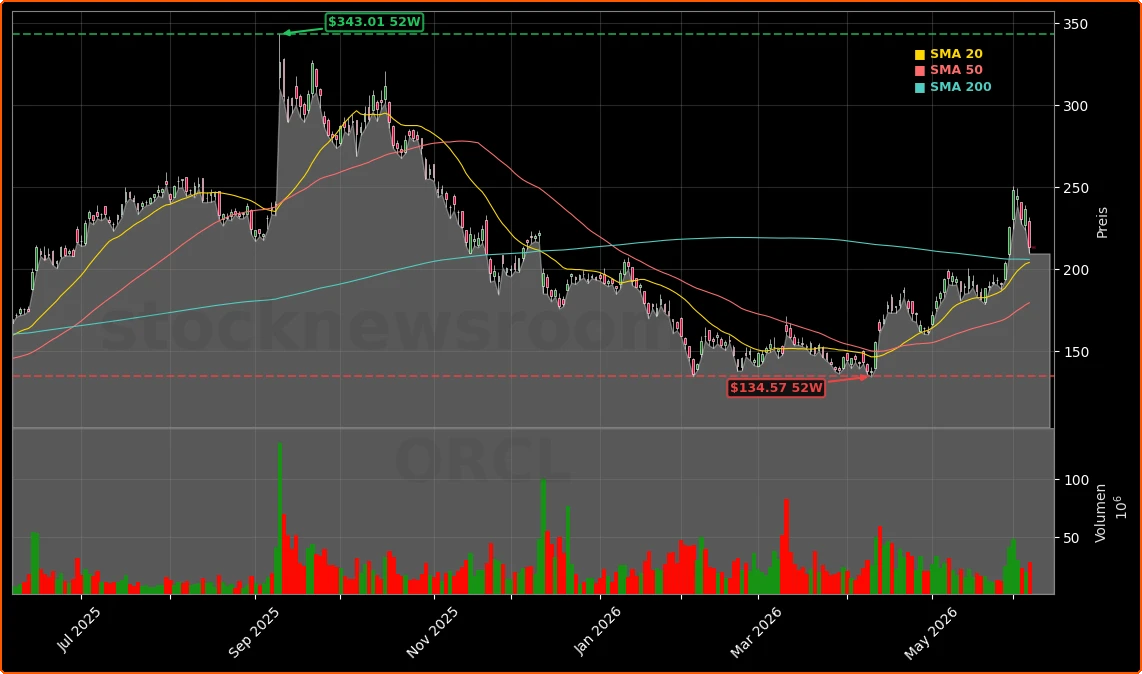
Despite Friday’s 9.59% sell-off, bullish sentiment remains structurally intact — but with widening divergence. Guggenheim’s John DiFucci reiterated a $400 price target and ‘buy’ rating, citing Oracle’s ability to raise $45 billion in debt and equity as validation for its $160 billion AI infrastructure spend. Cantor Fitzgerald lifted its target from $229 to $284, citing strong demand across database and applications segments. Meanwhile, RBC Capital Markets downgraded its target to $190 and maintained a ‘Sector Perform’ rating, warning that recent gains reflect ‘multiple expansion’ rather than earnings acceleration. Deutsche Bank held its $300 target, emphasizing execution credibility in cloud infrastructure ramp-up — but flagged investor questions around leverage and financing.
Is Oracle’s Debt Load Sustainable Amid AI Capex?
Oracle Corporation’s long-term debt now stands at $124.7 billion — a figure that has ballooned alongside its AI ambitions. With Guggenheim forecasting $75 billion in capex for FY2027 and $85 billion for FY2028, the company’s financing strategy is under intense scrutiny. CEO Clay Magouyrk confirmed that the AI data center buildout — including a single facility costing over $15 billion, with underlying tech adding $30–$40 billion more — will require substantial capital deployment. That raises urgent questions for investors: Will Oracle rely on debt, equity, or internal cash flow? With trailing FCF negative and EPS guidance for Q4 set at $1.96–$2.00, Oracle Earnings must clarify the path to cash flow breakeven — especially as competitors like NVIDIA and Microsoft scale AI infrastructure with different capital structures.
How Does Oracle Compare to Hyperscaler Peers on AI Infrastructure?
Oracle Corporation’s AI infrastructure push sets it apart from traditional enterprise software peers — but places it directly in competition with the hyperscalers. While Amazon (NASDAQ:AMZN), Microsoft (NASDAQ:MSFT), and Alphabet (NASDAQ:GOOGL) built cloud dominance organically, Oracle is executing a capital-intensive, fast-follow strategy anchored by multicloud integration and AI tenant wins like OpenAI. Its 10-year total return of 595.63% — vastly outpacing the S&P 500’s 258.22% — reflects investor belief in that model. Yet, with the NASDAQ down quadruple digits Friday amid broad tech weakness, Oracle’s -10% drop highlights its growing correlation with AI hardware and infrastructure names like Tesla and Apple, rather than its legacy software peers. That shift in beta matters for portfolio diversification.
Oracle Earnings: What’s the Wall Street Consensus on Guidance?
Consensus EPS for Oracle’s Q4 FY2026 stands at $1.98, with revenue expected near $17.5 billion — up modestly from Q3’s $17.19 billion. But guidance — particularly on FY2027 revenue, cloud infrastructure growth, and capex — will carry more weight than the quarter itself. Analysts expect Oracle to reaffirm its $90 billion FY2027 revenue target and reiterate its $144 billion OCI revenue goal by FY2030. Yet with shares trading 25% below their 52-week high of $280.70, Oracle Earnings must deliver confidence on execution velocity and financing discipline. As one strategist noted, ‘This isn’t about beating estimates — it’s about proving the model isn’t over-leveraged.’
Oracle is entering the inflection point in its cloud buildout/investment cycle, which we expect to temporarily put pressure on margins and FCF over the next couple years.— Deutsche Bank analysts
Related Coverage: For deeper analysis on Oracle’s debt dynamics and AI backlog trade-off, see Oracle Earnings -5.6%: AI Backlog Faces Debt Test, published June 3 by StockNewsRoom’s Editor in Chief Maik Kemper. The piece examines how Oracle’s self-funded growth model is now triggering caution even among longtime bulls — especially as interest rates remain elevated and refinancing windows narrow. It remains one of the most-read technical deep dives on Oracle Corporation this earnings season.