
RTX Earnings just delivered record growth and a backlog surge, so why is the stock sliding instead of rallying?

How strong were RTX Earnings in Q1?
RTX Corporation reported adjusted EPS of $1.78 for Q1 2026, up 21% year over year and comfortably above consensus estimates around $1.51. Adjusted sales reached $22.1 billion, growing 9% reported and about 10% organically versus the prior year. Net income attributable to common shareholders climbed roughly a third to just over $2.0 billion, while free cash flow improved to $1.3 billion, supported by higher segment profits and lower interest expense.
All three operating segments contributed. Collins Aerospace sales rose to $7.6 billion, Pratt & Whitney to $8.2 billion and Raytheon to $6.9 billion, each delivering high single‑ to double‑digit organic growth. Segment operating profit increased 14% overall, driving a 70‑basis‑point uplift in consolidated margins despite ongoing tariff headwinds.
Operationally, commercial and defense demand remained robust. Commercial aftermarket revenue, a key profit driver for aerospace names from RTX to Apple’s supplier base in avionics and electronics, rose 14% company‑wide. Defense sales grew 9% as the Pentagon and allies accelerated orders for munitions and air‑ and missile‑defense systems.
What changed in RTX’s 2026 guidance?
On the back of the strong RTX Earnings, management nudged full‑year 2026 guidance higher. Adjusted sales are now projected at $92.5 billion to $93.5 billion, up $500 million at the midpoint, implying 5%–6% organic growth. The adjusted EPS range was raised by $0.10 to $6.70–$6.90, modestly above many prior Wall Street models clustered around $6.80.
The upgrade is driven primarily by the Raytheon defense segment, where missile and sensor programs are running ahead of plan, and by slightly lower corporate eliminations. RTX kept its free cash flow outlook intact at $8.25 billion to $8.75 billion, signaling that higher capital spending to grow missile output is expected to be offset by stronger operating cash generation.
Management emphasized that most of the $500 million sales bump is tied to munitions volume. RTX has signed multiple long‑term framework agreements with the U.S. Department of Defense covering key missile families such as Tomahawk, AMRAAM and Standard Missile. These deals, once fully contracted, are designed to give RTX and its suppliers the visibility needed to invest in capacity for a decade‑long production ramp.
How critical is missile demand for RTX?
Raytheon’s bookings in the quarter reached $6.6 billion, including Patriot air‑ and missile‑defense equipment for European allies and additional contracts for naval missiles. On a rolling 12‑month basis, Raytheon’s book‑to‑bill sits near 1.5, and the segment’s backlog stands at about $74 billion. Across the group, total backlog hit a record $271 billion, up 25% year on year, split between $162 billion in commercial and $109 billion in defense.
Geopolitical tensions from Ukraine to the war in Iran are driving a multi‑year restocking cycle for U.S. and allied arsenals. RTX’s munitions and interceptor portfolio is central to that effort, and the company has already invested close to $900 million over the last three years to expand missile capacity in Arizona, Alabama and Massachusetts, with further investments coming. Raytheon’s effector (missiles and munitions) business alone now accounts for a little over 40% of that segment’s sales.
At the same time, RTX is trying to avoid the classic boom‑and‑bust for defense manufacturing. Management highlighted the importance of smoothing demand through long‑term agreements so that production lines do not “start and stop,” which would undermine returns and strain the supply chain.
What about Pratt & Whitney and Collins Aerospace?
Beyond pure defense, RTX Earnings also benefited from a resilient commercial aviation cycle. Pratt & Whitney’s Q1 sales climbed 11%, with commercial aftermarket up 19% and military engines up 7%, helped by F135 fighter‑engine production. The group is still working through the costly powder‑metal issue affecting certain geared turbofan (GTF) engines, but reported that grounded PW1100‑powered aircraft declined about 15% since year‑end as maintenance, repair and overhaul (MRO) output rose 23%.
Collins Aerospace posted 10% organic growth, led by a 15% jump in commercial original equipment and solid defense demand. Airlines’ need to keep older jets flying longer, amid new aircraft delivery delays, continues to support spare parts and repair activity, although management acknowledged that provisioning and upgrades could soften if global air‑traffic growth slows.
The commercial side of RTX’s portfolio offers a useful contrast to pure‑play defense names like Tesla’s manufacturing automation partners or prime contractors such as Lockheed Martin and Northrop Grumman. For diversified investors in the S&P 500 and NASDAQ, RTX provides exposure to both the long upcycle in global air travel and the structurally higher defense budgets now being debated in Washington.
Why did the stock fall after RTX Earnings?
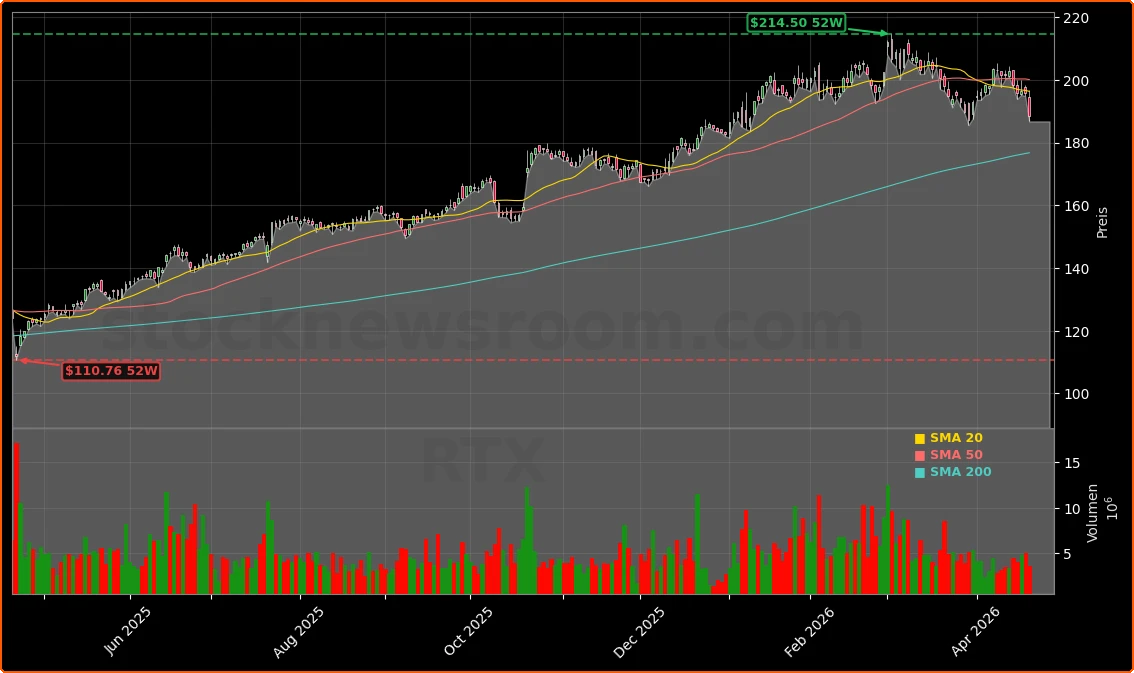
Despite the upbeat RTX Earnings and higher outlook, RTX shares traded down around 3% on Tuesday to roughly $188.50, retreating from recent highs near $196 and below a flat‑base buy point around $214 that chart watchers have been tracking. Part of the reaction likely reflects profit‑taking after a strong run: the stock is still up solidly year to date and sits not far below its 52‑week high just under $215.
Another factor is expectations. With defense contractors widely seen as beneficiaries of elevated geopolitical risk, Wall Street had already priced in a substantial portion of the missile‑driven growth story. Some investors may also be cautious about the capital‑allocation shift underway as RTX spends more on factories and less on shareholder returns to support its expanded agreements with the Pentagon.
The current landscape clearly underscores the need for munitions depth, integrated air- and missile-defense technology, and more advanced capabilities to counter evolving threats.— Chris Calio, Chairman and CEO of RTX Corporation
Still, large U.S. institutions looking for defense exposure alongside secular technology winners like NVIDIA and Apple are likely to see RTX’s record backlog, rising margins and robust free cash flow as supportive of the long‑term thesis.