

Is the latest Bitcoin MicroStrategy Purchase turning a single corporate balance sheet into Wall Street’s most aggressive BTC accumulation machine?

How is the Bitcoin MicroStrategy Purchase moving the market?
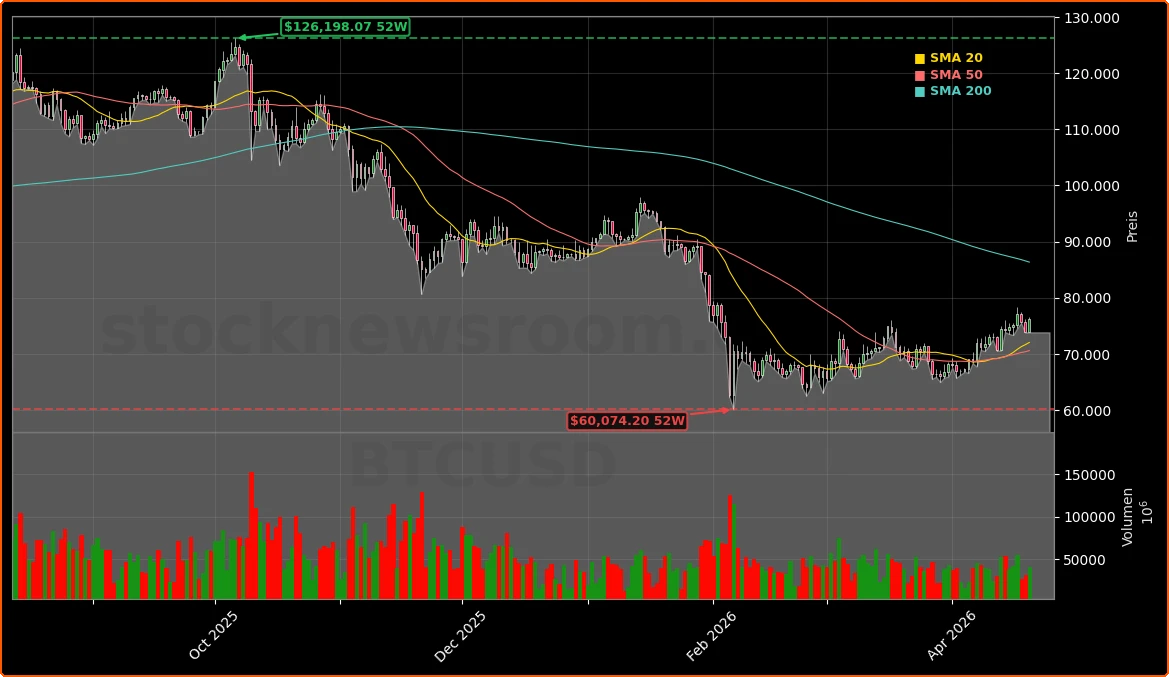
Bitcoin is trading near $76,308 on Monday, modestly below its recent local peak around $78,300 but well off the lows seen after a 50% correction earlier in the year. In that context, the latest Bitcoin MicroStrategy Purchase stands out: Saylor’s company has acquired 34,164 additional coins for about $2.5 billion at an average price of $74,395 per Bitcoin. That lifts its total holdings to roughly 815,061 BTC, with a notional value of about $61 billion at current prices.
Strategists see this as a powerful demand shock in an otherwise range-bound market. Despite geopolitical tensions and a stronger US dollar, Bitcoin has climbed 18–20% since the start of the recent Middle East crisis and briefly reclaimed the $78,000 zone, last seen in early February. Technical traders note a tug-of-war between a potential bear-flag setup pointing as low as $40,000 on the downside and a possible trend confirmation toward $83,000–$87,000 if Bitcoin can clear key resistance and hold above roughly $82,700.
Short term, liquidity maps show balanced long and short positioning above and below spot, suggesting no immediate one-sided squeeze. But large, recurring corporate orders like the Bitcoin MicroStrategy Purchase are increasingly viewed as a structural bid that can absorb dips when speculative interest fades.
What is MicroStrategy’s new financing machine?
To fund the latest buying spree, Saylor has leaned on an innovative perpetual preferred equity instrument known as STRC, sometimes branded Stretch. The company sold about $2.18 billion of these preferred shares in the past week alone, channeling the proceeds almost directly into Bitcoin. STRC pays an 11.5% dividend, treated for many investors as tax-advantaged return of capital, implying an effective yield in the mid-teens.
The structure is designed to operate like a funding engine: when STRC trades above its $100 reference level, new shares can be issued and the capital rapidly deployed into Bitcoin purchases, effectively converting yield-hungry capital into continuous BTC demand. There are even plans to shift from monthly to semi-monthly dividend payments, accelerating the cycle of cash flows and potential Bitcoin accumulation.
For equity holders, this comes with trade-offs. While preferred shares are less dilutive for common stock than repeated secondary offerings, they significantly increase the company’s fixed distribution burden. The strategy resembles a leveraged, yield-funded Bitcoin ETF built on a corporate balance sheet. That aggressive stance has made the stock highly sensitive to crypto drawdowns but also rewarded believers when Bitcoin rallies.
How does institutional adoption on Wall Street fit in?
The Bitcoin MicroStrategy Purchase is only one side of the institutional story. On Wall Street, traditional giants are racing to make Bitcoin accessible inside brokerage accounts and model portfolios. Morgan Stanley has launched a spot Bitcoin ETF with a fee of just 0.14%, undercutting rivals and challenging the dominant iShares Bitcoin Trust, which manages over $53 billion at a higher expense ratio. Goldman Sachs is preparing an income-oriented Bitcoin ETF, aiming to package yield strategies on top of spot exposure for wealth-management clients.
Meanwhile, Charles Schwab is developing direct trading for Bitcoin and Ethereum in a closed environment, where users cannot self-custody but can hold positions within traditional brokerage accounts. The move is aimed at preventing client assets from drifting to pure-play crypto exchanges like Coinbase. For US advisors, these products make it easier to slot Bitcoin into risk buckets alongside S&P 500 and NASDAQ exposures, rather than treating it as an off-platform speculative side bet.
Beyond the US, regulatory winds are shifting as well. Pakistan has lifted an eight-year banking ban on crypto after striking agreements with global partners, opening the financial system of the world’s fifth-most populous country to digital assets. Combined with maturing rules in the US, this global shift supports the view that Bitcoin is moving from fringe to mainstream financial infrastructure.
What does this mean for other assets like Tesla and NVIDIA?
For high-growth names such as Tesla (TSLA) and NVIDIA (NVDA), Bitcoin’s behavior increasingly matters as a barometer of risk appetite. Bitcoin has begun trading less like a pure “risk-on” tech proxy and more like a hybrid macro asset, sometimes rallying alongside gold and silver in risk-off phases tied to Federal Reserve uncertainty and geopolitical stress. That complicates traditional correlations but also broadens the asset’s role in portfolio construction.
On the equity side, MicroStrategy’s approach offers a contrast to mega-cap techs like Apple and others in the NASDAQ 100, which generally return capital via buybacks and dividends rather than concentrating exposure in a single volatile asset. Some analysts argue that Saylor’s leveraged Bitcoin treasury play makes the stock a high-beta proxy for BTC itself, rather than a conventional software company, which may not suit all mandates. Still, its performance during the latest three-week Bitcoin rally, when the shares climbed almost 30%, shows how powerful the linkage can be when sentiment turns.
Bitcoin is shifting from a speculative side bet to a capital-market asset with recurring corporate and institutional demand behind it.— Scott Melker, crypto market commentator
For US investors, the market is increasingly divided into “haves” and “have-nots” within crypto: Bitcoin and Ethereum, with deep ETF markets and institutional adoption, versus smaller altcoins and experimental DeFi protocols that remain exposed to hacks and regulatory risk. Recent exploits exceeding $250 million at major DeFi platforms highlight why many wealth managers prefer regulated vehicles over direct smart-contract exposure.