Can MicroStrategy’s aggressive Bitcoin strategy and STRC funding twist really turn a software company into crypto’s most powerful proxy?

How is MicroStrategy reshaping its Bitcoin play?
MicroStrategy (MSTR) has cemented itself as the largest corporate holder of Bitcoin, turning its balance sheet into a de facto spot BTC fund. The latest iteration of the MicroStrategy Bitcoin Strategy saw the company add 13,927 BTC last week at an average price of about $71,902 per coin, a roughly $1 billion ticket that lifted its treasury to around 780,897 BTC. At current crypto prices, that stash is valued at more than $59 billion and has made MSTR one of Wall Street’s purest listed proxies on Bitcoin volatility.
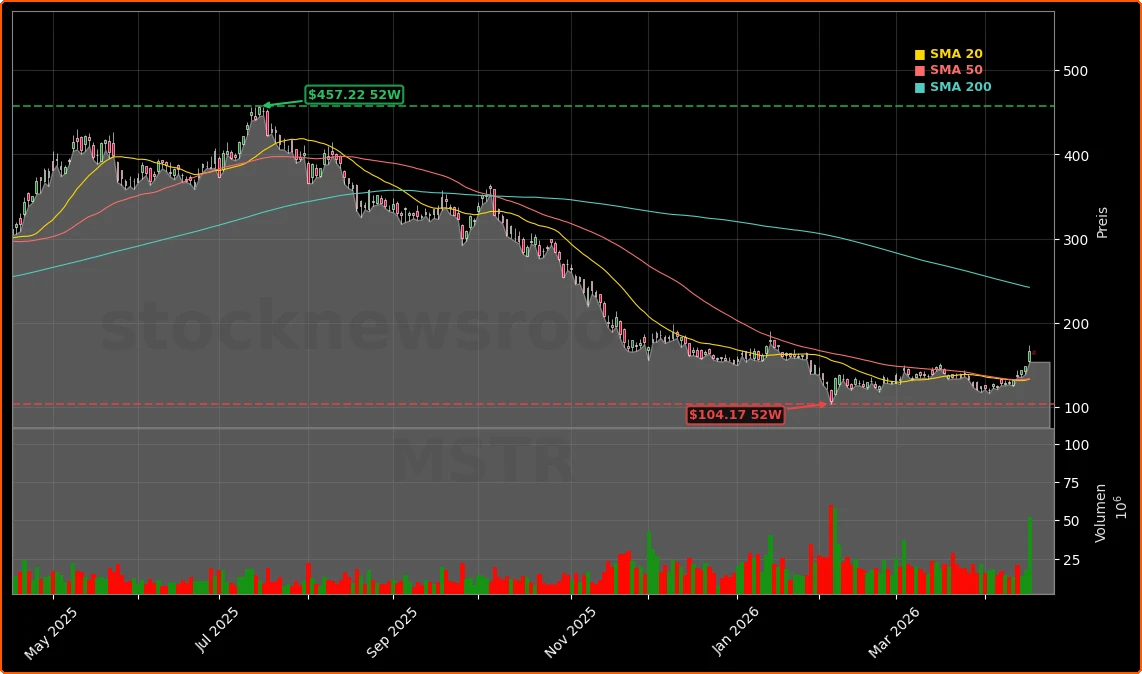
The stock’s latest 11.8% surge came on unusually high volume and outpaced its roughly 7.7% gain over the past four weeks, underscoring how tightly MSTR now tracks Bitcoin’s direction. Yet the fundamental backdrop is still that of a niche software and digital credit business expected to post a quarterly loss of about $3.41 per share, even as revenues for the coming report are projected near $124.6 million, up more than 12% year over year. That disconnect between operating business and crypto treasury is central to how investors must analyze the MicroStrategy Bitcoin Strategy today.
How does STRC fund Bitcoin accumulation?
The latest billion‑dollar purchase was financed entirely through MicroStrategy’s Variable Rate Series A Perpetual Stretch Preferred Stock, trading as STRC. Designed to hover around a $100 par value, STRC currently pays a variable dividend with an 11.5% annualized yield, resetting monthly. For MicroStrategy, it has become a core funding engine for the Bitcoin strategy, offering income‑seeking investors a high‑yield instrument while freeing common equity from immediate dilution.
Management now wants to tweak that design. MicroStrategy has proposed shifting STRC’s dividend cadence from monthly to semi‑monthly payments, keeping the 11.5% annualized yield intact while splitting record dates to the 15th and last day of each month. The pitch: tighter liquidity, less ex‑dividend price whiplash, and better collateral usability for institutional holders, especially hedge funds and structured‑product desks that value smoother cash‑flow profiles.
Recent trading in STRC shows why this matters. The preferred saw back‑to‑back days with more than $1 billion in volume, helping push outstanding notional value to roughly $6–6.4 billion and compressing volatility from double‑digit levels to just above 2% in recent months. If the semi‑monthly proposal, which requires approval from both STRC investors and common shareholders, passes, it could broaden institutional demand and extend the runway for the MicroStrategy Bitcoin Strategy.
Could MicroStrategy overtake BlackRock in BTC?
Speculation is building that MicroStrategy may already be preparing its next major buy. Executive chairman Michael Saylor has teased a “Think Even ₿igger” message alongside a chart of the company’s purchase history, a pattern that in the past has preceded new SEC filings. With roughly $2.25 billion in cash capacity earmarked for additional Bitcoin, some market models suggest that recent STRC activity could support another acquisition of up to 30,000 BTC.
That scale would be pivotal. BlackRock’s iShares Bitcoin Trust (IBIT) is currently the largest Bitcoin fund with about 798,026 BTC. MicroStrategy’s 780,897 BTC leaves a relatively narrow gap. A fresh purchase north of 20,000 BTC could allow the company to surpass IBIT and become the second‑largest holder of Bitcoin globally, behind only the pseudonymous founder Satoshi Nakamoto. For US investors, that would mark a symbolic moment: a single corporate treasury eclipsing the flagship ETF run by the world’s largest asset manager, BlackRock.
On Wall Street, this elevated role means MSTR increasingly trades less like a traditional software name and more like a leveraged spot Bitcoin instrument. Technical strategists on platforms such as TradingView flag MSTR as a high‑beta BTC proxy, while fundamental analysts at firms like TradingKey highlight a “Buy” stance based on strong growth optionality despite recent stock volatility. The stability and scalability of the STRC program will be central to whether this thesis holds.
What does this mean for US portfolios now?
For American investors, the MicroStrategy Bitcoin Strategy turns MSTR into a hybrid exposure: part business‑software company, part capital‑markets lab, and part synthetic spot Bitcoin tracker with embedded leverage. That profile can complement direct Bitcoin holdings in taxable accounts, but also introduces layered risks. Earnings estimate revisions have been flat in recent weeks, and MSTR currently carries a mid‑range “Hold” style ranking from Zacks, suggesting that near‑term price moves will hinge more on Bitcoin and capital‑markets flows than on incremental software deals.
Investors who already own crypto via ETFs from giants like NVIDIA‑exposed AI plays, Tesla’s balance‑sheet experiment, or big‑tech cash‑rich names such as Apple need to decide whether MicroStrategy offers additive diversification or simply magnifies BTC beta. While the company’s disciplined Bitcoin accumulation and growing digital credit products support the long‑term bull case, the dependence on preferred‑stock markets via STRC, STRF, STRE, STRK and STRD introduces funding‑liquidity risk if sentiment toward high‑yield instruments sours.
Related Coverage: Investors wanting a deeper dive into MicroStrategy’s recent rally can read how the latest BTC purchase wave fueled a double‑digit surge in MSTR in “MicroStrategy Bitcoin Expansion +10.6% Rally Shocks Traders”, which examines whether this is a masterstroke or over‑leverage into the next Bitcoin spike. For a broader macro lens on crypto risk, “Bitcoin Market Analysis as Iran Shock Tests Bulls” analyzes how rising geopolitical tensions could test Bitcoin’s safe‑haven narrative, context that is crucial when assessing MicroStrategy’s balance‑sheet bet.
The proposed changes are intended to stabilize price, dampen cyclicality, drive liquidity, and grow demand.— Michael Saylor, Executive Chairman of MicroStrategy
In conclusion, the MicroStrategy Bitcoin Strategy is evolving into a full‑blown capital‑markets machine, where high‑yield STRC preferred stock fuels ever larger BTC purchases. For US investors, that means MSTR can function as a turbocharged Bitcoin proxy, but only for those comfortable with both crypto and funding‑liquidity risk. The next disclosure on Bitcoin holdings and the shareholder vote on STRC’s dividend reform will show whether the strategy’s momentum can continue to outpace Wall Street’s skepticism.