
Can Bitcoin stay resilient as Iran tensions rise again, or is this the start of a deeper shakeout for crypto portfolios?

How is Bitcoin reacting to fresh Iran risk?
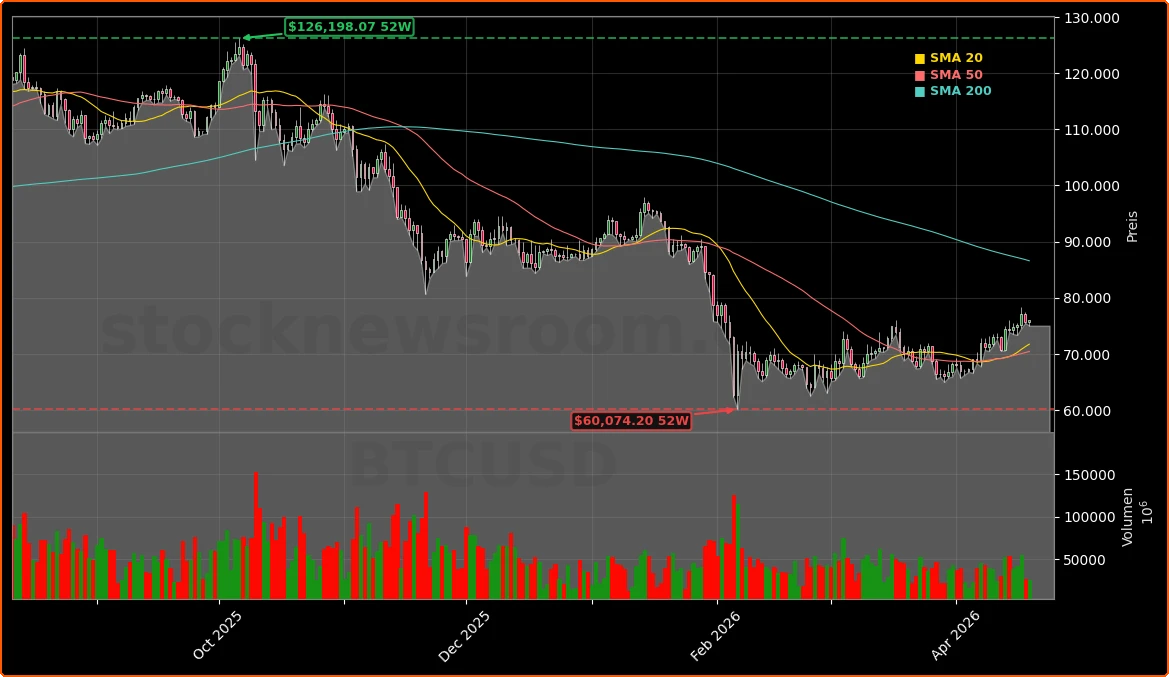
Bitcoin slipped modestly into the weekend after testing ten-week highs close to $78,400, with the price easing back toward $76,000 as of Sunday afternoon in Europe. Renewed fears that the U.S.–Iran conflict could re-escalate, including reports of another closure of the Strait of Hormuz and the risk of an oil-price spike, have pressured risk assets globally. While the S&P 500 and NASDAQ are not trading on Sunday, futures and crypto markets have already repriced part of this risk.
Technical traders note that Bitcoin has repeatedly struggled to clear a 21‑week exponential moving average near $78,900, with the latest rejection increasing the odds of a short-term retest of support around $73,000. Derivatives data show roughly $260 million in crypto positions liquidated over the past 24 hours, skewed toward leveraged longs forced out during the retracement. That flush has been typical for Bitcoin bull cycles historically, where 10% intraday swings are common and can be amplified by high leverage.
Is Bitcoin decoupling from stocks and gold?
Despite the latest pullback, recent Bitcoin Market Analysis highlights a notable decoupling from traditional risk assets since the Iran crisis began. While global equities and bonds have struggled with higher volatility and conflicting narratives around inflation and growth, Bitcoin has held up comparatively well and outperformed many benchmarks. Some multi-asset managers are revisiting the token as a portfolio diversifier after classic 60/40 stock-bond mixes failed to cushion drawdowns during earlier geopolitical and inflation shocks.
Gold, normally the go-to haven, has seen erratic moves as oil and rate expectations whipsaw. That has strengthened the argument for including a scarce digital asset such as Bitcoin alongside gold, commodities and defensive equities like Apple or NVIDIA. The thesis is not that Bitcoin is risk-free—far from it—but that its return drivers differ enough from the S&P 500 and Treasuries to improve long-term risk-adjusted returns when position sizes are modest.
What does this Bitcoin Market Analysis mean for portfolios?
Professional strategists who study historical data often cite a 2–5% allocation to Bitcoin within a traditional 60/40 portfolio as a range that would have boosted returns while keeping volatility manageable in past cycles. The key lesson from recent volatility is that sizing matters more than short-term timing. Bitcoin has repeatedly endured drawdowns of 30–50% within a single year and still gone on to finish higher or print new all-time highs later, as seen in 2021.
For U.S. retail investors using platforms such as Kraken or Coinbase, dollar-cost averaging via recurring purchases can help reduce the impact of timing risk. Kraken, for example, offers savings plan–style recurring buys in Bitcoin and hundreds of other tokens, with MiCA-regulated operations in Europe and a focus on security since inception. The boring disciplines of risk management—defining why you buy, when you might take profits, and how much of your net worth to risk—have again proved more important than chasing social-media-driven “pumps.”
How do long-term bull and bear scenarios stack up?
The medium-term bull case remains rooted in Bitcoin’s fixed supply, its latest halving and growing institutional interest. Well-known investors such as Cathie Wood of ARK Invest have floated price targets above $1 million per coin by 2030, arguing that broader adoption, corporate treasury allocations and even potential sovereign buying could drive an extended bull market. Coinbase CEO Brian Armstrong has also suggested seven‑figure prices are possible over the next five years if adoption accelerates.
More conservative outlooks envision Bitcoin delivering annualized returns of roughly 20% from current levels, which would still comfortably beat most equity indices if realized. Bearish scenarios focus on regulatory crackdowns, a loss of narrative relevance if Bitcoin becomes too correlated with the broader market, or technology shocks—such as a breakthrough in quantum computing—that might undermine confidence in its cryptography. In harsher downside cases, analysts warn the price could revisit levels below $30,000, especially if leverage builds up again.
What can U.S. investors learn from current volatility?
For investors used to large-cap growth names like Tesla and mega-cap tech leaders in the NASDAQ 100, Bitcoin’s swings are on another level. A 10% move in a single session, which would be extreme for a blue-chip such as Apple, is routine for Bitcoin and can be career-ending for over-levered traders. That is why many experienced market participants avoid leverage altogether in spot crypto and instead treat Bitcoin as a long-duration, high-beta allocation within a diversified portfolio.
Volatility in Bitcoin isn’t a bug, it’s the feature that has historically delivered the outsized returns—investors just need to size positions so they can survive 30–50% drawdowns without panicking out.— Ryan Grace, crypto strategist
At the same time, institutional infrastructure around Bitcoin has matured, from audit methodologies for bank balance-sheet exposure to regulated custody and MiCA-compliant stablecoins that interact with blockchain ecosystems like Cardano. This backdrop is slowly making it easier for traditional wealth managers and family offices in the U.S. to integrate modest Bitcoin exposure alongside equities, bonds and alternative assets, rather than viewing it as a separate speculative playground.