
Can Ripple Expansion with billion‑dollar buybacks and M&A finally ignite XRP, or is the token being left behind?

Is Ripple Expansion a bullish signal for XRP?
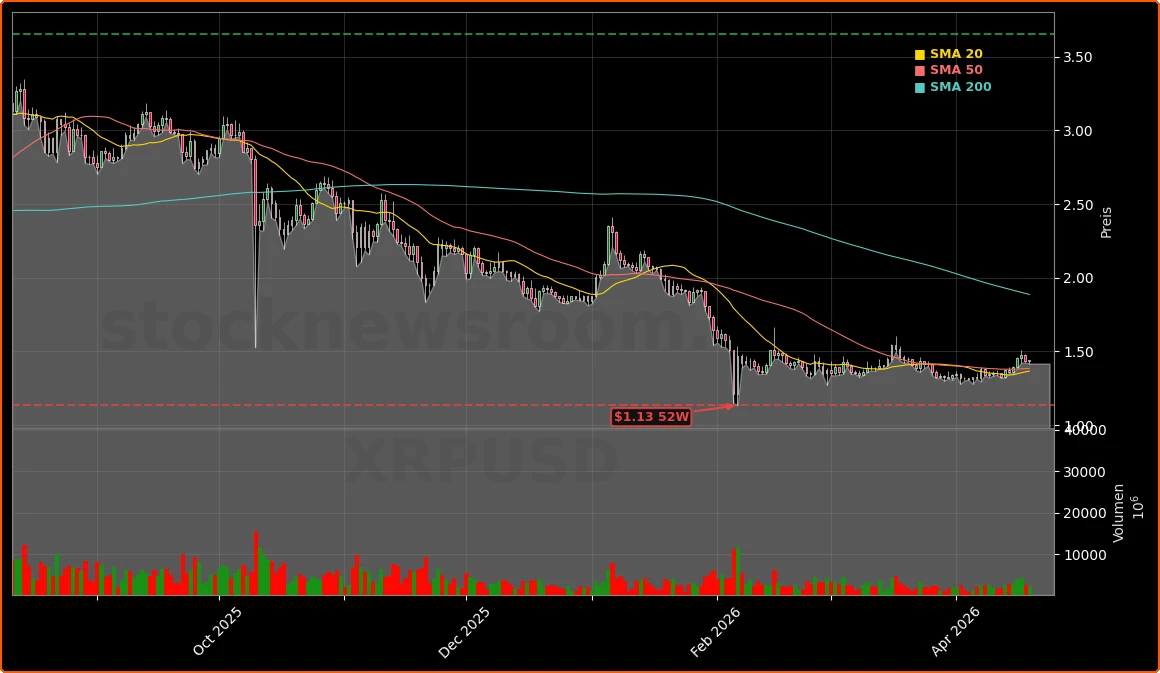
At around $1.44, **Ripple (XRPUSD)** is up only marginally from the prior close of $1.43, and it remains far below its all‑time high near $3.65 set in July 2025. That disconnect contrasts sharply with the latest Ripple Expansion story on the corporate side. The company has just completed a $750 million share buyback, implying a private valuation of roughly $50 billion – about 25% higher than only a few months ago. For U.S. crypto investors used to tech names like NVIDIA and Apple where buybacks often underpin equity performance, the obvious question is why XRP is not seeing a similar tailwind.
The valuation jump is being driven by an aggressive deployment of nearly $3 billion in 2025–2026 aimed at broadening Ripple’s footprint across infrastructure, treasury and payments. That capital allocation strategy resembles what high‑growth fintechs on the NASDAQ have done to secure critical rails, but with one crucial twist: Ripple’s core token is not equity, and its economics are increasingly decoupled from the company’s balance sheet.
How is Ripple using M&A to reshape its network?
The most visible pillar of Ripple Expansion is its M&A spree. Ripple acquired prime brokerage Hidden Road for about $1.25 billion, giving the company a regulated gateway into traditional financial markets and, more importantly for Wall Street, a direct connection between the XRP Ledger (XRPL) and established clearing infrastructure. Hidden Road’s subsequent inclusion in the NSCC directory ties XRPL into the U.S. securities plumbing used by major broker‑dealers and banks.
Alongside that deal, Ripple bought treasury management platform GTreasury for roughly $1 billion, plus stablecoin payments provider Rail for about $200 million. Together, these assets turn Ripple into more than a cross‑border remittance player; it is now a broader B2B finance stack that can embed stablecoin and tokenized liquidity directly into corporate treasury operations. For large U.S. corporates trading on the S&P 500, that could eventually offer an alternative to traditional correspondent banking, though the near‑term benefit accrues mainly to Ripple’s private valuation, not XRP’s price.
Does Ripple Expansion still rely on XRP or on RLUSD?
For years, the bullish thesis was simple: more demand for Ripple’s products would mean more demand for XRP as a bridge asset. Ripple Expansion is now testing that assumption. Ripple has launched its own U.S. dollar‑pegged stablecoin, RLUSD, which can substitute for XRP in many payment corridors. Instead of using a volatile token to hop between, say, USD and EUR, institutions can rely on RLUSD for similar speed and cost efficiency with far less price risk.
This design choice makes commercial sense for banks and corporates, but it also means that incremental volume on Ripple’s rails does not automatically translate into XRP buying pressure. Ripple still unlocks 1 billion XRP per month from escrow – around $1.44 billion at current prices – and typically relocks 70%–80%. That still leaves an estimated 200–300 million XRP entering potential circulation every 30 days, with roughly 38 billion XRP still in escrow. On top of that, around 60% of circulating XRP sits at an average cost basis near today’s price zone, creating a wall of potential sell pressure whenever the token nears break‑even.
Can ETF flows and derivatives break the $1.40 ceiling?
Despite those headwinds, institutional interest in XRP‑backed products has been improving again. XRP ETFs have booked their strongest weekly net inflow of 2026 so far, with about $55.4 million in positive flows after several weeks of heavy redemptions. Separate data shows cumulative inflows into XRP ETFs at roughly $1.23 billion, with assets under management averaging around $966 million. That mirrors the pattern U.S. investors have seen in bitcoin and ether ETFs, where large regulated vehicles act as gateways for retirement accounts and RIAs.
Derivatives are also stabilizing. Futures open interest recently climbed back toward $2.5 billion, up from earlier in the month, although that remains far below the July 2025 peak near $10.9 billion when XRP traded close to $3.66. Technically, XRP continues to struggle with resistance around $1.40–$1.41, aligned with the 50‑day EMA, while higher EMAs near $1.56 and $1.81 cap any deeper recovery attempts. Unless a clear catalyst – such as further U.S. regulatory clarity similar in impact to the CLARITY Act – emerges, analysts on Wall Street expect the token to remain range‑bound in the near term.
How should U.S. investors read the XRP narrative?
For American portfolios already heavy in growth stocks like Tesla and other high‑beta names, XRP sits at the intersection of fintech infrastructure and speculative crypto. Ripple’s deepening partnerships with major financial institutions and its invitation into the Monetary Authority of Singapore’s stablecoin‑based trade finance pilot underscore its credibility as a global payments provider. But the corporate winners from Ripple Expansion may ultimately be banks and enterprises using RLUSD and XRPL infrastructure, rather than XRP holders waiting for extreme price targets like the long‑standing “$589” meme.
Major Wall Street research desks such as Goldman Sachs, Citigroup and Morgan Stanley continue to highlight regulatory risk, token supply overhang and the shift toward stablecoins as the key variables for any long‑term XRP allocation. While they differ on precise price targets, the common thread is that corporate growth alone is not enough; investors need clearer evidence that XRP itself will remain central to Ripple’s business model.
Related Coverage
For a closer look at near‑term trading dynamics and how shifting leverage on Binance interacts with on‑chain metrics, the article “Ripple Q2 Outlook: Binance Margin Shock vs On‑Chain Surge” analyzes whether XRP’s network usage can offset reduced margin firepower. It offers additional context on how derivatives positioning might amplify or dampen the impact of Ripple Expansion on the token price.
Broader crypto sentiment also matters for XRP, and bitcoin’s behavior at key levels often sets the tone. The piece “Bitcoin Market Rally Warning as $76k Support Gets Tested” examines whether the current BTC rally is a launchpad to new highs or a looming bull trap, a scenario that could either fuel or cap gains across major altcoins like XRP.
Ripple Expansion is undeniably transforming Ripple into a heavyweight in global financial infrastructure, but that success has not yet translated into a sustained breakout for XRP. For U.S. investors, the key is to separate the company’s impressive M&A and partnership story from the token’s more complicated supply and utility profile. The next phase of Ripple Expansion – especially how aggressively RLUSD displaces XRP in real‑world flows – will determine whether XRP evolves into a durable long‑term asset or remains a trading vehicle tethered to shifting narratives.