
Is the latest Bitcoin Market Rally a launchpad toward fresh highs or just another bull trap waiting to snap shut?

Is the Bitcoin Market Rally losing momentum?
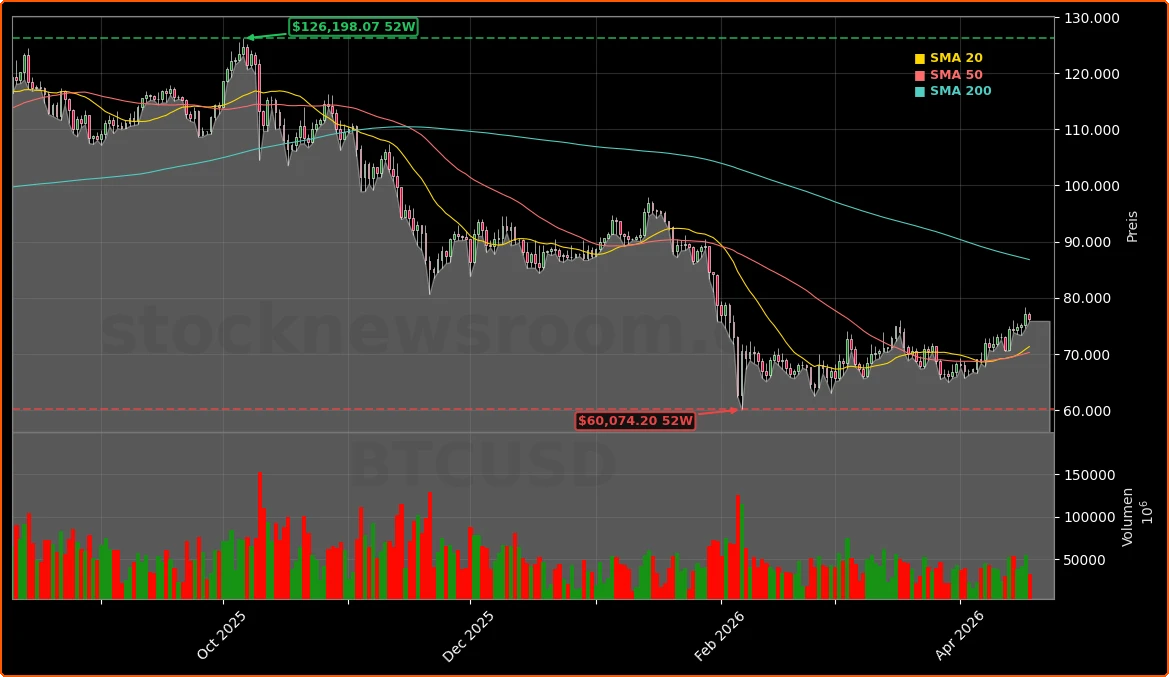
Bitcoin (BTCUSD) is changing hands near $76,116, down about 2.3% from the prior close of roughly $77,098. Earlier in the week, the Bitcoin Market Rally drove prices as high as the $77,000–$78,000 zone, marking the strongest levels in about two and a half months but still well below the all‑time highs reached roughly three to four months ago. Technicians highlight the $76,000 region as a key battleground: a sustained reclaim above this area could open the door to $78,000–$80,000, while a drop back toward $73,000–$73,500 would neutralize the latest bullish setup.
Chart analysts note that Bitcoin has recently broken out of a seven‑month downtrend, accompanied by a weekly MACD bullish cross. Some see room for a final momentum push into an $84,000–$85,000 target band if risk sentiment holds. Others warn that the latest leg may already be a bull trap, arguing that the local top around $78,000 could soon give way to another corrective wave that would also weigh on U.S. equities. This split view underscores how fragile the Bitcoin Market Rally remains at current levels.
How do geopolitics and oil factor in?
The macro backdrop around the Middle East remains central for digital-asset traders. Iran’s decision to reopen the strategically crucial Strait of Hormuz triggered a roughly 10% pullback in global oil prices, sparking a relief bid across risk assets from cryptocurrencies to high‑beta tech stocks. For Bitcoin, the easing in energy market stress contributed to an advance of around 8–10% over the past week, helping BTCUSD reclaim the mid‑$70,000s.
Going forward, talks involving Iran and international mediators over nuclear issues and some $20 billion in frozen Iranian assets could determine whether the recent stabilization in oil extends. A durable agreement that keeps crude prices in check would likely support appetite for speculative growth assets, including crypto and leading U.S. names such as NVIDIA and Tesla, which tend to benefit when macro volatility subsides. A renewed escalation, by contrast, could send investors back into traditional safe havens and test whether Bitcoin behaves more like risk-on tech or like digital gold.
Is Bitcoin acting like digital gold for Wall Street?
On a performance basis, Bitcoin has recently outpaced gold as a store-of-value trade during the US–Iran standoff, with BTC up roughly 12% versus about 10% for the yellow metal over the latest leg. Some asset managers argue that Bitcoin’s total addressable market as a store of value is now surpassing $34 trillion, putting it in direct competition with gold in global portfolios. Bitcoin’s role as a digital, scarce asset is increasingly mentioned in the same breath as bullion when investors discuss hedges against currency debasement and long‑term inflation.
At the same time, several strategists still see Bitcoin as a classic risk asset whose fortunes are tightly linked to liquidity conditions and Fed policy. Since 2021, crypto’s overall performance has lagged the S&P 500 and the Nasdaq, especially after the rollout of spot Bitcoin ETFs. That divergence is notable for U.S. investors who now must decide whether to treat Bitcoin exposures more like a high‑volatility component of their tech allocation—alongside Apple and other mega caps—or as a separate sleeve for alternative stores of value alongside gold and commodities.
What role does the Federal Reserve play now?
The broader crypto complex has been heavily driven by speculation around when the Federal Reserve might begin cutting interest rates. Recent inflation and producer price data in the U.S. showed renewed upticks, dampening expectations of near‑term easing. Fed futures and derivatives pricing suggest roughly a two‑thirds probability that there will be no rate cut before December, keeping financial conditions relatively tight. That backdrop has effectively put a leash on the Bitcoin Market Rally, limiting the kind of parabolic moves seen in earlier cycles.
Wall Street research houses remain divided on the longer‑term implications. TD Cowen, for instance, has floated a scenario in which Bitcoin could reach $140,000 by the end of the year, citing the asset’s historical tendency to double in value repeatedly, including in 2023 and 2024. Prediction markets such as Kalshi and Polymarket, however, currently assign only around an 11% probability that BTC will touch that level in 2026. Other long‑horizon models see more gradual appreciation, projecting end‑2026 prices near $81,600 and potential six‑figure levels by 2030, but with wide uncertainty bands.
Are institutions finally committing to Bitcoin?
Institutional participation remains the key wildcard. A recent survey of over 500 professional investors indicates that roughly 80% of institutions either invest in Bitcoin and digital assets already or plan to do so, suggesting that a long “preparatory period” is ending. The steady uptake of spot Bitcoin ETFs, corporate treasury allocations, and digital-asset strategies at hedge funds all contribute to a deeper market that is more closely intertwined with the traditional financial system.
Bitcoin is increasingly sitting at the intersection of macro, geopolitics and institutional flows, which makes this rally more complex—but also more consequential for Wall Street portfolios.— Imaginary Digital-Asset Strategist
Some strategists argue that this institutionalization could help dampen extreme volatility and solidify Bitcoin’s position as “digital gold” over the next decade. Others caution that tighter correlations with equities and credit could mean that the next major crypto drawdown transmits more directly to the S&P 500 and Nasdaq. With Bitcoin having started 2026 near $90,000 and still trading roughly 30–40% below its peak, the current Bitcoin Market Rally is best seen as a contested recovery phase rather than the start of an unchecked new bull market.