

Is Ethereum’s latest rebound just another bull trap, or are whales and new U.S. access quietly building a lasting rally?

Is macro relief reviving risk appetite?
Ethereum has rebounded strongly in recent weeks as broader risk appetite stabilized following geopolitical tensions in the Middle East. The reopening of oil shipping lanes and a temporary ceasefire helped cool crude prices, easing pressure on global inflation expectations. That backdrop has historically supported risk assets, and cryptocurrencies have again outperformed traditional havens like gold.
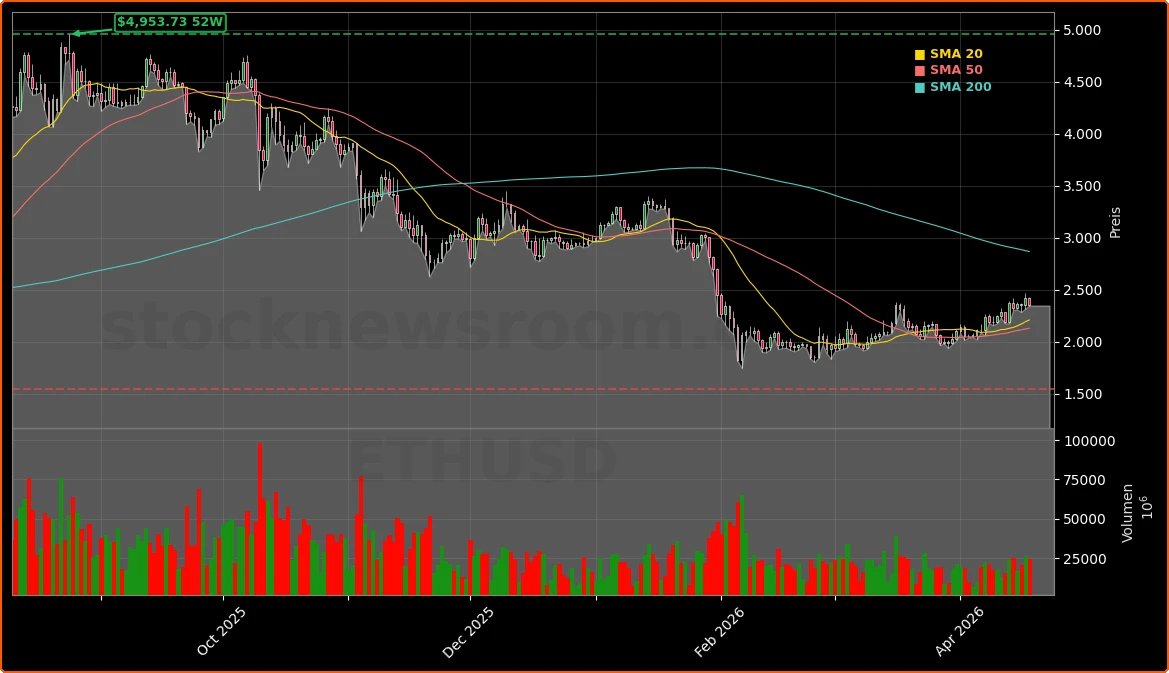
From a late‑March low near $1,937, ETH has rallied more than 17% at the recent peak around $2,466 before today’s pullback to $2,356.70. While that level is still far below the all‑time high around $4,955 reached in 2025, the move marks a notable recovery leg. For U.S. investors who typically benchmark against the S&P 500 or Nasdaq, Ethereum’s short‑term performance is again rivaling high‑beta tech names such as NVIDIA or Tesla, albeit with far greater volatility.
This Ethereum Market Analysis suggests macro conditions are no longer the primary headwind; instead, positioning, technical levels and adoption trends are taking center stage in the near term.
Are whales signaling renewed confidence?
On‑chain flows show a sharp divergence between large and small holders. One “mystery whale” address recently withdrew 32,007 ETH—roughly $77.5 million—from Binance after first sending about $225 million in USDC to several major derivatives and spot venues. At the same time, the number of Ethereum wallets holding at least 100,000 ETH has climbed from 54 to 57, underscoring renewed accumulation by deep‑pocketed players.
In contrast, smaller retail addresses holding 0.01 ETH or less have collectively dumped around 1,791 ETH (about $4.2 million) over the last two days. Some short‑term traders label the recent bounce a potential bull trap, especially after Ethereum’s roughly 10% gain over the past month. One leveraged trader running large BTC and ETH short positions is reportedly down more than $15.5 million as prices moved against those bearish bets.
For U.S. investors accustomed to watching institutional flows in mega‑caps like Apple, this pattern in Ethereum resembles classic “smart money vs. weak hands” behavior: whales accumulate on weakness while smaller traders sell into strength. That divergence is a central element in this Ethereum Market Analysis, hinting that downside supply could be drying up even as price action chops sideways.
Ethereum Market Analysis: what do the charts say?
Technically, Ethereum has broken above a key resistance zone near $2,385, which had capped prices multiple times since February. That level formed the upper boundary of a large ascending triangle pattern. A recent close above $2,385 turned that zone into short‑term support, invalidating a prior sell signal from the TD Sequential indicator that had triggered a correction on the last approach to $2,400.
With that resistance now flipped to support, some technicians see an immediate upside target near $2,721, representing at least 12% further upside from current levels if momentum resumes. A larger measured move from the triangle projects toward roughly $2,900. However, this constructive setup holds only as long as ETH stays above the $2,385 support. A decisive break back below that line would likely revive bearish sentiment and could confirm the bull‑trap fears voiced by short‑term traders.
For investors used to charting growth names on the Nasdaq, the structure is familiar: a long consolidation, breakout over a clearly defined ceiling, then a test of the new floor. This Ethereum Market Analysis therefore places $2,385 as the pivot level U.S. traders should watch most closely in coming sessions.
How does Schwab change U.S. retail access?
Another key development for market structure comes from Charles Schwab. The brokerage giant, which oversees about $12.2 trillion in client assets, is preparing to roll out spot Bitcoin and Ethereum trading for retail customers via Paxos, charging around 75 basis points per transaction. That move could meaningfully expand direct access to ETH for U.S. households who until now have primarily used ETFs, trusts or third‑party crypto apps.
For American investors already active in equities or options, Schwab’s integration should lower the friction of adding a modest ETH allocation alongside traditional holdings. It also positions Ethereum more clearly as a mainstream alternative asset, similar to how gold ETFs broadened access to bullion for equity investors. While no major Wall Street banks like Goldman Sachs, Citigroup or Morgan Stanley have issued fresh public ratings on ETH itself, multi‑asset strategists have increasingly framed leading smart‑contract platforms as high‑risk, high‑reward complements to tech and AI themes.
Institutional vehicles are adapting as well. The Grayscale Ethereum Staking ETF has introduced “delayed delivery orders” to better manage on‑chain liquidity when large redemptions occur, and it is migrating to a new CoinDesk Ether Benchmark Rate designed to improve price accuracy and reduce manipulation risk. Those steps aim to make Ethereum exposure via regulated products more resilient for RIAs and hedge funds operating on Wall Street.
What does this mean for long-term adoption?
Beyond short‑term trading, Ethereum remains the dominant smart‑contract network underpinning decentralized finance, NFTs and an expanding Web3 application stack. Research from large digital‑asset managers highlights Ethereum and other smart‑contract platforms as core infrastructure for Web3, with revenue streams based on transaction fees and staking yields rather than traditional advertising or hardware sales seen at companies like NVIDIA or Apple.
Despite a 40%–50% drawdown from prior peaks and bouts of “crypto winter” rhetoric, some institutional strategists argue that the current environment is more akin to a mid‑cycle reset than the start of a long, grinding bear market. For diversified portfolios, that view frames recent weakness as a potential long‑term entry point rather than a reason to exit entirely.
In this Ethereum Market Analysis, the intersection of whale accumulation, improving technicals, new brokerage access via Schwab and evolving ETF infrastructure suggests the ecosystem is quietly strengthening beneath the surface, even as headline prices remain volatile and well below record highs.