

Is Bitcoin’s latest push toward $75,000 the start of a new boom or a fragile rally facing structural and security risks?

Is Bitcoin stuck below a critical ceiling?
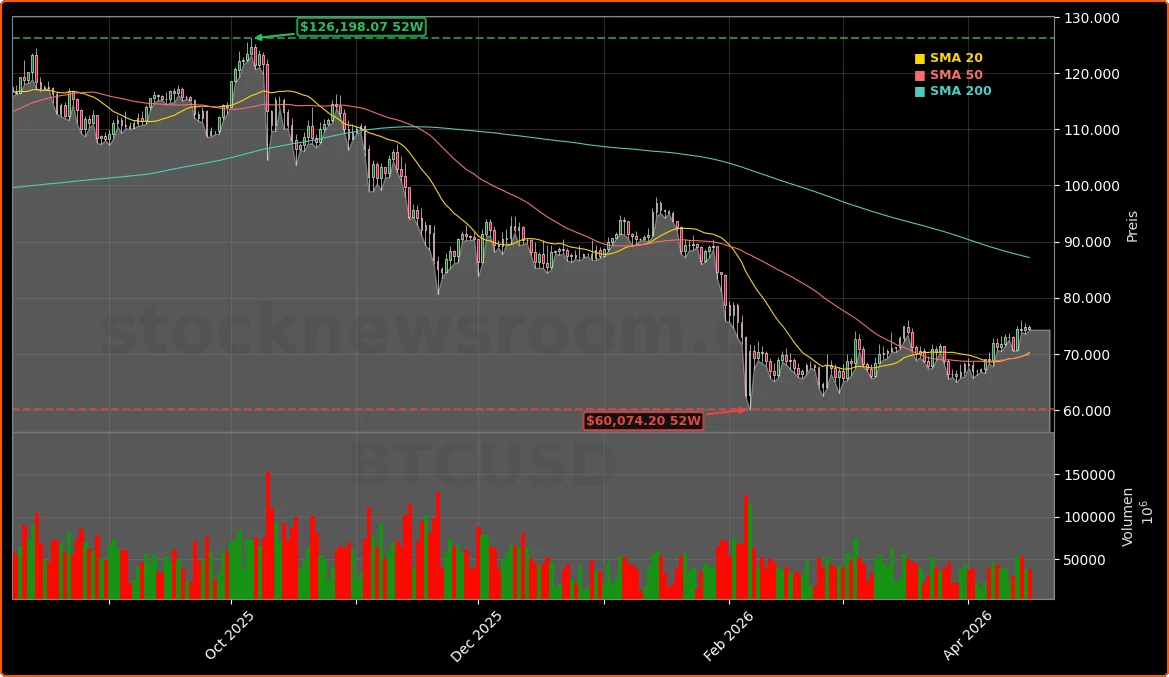
Bitcoin (BTC-USD) is changing hands near $74,478, modestly higher on the day and slightly below Wednesday’s intraday peak above $75,000. On the short-term chart, the coin is trading above $74,000 and its 100-hour simple moving average, signaling that the recent pullback from last week’s high around $76,088 remains a correction within an ongoing uptrend rather than a full reversal.
Technicians are laser-focused on a declining channel with immediate resistance at $75,000 and a stronger barrier around $75,500. A sustained close above $75,500 would likely invite momentum buyers and could open the door to a retest of $76,000, followed by potential pushes toward $77,500 and even $78,000. On the downside, initial support appears around $74,250, with more important zones at $73,650 and $73,300. Below $72,650, bears could attempt to drive prices back toward the major $72,000 support.
The hourly MACD remains in bullish territory and the RSI is holding above 50, indicating that buyers still have the upper hand in the near term. However, as several Wall Street strategists note, Bitcoin has been trading largely sideways since February and is now pressing against the upper edge of this multi-month range. Some analysts frame the recent strength as a possible bear-market rally inside a broader “crypto winter,” while others argue that the market has already carved out a durable floor.
What does this Bitcoin Market Analysis mean for U.S. portfolios?
From a U.S. investor perspective, the current Bitcoin Market Analysis highlights the growing role of institutional capital. Since spot Bitcoin ETFs launched in early 2024, flows from traditional asset managers and hedge funds have become a dominant driver of price action. Derivatives markets now matter almost as much as the underlying spot market, and rising open interest in perpetual futures is amplifying moves near key levels like $75,000.
Meanwhile, crypto-linked equities listed on the NASDAQ and NYSE are riding the same wave. Trading platforms and custody firms have rallied sharply in recent weeks, mirroring Bitcoin’s nearly 10% advance over the past two weeks. This broader participation in risk assets is occurring even as the S&P 500 and NASDAQ remain sensitive to macro headlines such as the evolving U.S.–Iran situation, underlining Bitcoin’s partial decoupling from mega-cap tech stocks like NVIDIA, Tesla and Apple.
For registered investment advisers and family offices, the key takeaway from the latest Bitcoin Market Analysis is the need to distinguish between speculation and strategic allocation. Short-term traders are watching for a daily or weekly close above roughly $76,500–77,000 as a more convincing breakout signal, while longer-term allocators often keep exposure capped at low single-digit portfolio percentages, treating Bitcoin as a high-volatility satellite position rather than a core holding.
How are derivatives platforms shifting market structure?
Beyond Wall Street ETFs, the rapid growth of decentralized derivatives venues is reshaping Bitcoin’s liquidity profile. Hyperliquid, a decentralized perpetual-futures exchange running on its own Layer-1 blockchain, has emerged as one of the largest platforms for Bitcoin perpetual contracts, an area historically dominated by centralized players such as Binance and Coinbase. In 2025, Hyperliquid processed nearly $3 trillion in trading volume, with average daily turnover around $8 billion and peak days reaching $32 billion.
The platform’s token model is also altering incentives. Its Hype token has a fixed maximum supply of 1 billion, with roughly 337 million currently in circulation. Hyperliquid directs 97–99% of all trading fees into an assistance fund that continuously buys Hype tokens on the open market. In 2025 alone, about $716 million was spent on buybacks, removing roughly 3.4% of total supply, and the community recently voted to permanently burn approximately 37 million tokens, around 13% of the circulating float. Weekly burns currently run near $9.2 million worth of Hype.
Institutional interest is following. Grayscale has filed for a spot Hype product under the ticker GHYP on NASDAQ, while Bitwise is pursuing BHYP on NYSE Arca. A SPAC named Hyperliquid Strategies has also filed to raise $1 billion. The bull case is that 24/7 derivatives on crypto, commodities, single stocks and even prediction markets will keep drawing volume. The bear case is that revenues are tightly tied to trading activity and could contract sharply in a prolonged downturn, while regulators may push back against high-leverage products on U.S. equities.
Why is quantum security suddenly in focus?
As Bitcoin flirts with $75,000, a new long-term debate is gaining momentum: how to protect the network against future quantum computers that could, in theory, break current cryptographic signatures. A recently floated proposal, known within the community as BIP-361, sparked pushback because critics feared it might interfere with existing property rights by proactively moving coins deemed at risk.
In response, exchange operator BitMEX has outlined an alternative framework that would only trigger protective actions if a concrete quantum threat is empirically demonstrated. Under that approach, users could continue to move their coins freely until credible evidence emerges that current signatures are vulnerable, at which point a more complex, quantum-safe transition would activate.
For now, most cryptographers believe large-scale quantum attacks remain years away, but the discussion underscores that Bitcoin’s risk profile is not purely macro or regulatory. For institutional investors bound by strict fiduciary standards, having a credible roadmap for quantum resilience could become as important as clarity from the SEC or the outcome of the Clarity Act, which is expected to refine how digital assets and stablecoin yields are treated in the United States.
Tax authorities are also stepping up. The IRS is rolling out Form 1099-DA for digital assets, which will automatically report crypto transactions above certain thresholds. Tax expert Mark Steber emphasizes that even small crypto gains are taxable and that there is no de minimis exemption, bringing Bitcoin closer in treatment to traditional equity trades on the NYSE and NASDAQ.
For U.S. investors, Bitcoin is no longer a fringe speculation but a high-volatility satellite asset whose fate is increasingly tied to institutional flows, regulation and long-term security design.— stocknewsroom.com research desk
In sum, today’s Bitcoin Market Analysis shows a market balanced between an imminent technical breakout and a series of structural shifts, from derivatives and regulation to quantum security planning. For U.S. investors, that means watching the $75,000–$76,000 resistance band just as closely as the evolving rulebook and technology roadmap.