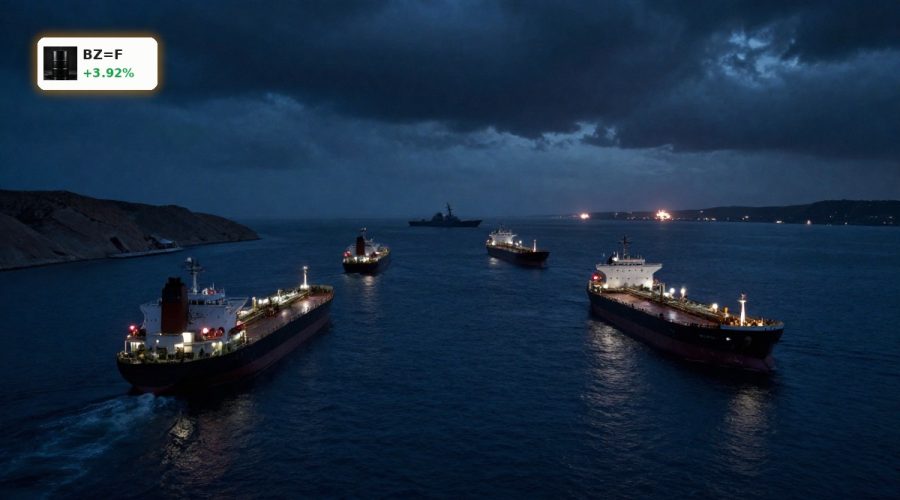
Is the latest Brent Oil Shock a short-lived scare or the start of a new inflation and central bank headache?

How severe is the current Brent Oil Shock?
The latest move caps a wild few sessions for Brent Crude Oil. After headlines on Friday suggested a partial reopening of the Strait of Hormuz, Brent briefly dove toward $84–$86 per barrel, a drop of roughly 10–12% intraday. That optimism evaporated over the weekend as the U.S. Navy seized an Iran-linked cargo vessel and Tehran responded by effectively halting traffic through the narrow choke point, which usually handles about a fifth of global oil flows and around 20% of LNG.
By early Monday, Brent had rebounded sharply, trading in a $94–$96 range after intraday highs near $95. Futures are still below the roughly $100–$102 levels seen before the most recent cease-fire headlines, signaling that traders continue to price in at least some chance of a diplomatic solution. At the same time, the physical market is sending a mixed message: Dated Brent cargoes have slipped to just under $100 per barrel, suggesting that some buyers still expect the supply squeeze to ease later this year.
The spread between Brent and WTI has widened to roughly $7–$8, well above the typical $3–$4 pre-war band. That premium underlines how tightly this Brent Oil Shock is tied to Middle East export risk rather than to North American fundamentals.
What does this mean for Exxon Mobil and Chevron?
For U.S. energy majors like Exxon Mobil and Chevron, the price spike is a double-edged sword. On one hand, a Brent band of $90–$95 significantly boosts upstream cash flows compared with the $70–$80 environment many analysts used in their base cases. JPMorgan’s commodities team, led by Parsley Ong, continues to model an average Brent price of about $90 for 2026, easing to $80 in 2027 and $75 in 2028. In that range, defensive upstream names are seen as having upside risk to consensus EPS estimates and potentially attractive dividend yields in a still‑inflationary backdrop.
On the other hand, sustained high energy prices can trigger demand destruction in later quarters. Several strategists warn that if Brent holds near or above $95 into Q2 and Q3, airlines, shipping lines and heavy industry could start cutting capacity, eventually feeding back into weaker product demand and lower volumes for integrated majors. For now, banks such as Barclays keep a base case around $85 average Brent for this year but caution that a move back toward $100, should the Strait of Hormuz remain shut for weeks, would resurrect fears of higher headline inflation and a more hawkish Federal Reserve.
That in turn matters for growth stocks across the S&P 500 and NASDAQ, including energy-intensive data center plays like NVIDIA and large industrial users such as Apple, where higher power and logistics costs could pressure margins if companies are unable to pass them on to consumers.
Is the Brent Oil Shock already visible in inflation data?
Economists emphasize that the real macro impact of this Brent Oil Shock will only show up with a lag. Many refiners and airlines secured crude and jet fuel several weeks in advance; inventories in the U.S. and Europe were not critically low heading into the crisis. The more immediate effect is psychological: consumer surveys show that roughly two-thirds of Americans already feel strained by higher gasoline prices, with national averages above $4 per gallon, the highest since 2022.
If Brent stabilizes somewhere between $70 and $80 later this year, most central banks could live with slightly higher input costs that nudge inflation but do not crush growth. The bigger risk for Wall Street is a stickier $95–$100 regime amid ongoing disruption in the Gulf. Citigroup and Goldman Sachs both flag that such a scenario would complicate rate-cut plans, particularly for the Fed, by flaring headline CPI just as underlying inflation inches closer to target.
So far, equity markets have taken the spike in stride. Major U.S. indices are flirting with record highs, reflecting hopes that the war is closer to resolution than escalation. But portfolio managers warn that a fresh leg higher in oil—especially toward the $110 area suggested as possible if key Saudi or Iraqi infrastructure is hit—would likely trigger a rotation out of travel, leisure and luxury stocks into energy, defense and select quality tech names, including Tesla and NVIDIA, which are more insulated by structural growth drivers.
How long could the supply disruption last?
The operational reality behind the geopolitics is sobering. Even if Washington and Tehran strike a deal to reopen Hormuz in the coming weeks, engineers note that oil production cannot be ramped back up like a faucet. Wells that have been choked back or shut in can take weeks or months to return to prior output levels, and damaged export infrastructure across the region will need time and capital to repair.
Forecasts for global inventories reflect this lag. Some research desks expect worldwide crude and product stocks to trough near 7.8 billion barrels within the next two months. Even if global supply later exceeds demand by roughly 1 million barrels per day, it could take about a year to rebuild inventories toward 8.2 billion barrels, a level consistent with Brent nearer $75. This structural tightness is a key reason why Bank of America strategist Francisco Blanch argues that the market may be underestimating how long elevated prices could persist after any cease-fire.
For U.S. investors, that argues for keeping an eye not only on pure-play E&Ps and integrated majors but also on second-order beneficiaries such as domestic shale service providers and industrial names leveraged to North American gas, as well as on potential headwinds for fuel-sensitive sectors like airlines, logistics and European chemicals.
Related Coverage: What did the last Brent Oil Shock show?
Investors looking for more context on the broader macro stakes of the current Brent Oil Shock can revisit the earlier analysis in “Brent Oil Crisis Rally: $100+ Surge and Stagflation Warning”. That piece explores how a previous move above $100 raised the specter of stagflation, and why another sustained spike could again pressure both risk assets and central bank policy paths.
Even if the Strait of Hormuz reopens quickly, the physical reality is that oil flows and production will take months, not weeks, to normalize.— Francisco Blanch, Bank of America
The bottom line for now is that the Brent Oil Shock has returned as a central macro variable, with Brent Crude Oil back near the mid‑$90s, physical flows from the Gulf constrained and central banks watching gasoline and diesel prices closely. For U.S. investors, that means reassessing exposure to energy producers, fuel‑sensitive cyclicals and rate‑sensitive growth stocks in tandem rather than in isolation. The next decisive move in the Strait of Hormuz—toward either lasting de-escalation or deeper disruption—will likely determine whether this Brent Oil Shock fades into another buy‑the‑dip opportunity or marks the start of a more persistent regime change in the global oil market.