

Is Bitcoin’s latest surge toward $80,000 the start of a new institutional-led boom or just another volatile head fake?

Is Bitcoin decoupling from Wall Street?
Bitcoin has climbed back toward $79,000 while major equity benchmarks such as the S&P 500 and Nasdaq recently came under pressure, with global stocks losing over $400 billion in market value in a single day. The move underlines Bitcoin’s current role as a high-beta macro asset that can at times diverge from traditional risk sentiment. Since the latest Middle East tensions began, Bitcoin has gained close to 20%, while gold has actually slipped around 10%, flipping the usual narrative of the metal as the primary geopolitical hedge.
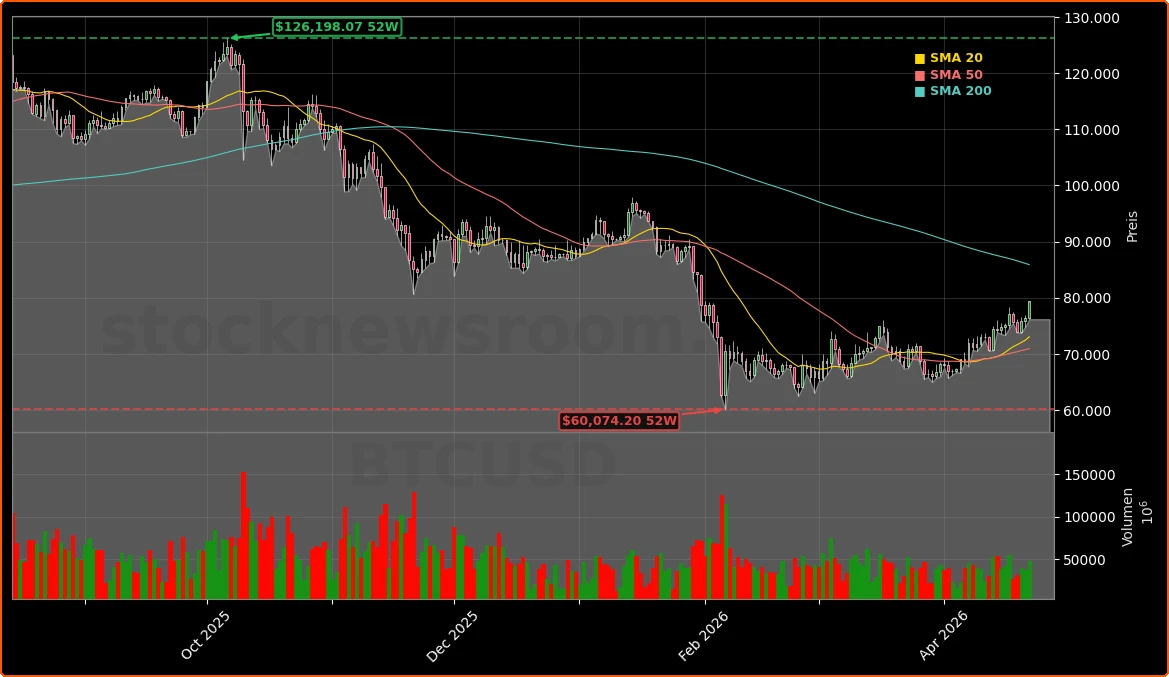
At today’s level near $79,355, Bitcoin remains well below its all-time high near $126,000 set in October 2025, so recent strength is best described as a recovery phase rather than a new record run. Still, technicians highlight the $72,000 zone as a key support area that held during recent volatility, while resistance clusters are forming around $79,000–$80,000. Futures pricing above $79,000 and strong spot action suggest a classic “risk-on” day, with crypto-linked equities such as Coinbase and large miners showing notable intraday gains, even as some brokers like Robinhood have lagged the move.
How critical are BlackRock and ETF flows?
Institutional behavior is once again central to any serious Bitcoin Market Analysis. Asset-management giant BlackRock has reportedly executed its biggest weekly Bitcoin purchase of the year, scooping up more than $900 million worth of BTC within five trading days. That single wave of buying accounted for over 90% of net capital flowing into U.S. Bitcoin ETFs over the same period, reinforcing BlackRock’s status as the world’s largest Bitcoin fund sponsor.
Other corporate treasuries such as MicroStrategy and Metaplanet are also adding to their holdings, contributing to a pronounced drain of available coins on centralized exchanges. Estimates put the current exchange balance at roughly 2.6 million BTC, down as whales and long-term holders continue to accumulate. For U.S. portfolio managers, the message is clear: large, regulated institutions are no longer just experimenting with small allocations – they are deploying meaningful size, which can amplify moves in a relatively illiquid spot market.
On the derivatives side, recent days have seen a balanced rise in both spot and futures volume. Funding rates, which were previously elevated during speculative surges, have turned neutral to slightly negative, signaling that leverage is not excessively skewed to the long side. Several billion dollars in short positions between $76,000 and $78,000 were liquidated as price marched higher, removing a layer of overhead selling pressure in the near term.
Bitcoin Market Analysis: what do the charts say?
From a technical vantage point, Bitcoin is approaching a potentially decisive moment. On the monthly timeframe, Bollinger Bands have compressed to their tightest reading on record, historically a prelude to major volatility expansions. Previous squeezes in 2016, 2020 and again in 2023 preceded bull runs of several hundred percent. The current setup is similar: price is coiling just below resistance between $79,000 and $80,000, with many traders eyeing the next CME futures gap above $80,000 as a logical magnet.
Momentum indicators are also noteworthy. The monthly RSI has pulled back to its lowest level since late 2022, precisely when the last bear-market bottom was formed, while the weekly MACD is close to a bullish crossover. Short-term analysts on Wall Street and in the crypto space are mapping out upside targets at $81,000, then $85,000–$86,000, followed by $93,000–$94,000 if macro conditions cooperate. On the downside, several desks still see an attractive entry zone around $73,000 and, for longer-term limit orders, near $60,000, which research teams such as Grayscale’s have highlighted as a structural support area.
Sentiment data also feed into this Bitcoin Market Analysis. The Crypto Fear & Greed Index has swung from prolonged fear into greed, recently printing around 61. While that indicates rising optimism, it is not yet in the extreme-euphoria territory seen at major cycle tops. Notably, this latest push higher is backed by increasing spot participation instead of purely derivatives-driven spikes, a dynamic that some traders interpret as healthier and more sustainable.
How are regulation and macro shaping demand?
On the policy front, the tone in Washington has become more nuanced. The designated Federal Reserve chair Kevin Walsh has publicly acknowledged that crypto is now effectively part of the U.S. financial system. In parallel, the U.S. Senate is debating a clearer framework for digital assets, with lawmakers emphasizing the need to bring trading activity onshore under existing anti-money-laundering and KYC rules. For Wall Street, regulatory clarity – even if stringent – is often preferable to legal ambiguity, as it allows banks, brokers and asset managers to scale compliant products.
Crypto is also being discussed alongside other scarce assets in institutional portfolios. Some allocators now group Bitcoin with gold and even high-end collectibles as part of a broader “debasement” or inflation-hedge trade. While conservative advisors still recommend small allocations – often around 1% of a diversified portfolio – the trend among growth-oriented family offices and hedge funds is toward gradually higher exposure, particularly when Bitcoin is trading 30–40% below its historical peak.
Because of growing institutional demand and broader adoption, Bitcoin now behaves far more like a durable macro asset than a speculative toy.— Catherine Wood, ARK Invest CEO
At the same time, technology risks are being reassessed. Advisory boards linked to major exchanges like Coinbase have highlighted the long-term threat of quantum computing to existing cryptography, while developers in the Bitcoin and Ethereum ecosystems weigh post-quantum signature schemes. For now, large-scale quantum attacks remain theoretical, and Bitcoin’s core developers continue to favor conservative, battle-tested designs over quick changes that might introduce new vulnerabilities.