

Is Coinbase’s latest 7% slide just volatility or an early warning shot about deeper Coinbase Quantum Risk and regulatory pressure?

How is Coinbase trading after the pullback?
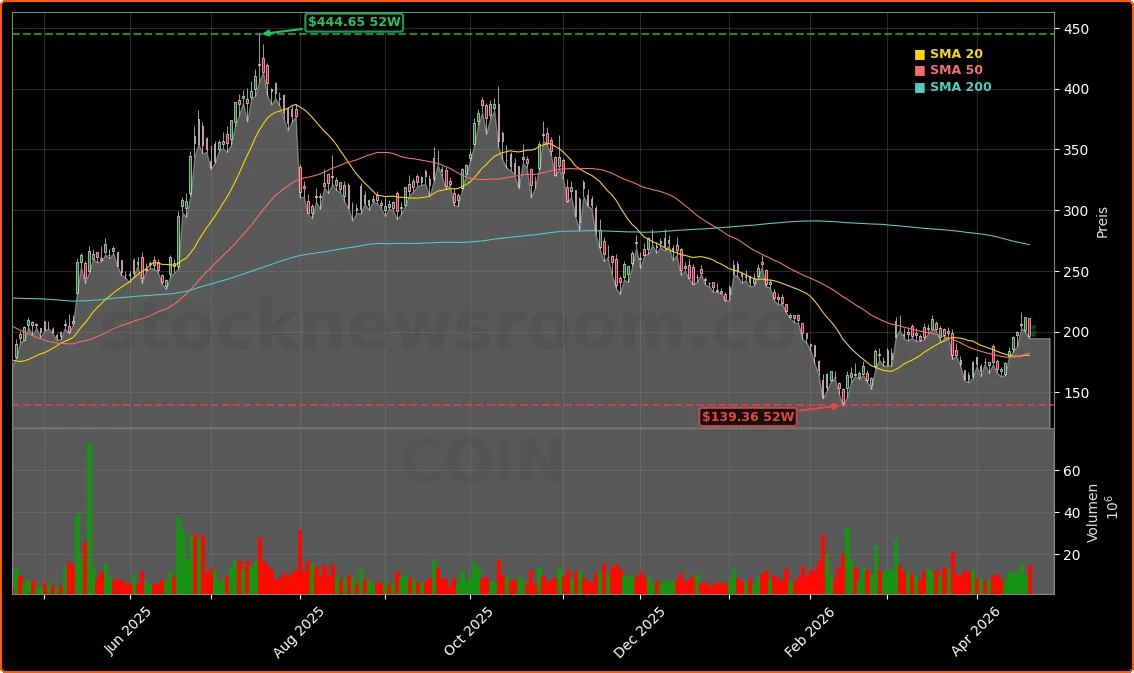
After surging more than 21% in recent sessions, Coinbase Global, Inc. stock dropped 7.41% on Tuesday to close at $195.95, sliding from a prior close of $200.26. In early Wednesday pre-market action, COIN is quoted around $204.55, up roughly 4.4% versus the close, as traders key off another leg higher in Bitcoin and risk assets on Wall Street. The move keeps Coinbase firmly in the high-beta corner of the S&P 500, where crypto-linked stocks often amplify swings in the underlying digital assets.
Options investors are leaning into the volatility. Discount certificates and capped products tied to COIN are positioned for the stock to stay above $155, with some structures targeting potential returns north of 30–40% if that level holds into late 2025. Technically oriented traders see room toward $320 as an upper chart target, while the sell side is more conservative. A consensus of U.S. and global analysts points to an average target around $236, and 23 of 38 analysts currently rate COIN as a “Strong Buy,” underscoring how aggressively the Street is positioned despite regulatory noise.
What does the Coinbase Quantum Risk report say?
The biggest new strategic overhang is Coinbase Quantum Risk, highlighted by an independent advisory board that released a detailed paper on how future quantum computers could threaten today’s crypto infrastructure. The report draws a sharp distinction between Bitcoin and proof-of-stake (PoS) chains like Ethereum and Solana. While Bitcoin’s primary quantum exposure centers on already-revealed public keys, PoS chains face a deeper vulnerability: their consensus mechanisms rely on signature schemes that a sufficiently powerful quantum computer running Shor’s algorithm could, in theory, break.
In Ethereum’s case, compromising about one-third of validators would be enough to prevent the network from finalizing transactions. With control of two-thirds, an attacker could rewrite chain history. The board warns that for PoS ecosystems, “the challenge … isn’t just upgrading wallets; parts of the core consensus mechanism itself may need to be redesigned.” That framing elevates Coinbase Quantum Risk from a niche security debate to a long-term business issue for COIN, which earns trading, staking, and infrastructure fees across multiple chains, not just Bitcoin.
The report stresses that no existing quantum computer can currently execute such attacks. However, it flags a “harvest now, decrypt later” threat, where hostile actors might be stockpiling encrypted traffic or signature data today in anticipation of future quantum capabilities. Coinbase’s leadership has tried to keep the narrative constructive. CEO Brian Armstrong has emphasized that quantum computing is a solvable engineering problem and that the company is already working with major blockchains to define a migration path toward post-quantum cryptography.
Does Coinbase Quantum Risk change the crypto thesis?
For now, Coinbase Quantum Risk is more about timing and capex than imminent existential danger. Large-cap tech names like NVIDIA and Apple have already shown how quickly new computing paradigms—from GPUs to AI accelerators—can shift industry economics. Investors in COIN now have to factor in a similar long-run transition curve in crypto security stacks, one that could reweight value toward platforms that move fastest on post-quantum standards.
Markets reacted cautiously to the advisory board’s hawkish tone. COIN slid roughly 6% on the initial headlines, while other crypto-exposed stocks like Robinhood also fell. Bitcoin itself retreated toward the mid-$70,000s before recovering, and later pushed to an 11‑week high around $78,000 as geopolitical tensions eased and risk sentiment improved. For U.S. investors comparing COIN to crypto-adjacent vehicles—from leveraged ETFs to equity plays like Tesla with its on‑and‑off Bitcoin exposure—the quantum debate may steer incremental flows toward Bitcoin-first narratives and away from PoS-heavy ecosystems if the industry does not deliver a clear post-quantum roadmap.
How serious is the New York lawsuit for Coinbase?
Adding to the complexity, New York Attorney General Letitia James filed suit this week against Coinbase and rival exchange Gemini, arguing that certain prediction-market products amount to illegal gambling under state law. The case lands on top of an already crowded regulatory docket for U.S. digital-asset intermediaries and keeps legal risk front and center for COIN shareholders.
So far, the stock appears more tethered to Bitcoin and macro headlines than to the lawsuit. COIN traded higher in pre-market even after the filing became public, suggesting investors see the products at issue as niche relative to the core spot and derivatives franchises. Still, the complaint reinforces a theme also dogging stablecoin issuer Circle and other regulated players: state and federal authorities are likely to press harder on yield-bearing or quasi-derivative crypto offerings that touch U.S. consumers, especially in New York’s jurisdiction.
Regulatory uncertainty extends to stablecoins themselves, a key revenue engine for Coinbase through trading spreads, interest, and partnership economics. Policy efforts like the Clarity Act and parallel stablecoin bills in Congress could reshape how these tokens are treated—from securities law to banking oversight. Morgan Stanley recently highlighted similar headwinds for Circle, pointing to evolving rules on stablecoin yield, DeFi liability and financial-crime controls. For Coinbase, tighter frameworks may ultimately be a mixed blessing, raising compliance costs but potentially entrenching larger, better-capitalized platforms at the expense of smaller rivals.
Where does this leave Coinbase versus other crypto plays?
Against this backdrop, COIN remains highly leveraged to Bitcoin cycles, much like listed Bitcoin treasuries or funds that mirror the asset’s moves. Recent institutional actions—such as major asset managers accumulating Bitcoin-focused equities and ETFs—underscore how deeply crypto has penetrated mainstream portfolios. But unlike pure Bitcoin vehicles, Coinbase must also juggle operational, legal, and technology-transition risks like Coinbase Quantum Risk and the New York lawsuit.
Management has been working to diversify revenue away from pure trading commissions into subscriptions, custody, staking, and infrastructure services. That should, in theory, reduce volatility over time. Yet many of those newer lines depend heavily on chains like Ethereum and Solana, making the pace of post-quantum upgrades and regulatory clarity on staking and stablecoins critical catalysts for COIN’s multiple. For now, Wall Street’s “Strong Buy” skew and targets well above the current $190s suggest investors remain willing to underwrite those uncertainties in exchange for high-growth, crypto‑beta exposure.
Related Coverage
Investors looking for more context on Coinbase’s volatility-linked strategy can read how the stock has tried to monetize swings in digital assets in Coinbase Crypto Strategy +5.7%: Volatility-Fueled Rally, which examines whether COIN can turn turbulence into a stable business model. For a broader view of regulatory and ecosystem shifts in crypto, the piece Ripple Expansion Boom: $3B Bet and Buybacks Rattle XRP dives into how Ripple’s M&A and buyback push is reshaping XRP’s outlook and what that might signal for cross-border payments competitors.
In the end, Coinbase Quantum Risk, the Bitcoin rally, and the New York lawsuit together highlight how COIN sits at the crossroads of technology disruption, market momentum, and regulatory experimentation. For U.S. investors, the stock remains a leveraged play on the institutionalization of crypto, but one that demands close attention to security standards and legal developments. The next major test will be whether Coinbase can turn quantum planning and legal headwinds into a competitive edge before rivals like Apple-style fintech entrants or AI‑driven platforms narrow the field.