
Is Robinhood’s $75 million OpenAI bet the catalyst that turns its AI narrative into a full-blown stock market surge?

How big is the Robinhood OpenAI Investment move?
Robinhood Ventures Fund I disclosed that it closed the Robinhood OpenAI Investment on April 17, purchasing approximately $75 million of OpenAI common stock. Fund president Sarah Pinto called OpenAI “one of the frontier artificial intelligence companies” and said the position is among RVI’s largest to date, underscoring the strategy of concentrating capital in what the team views as transformative private businesses.
RVI only began trading on the NYSE in early March, giving retail investors a liquid vehicle for exposure to a curated basket of late‑stage private tech names. The portfolio already includes Databricks, Revolut, Ramp, Oura and others, alongside previously highlighted stakes in fintech leaders that compete with or complement public‑market heavyweights like NVIDIA and Apple in the AI and data ecosystem. With OpenAI now in the mix, the fund is directly tethered to one of the most closely watched engines of generative AI development.
For OpenAI, the new shareholder is small compared with multibillion‑dollar rounds from Big Tech partners, but the symbolism is significant: for the first time, everyday traders using the Robinhood app can get indirect exposure to OpenAI’s equity via a listed fund rather than waiting for a traditional IPO that may still be years away.
What does this mean for Robinhood’s stock story?
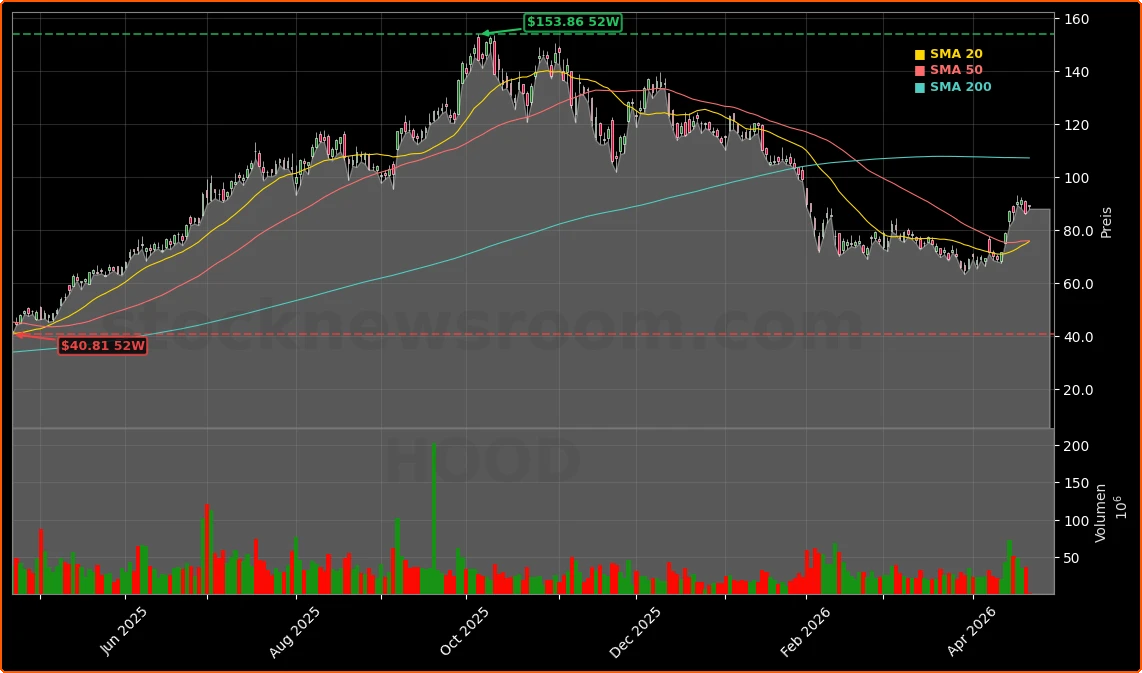
The Robinhood OpenAI Investment lands amid a volatile but improving backdrop for HOOD. The stock recently printed around $89.06, up about 3.15% versus Tuesday’s close of $88.47, and more than 40% above levels seen a month ago. Robinhood’s internal momentum score has surged as well, helped by stronger trading engagement and a regulatory tailwind from the U.S. Securities and Exchange Commission’s decision to scrap the long‑standing $25,000 pattern day‑trader equity requirement.
That SEC shift replaces rigid activity caps with real‑time, risk‑based margin rules and is widely expected to increase trading frequency among smaller accounts—the core constituency on Robinhood’s platform. More activity typically supports net interest and order‑flow revenues, even as the company pushes deeper into products like banking, retirement accounts and prediction markets that generate more recurring income.
Analyst opinion on HOOD remains divided. Piper Sandler continues to rate the shares “Buy,” pointing to Robinhood’s user growth and product expansion, while Louis Navellier’s service at Yahoo Finance recently cut the name from “Strong” to “Neutral” in its stock‑grader framework, reflecting concerns about volatility and valuation after the run‑up. Other Wall Street firms, including several with price targets between $100 and $135, still see upside if Robinhood can sustain revenue growth and execute on its super‑app ambitions.
How does RVI expand access to private markets?
Historically, exposure to late‑stage private companies like OpenAI, Databricks or Revolut was reserved for venture capital funds, large institutions and ultra‑high‑net‑worth investors. RVI is designed to chip away at that barrier. The closed‑end fund has no accreditation requirements and no investment minimums, charges a conventional management fee but no performance fees, and trades throughout the day on the NYSE like any other stock or ETF.
Pinto highlighted a structural shift in U.S. capital markets: the number of listed domestic companies has fallen from roughly 7,000 around 2000 to about 4,000 by 2025, even as the count and value of large private firms have exploded past $10 trillion. Companies are staying private longer, raising bigger funding rounds and delaying their NASDAQ or NYSE debuts. The Robinhood OpenAI Investment is framed as a way to plug retail investors back into that growth pool without waiting for a traditional IPO window to reopen.
For Robinhood Markets, Inc., RVI is also a strategic adjacency. It extends the brand’s “democratize finance” narrative beyond zero‑commission trading into the opaque realm of private equity, positioning the firm against incumbents that might otherwise dominate this space through institutional feeder funds and high‑minimum vehicles.
How does this fit into Robinhood’s AI and product roadmap?
Even before the Robinhood OpenAI Investment, the company had been leaning into AI‑linked themes. Management has talked up new AI initiatives inside the brokerage and banking app, including personalization and risk tools, at the same time as it builds out a sizable prediction‑markets business that reached an annualized revenue run‑rate above $100 million in late 2025. Those markets, which allow users to trade on event outcomes, have attracted both enthusiasm and criticism, but they position Robinhood at the intersection of fintech, data and probabilistic forecasting.
Beyond AI, Robinhood is progressing on its super‑app strategy. It already offers stocks, options and crypto, alongside checking and savings, debit cards, retirement accounts and a fast‑growing Robinhood Gold subscription, which climbed to about 4.2 million members by Q4 2025. Banking deposits have surpassed $1.5 billion, and the firm has won marquee mandates such as the so‑called “Trump Accounts” for tax‑deferred children’s investments, in partnership with BNY Mellon. High‑profile investors like Cathie Wood’s ARK Invest have been adding to HOOD positions even as some insiders, including co‑founder Baiju Bhatt, trim holdings through pre‑planned selling programs.
Competitively, Robinhood continues to battle full‑service brokers such as Charles Schwab and upstarts like SoFi Technologies, while operating in an AI‑obsessed market where names tied to infrastructure, from NVIDIA to Tesla, remain retail favorites. By surfacing OpenAI inside RVI’s portfolio, the company is effectively offering its users another AI exposure lever alongside traditional chip and cloud plays.
Related Coverage: What else is moving HOOD?
For a deeper dive into Robinhood’s regulatory backdrop and how it affects the trading narrative, readers can look at Robinhood Regulation: +4.5% Rally After SEC Shock Move. That analysis explains how the SEC’s surprise overhaul of day‑trading rules helped ignite a sharp rally in HOOD and why the market is re‑rating the stock’s growth prospects in light of higher expected retail activity.
As one of RVI’s largest investments to date, this underscores our core mission to provide everyday investors with access to what we believe are transformative companies shaping the future.— Sarah Pinto, President, Robinhood Ventures Fund I
The Robinhood OpenAI Investment highlights how aggressively the company is trying to extend its reach into AI and private markets while its core brokerage benefits from regulatory tailwinds and product expansion. For investors, HOOD is becoming a leveraged bet not only on U.S. retail trading but also on access to hard‑to‑reach growth stories like OpenAI via RVI. The next few quarters will show whether this strategy translates into sustained earnings momentum and justifies the premium valuation that is starting to build again around the name.