
Can Alphabet’s upgraded Google Cloud AI Strategy turn agentic AI, custom TPUs and a $750 million partner fund into lasting profit growth?

How is Google Cloud AI Strategy reshaping growth?
For equity investors, the upgraded Google Cloud AI Strategy is about turning AI hype into durable, high‑margin revenue. At Cloud Next ’26, Google Cloud introduced the Gemini Enterprise Agent Platform, designed to let enterprises build, deploy and govern autonomous AI agents across complex workflows. Management is positioning agentic AI as the next leg of cloud growth, aiming to deepen wallet share with existing customers rather than relying solely on headline compute consumption.
Enterprise adoption is already visible. Merck is committing up to $1 billion over multiple years to deploy an agentic platform across R&D, manufacturing and commercial operations. McKinsey, BCG and Deloitte are all standing up dedicated Gemini Enterprise and agentic transformation practices, signaling that blue‑chip advisory firms intend to push clients toward Google’s stack as they scale beyond pilots.
On the customer side, retailers like Home Depot and Ulta Beauty are using Gemini Enterprise for Customer Experience to power AI phone agents and shopping assistants, while Mars and Valeo are rolling Gemini Enterprise and Gemini for Workspace to tens of thousands of employees. This breadth of use cases – from automotive engineering to beauty e‑commerce – is central to the Google Cloud AI Strategy narrative that Gemini is not just a consumer chatbot but a horizontal enterprise platform.
Can Alphabet challenge Nvidia with new TPUs?
Cloud Next ’26 also underscored Alphabet’s ambitions at the silicon layer. Google unveiled its eighth‑generation tensor processing units, splitting the line into TPU 8t for training and TPU 8i for inference. The TPU 8t delivers roughly three times the performance of last year’s Ironwood generation for training workloads, while 8i is tuned to run inference at scale. This dual‑chip approach is designed to push performance per watt and lower total cost of ownership, directly addressing a key strength of NVIDIA’s current GPU lineup.
Crucially, Google plans to license TPU designs to external AI players, including Anthropic and Meta Platforms, a shift from a purely in‑house advantage to an IP‑driven revenue stream. Wells Fargo projects that TPU intellectual property licensing alone could generate more than $10 billion in high‑margin revenue across 2026 and 2027, which would be material even for a near‑$4 trillion company. The strategy complements earlier moves into custom silicon detailed in Alphabet’s AI chips push, including its collaboration with Marvell, as discussed in Alphabet AI Chips Boom: Custom TPUs and Marvell Deal Shake Up Nvidia.
For Wall Street, the question is whether Alphabet can convert TPU efficiency and IP licensing into sustained operating margin expansion within Google Cloud, especially as AI infrastructure capex remains elevated across the S&P 500’s tech heavyweights.
What role do partners play in Google Cloud AI Strategy?
A defining element of the Google Cloud AI Strategy is the ecosystem. Google Cloud announced a new $750 million fund aimed at global consulting firms, systems integrators, software vendors and channel partners to accelerate agentic AI development and education. The capital will support AI value assessments, Gemini proofs‑of‑concept, agentic AI prototyping and deployment, as well as embedded forward‑deployed engineers working alongside partners such as Deloitte, Accenture and TCS.
In parallel, Google Cloud struck a broad partnership with Vista Equity Partners to streamline access to its AI stack for more than 90 Vista portfolio companies. This should create a long runway of AI projects embedded in mission‑critical enterprise software used by millions of end customers. Other ecosystem wins include NetApp’s deepening role in Google’s air‑gapped AI cloud and Zscaler’s recognition as Google Cloud Partner of the Year for security in the application category, signaling strength in storage and cybersecurity around Gemini workloads.
On the application side, SiriusXM Media became the exclusive U.S. audio advertising representative for YouTube’s audio inventory, highlighting how Google is monetizing AI‑driven content discovery and ad targeting beyond traditional display. At the same time, Ulta Beauty is embedding agentic commerce into Search’s AI Mode and the Gemini app, tightening the integration between consumer search, conversational AI and transaction completion.
How does Alphabet stack up against Big Tech rivals?
For U.S. investors, the competitive context is critical. Microsoft and Amazon remain powerful in cloud AI, but Alphabet is leaning on its end‑to‑end stack—TPUs, Gemini models, data, security via Wiz and an expanding agent platform—to defend and grow Google Cloud’s share. The Google Cloud AI Strategy increasingly emphasizes agents that can execute multi‑step business tasks, a space where all three hyperscalers are racing to set standards.
On the consumer side, reports that Apple will rely on Google’s cloud‑based Gemini models to enhance Siri highlight how powerful Google’s data‑intensive cloud AI has become, even for a company that historically prioritized on‑device privacy. That cooperation could give Alphabet incremental high‑margin cloud and licensing revenue while exposing its models to hundreds of millions of additional users.
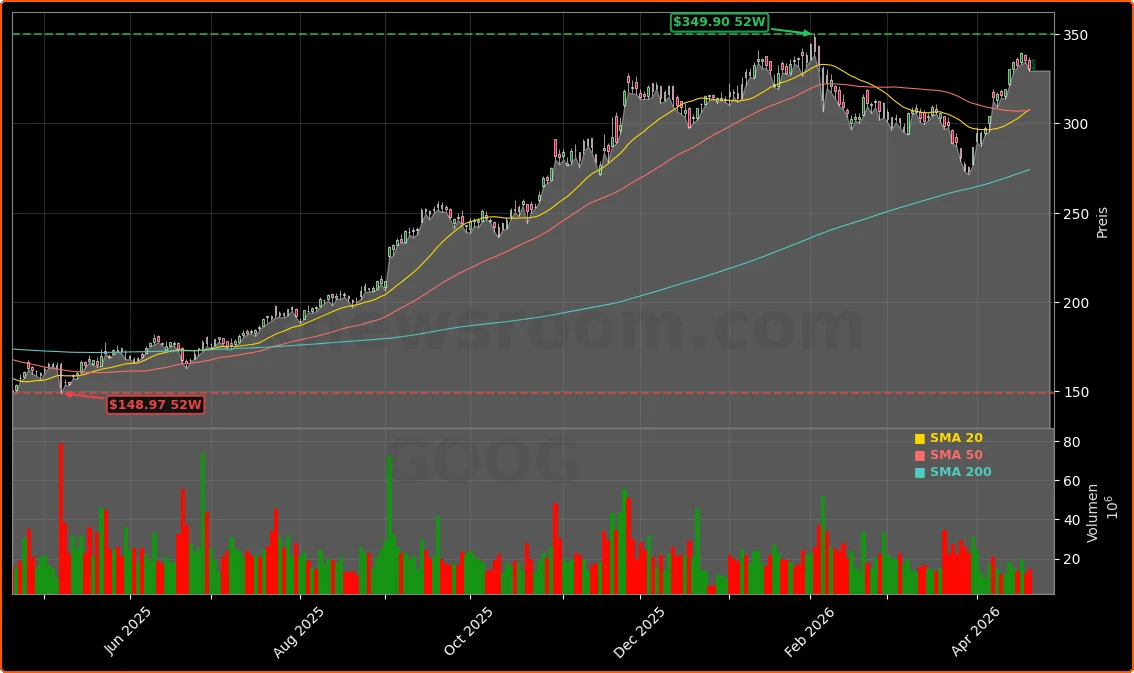
From a market perspective, GOOG has gained nearly 8% year to date after a 65% rally in 2025, and still carries a strong buy skew among major brokerages. MarketBeat data show institutional investors such as AssetMark increasing positions, while outlets like The Globe and Mail continue to cite Alphabet and Amazon as core ways to play the long‑term NASDAQ AI rally. Technical services point to a constructive setup ahead of Q1 2026 earnings on April 29, though the stock’s proximity to a 349 technical entry leaves limited room for error if AI monetization disappoints.
Related Coverage
Investors who want to dive deeper into Alphabet’s silicon roadmap can read Alphabet AI Chips Boom: Custom TPUs and Marvell Deal Shake Up Nvidia, which explores how custom TPUs and a collaboration with Marvell could quietly rewrite cloud AI economics and challenge NVIDIA’s dominance. Together with today’s Cloud Next ’26 announcements, that piece helps frame how Alphabet is building a vertically integrated AI stack from chips to agents.
In sum, the upgraded Google Cloud AI Strategy links custom TPUs, the Gemini Enterprise Agent Platform and a large partner fund into a coherent growth story that reaches from infrastructure to end‑user applications. For long‑term investors in Alphabet Inc. (Google), the next few quarters will show whether this AI pivot can translate into faster cloud growth and margin expansion versus Microsoft and Amazon, while potential upside from Apple and other ecosystem deals adds an additional layer of optionality.