Can Alphabet’s AI strategy outrun Meta’s ad momentum while turning Google Cloud into a true profit engine for investors?

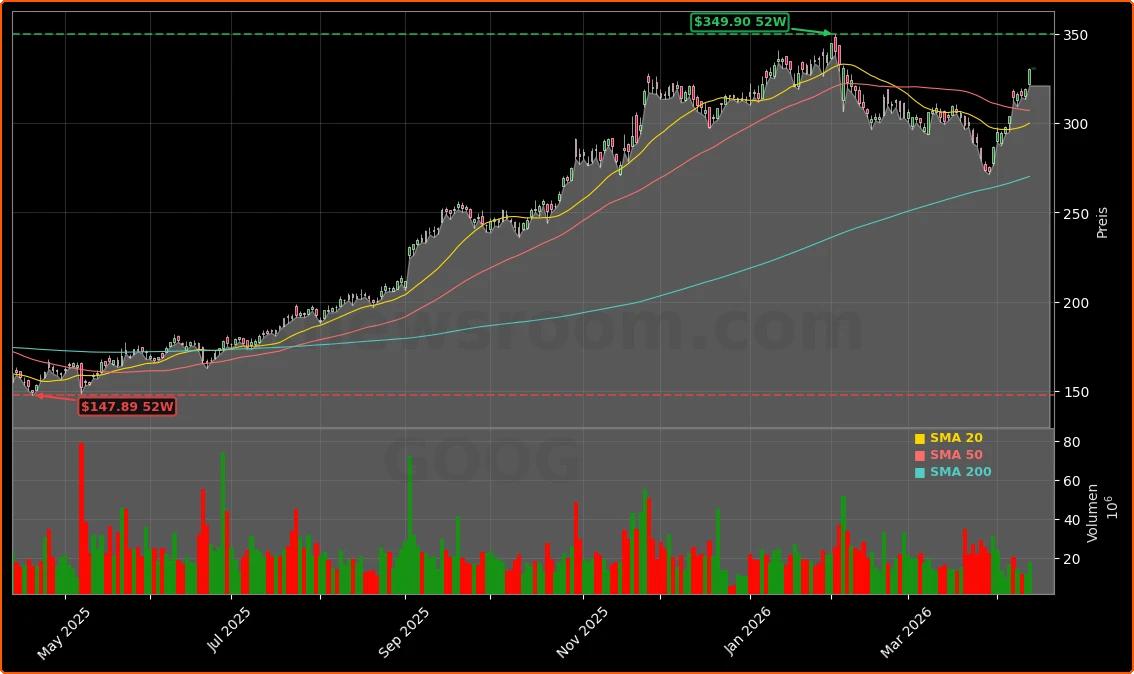
Alphabet Inc. (Google) – Meta-Druck im Werbegeschaeft und neue AI-Partnerschaften has suddenly become a sharper Wall Street story. Alphabet’s Class C shares closed at $330.58 on Tuesday, up 3.56%, with modest after-hours gains, while Class A finished at $332.91, up 3.63%. Those moves come just weeks before the April 29 earnings report and against a backdrop of intensifying AI competition and fresh institutional inflows into the stock.
Is Meta closing the ad revenue gap?
The biggest medium-term risk to Alphabet AI Strategy is emerging in digital advertising, where Meta is growing materially faster. Industry forecasts now project Meta’s ad revenue to reach about $243 billion by 2026 versus roughly $240 billion for Google, implying that Meta could overtake Google in global digital ad sales within two years. Meta’s expected ad growth of about 24% dwarfs Google’s roughly 12% pace, suggesting the shift is structural, not cyclical.
Rather than attacking search directly, Meta is leaning on AI-heavy automation and discovery. Its Advantage+ tools simplify campaign setup and optimization, while new ad placements across WhatsApp, Threads and short-form Reels video are pulling performance budgets earlier in the consumer funnel—before anyone types a Google query. For Alphabet, that means even if search remains dominant for intent-driven advertising, more demand creation is being captured elsewhere, putting a ceiling on growth in its core ad engine.
This adds a new dimension to the long-running rivalry between Alphabet and Meta, alongside AI infrastructure competition from NVIDIA and end-device ecosystems led by Apple. It also raises the bar for how quickly Alphabet can infuse generative AI and automation into its own ad products without undermining user experience or regulatory commitments.
How is Citigroup framing Alphabet AI Strategy?
Despite the mounting Meta threat, Wall Street’s sell-side remains broadly constructive on Alphabet AI Strategy. Citigroup on Tuesday raised its price target from $390 to $405 and placed Alphabet on a 90-day “catalyst watch,” signaling expectations for positive surprises around the upcoming earnings release and potential product upgrades. With the stock in the low-$330s, Citi’s target implies healthy double-digit upside if execution holds.
Other institutional signals have been supportive as well. Recent 13F filings show firms such as Robinhood Asset Management and South Shore Capital Advisors initiating or increasing positions in Alphabet during Q4, even as some managers like Nexus Investment Management trimmed stakes to lock in gains. MarketBeat data indicates a consensus “Buy” rating with an average target in the mid-$340s, while several large banks have nudged targets into the $375–$400 range in recent weeks.
Still, not all commentary is bullish. Some investors remain wary of heavy AI-related capex and ongoing U.S. and European antitrust scrutiny, both of which could pressure margins and constrain the pace of new monetization. For now, however, the market appears willing to finance Alphabet AI Strategy on the back of strong cash flows from search, YouTube and Google Network properties.
Can Google Cloud turn AI into a profit engine?
One key pillar of Alphabet AI Strategy is converting Google Cloud from a growth segment into a durable profit center. Cloud already contributed nearly 15% of Alphabet’s operating income in the last reported quarter, and the unit is increasingly a showcase for Gemini models, Vertex AI and custom Tensor Processing Units (TPUs). New AI partnerships are reinforcing that narrative.
GitLab just announced an expanded collaboration with Google Cloud, enabling enterprises to run GitLab Duo Agent Platform on Vertex AI—including Gemini models—while keeping all agent actions under GitLab’s existing compliance and audit controls. Customers can count this usage toward their existing Google Cloud commitments, effectively deepening wallet share without adding procurement friction. GitLab’s AI Gateway can also run on Google Cloud runtimes like GKE and Cloud Run, making Google infrastructure the default home for agentic DevSecOps workflows.
Separately, leading AI startup Anthropic has agreed to buy computing capacity built on Google’s TPUs. That deal not only validates Google’s in-house accelerators against GPUs from NVIDIA, but also opens the door to a broader ecosystem of AI-native customers using Google Cloud as a lower-cost, tightly integrated alternative in the generative AI race.
What risks still hang over Alphabet?
Even as Alphabet AI Strategy gains traction in cloud and infrastructure, investors cannot ignore lingering overhangs. Antitrust cases in search and digital advertising remain a wild card for long-term business model flexibility, while regulators globally are scrutinizing concentration in both data and AI infrastructure. At the same time, heavy AI capex—estimated by some market watchers to run well into the hundreds of billions of dollars across the industry—could weigh on near-term free cash flow.
There are also competitive uncertainties in “Other Bets” such as Waymo, where cost and scaling pressure from autonomous driving rivals, including Tesla, complicate the path to profitability. If Meta continues to claw share in digital ads and hyperscale AI customers diversify across multiple clouds, Alphabet will need to prove that its integrated stack—from Gemini and Vertex AI to TPUs and Android devices via partners like Apple—offers a defensible economic moat.
Related Coverage
For a deeper look at Alphabet’s legal backdrop, including recent antitrust tensions and how they might affect investor sentiment, see Alphabet Lawsuit -3.1% Shock: Is This Just the Start?, which explores whether recent litigation could be the opening shot in a broader campaign against Big Tech.
To understand how rival hyperscale ecosystems are using AI partnerships to reshape data center spending patterns, read Broadcom Meta Partnership Boom: AI Data Center Surge, which examines how Meta’s work with Broadcom may influence the competitive environment for chips and cloud providers across the NASDAQ and S&P 500.
In the end, Alphabet AI Strategy is being tested from multiple angles: Meta’s accelerating AI ads, rising capex and regulatory heat on one side, and promising cloud, TPU and Vertex AI partnerships on the other. For U.S. and global investors, the stock remains a high-conviction AI platform play, but one that now demands closer attention to execution in ads and cloud alike. The upcoming April 29 earnings report and subsequent AI product updates will be the next major checkpoint for whether Alphabet can keep its money machine humming while building the next generation of AI-driven growth.