
Can the Glamsterdam Ethereum Upgrade and surging ETF inflows turn today’s recovery into the next major leg of the crypto cycle?

Is Ethereum outpacing the broader market?
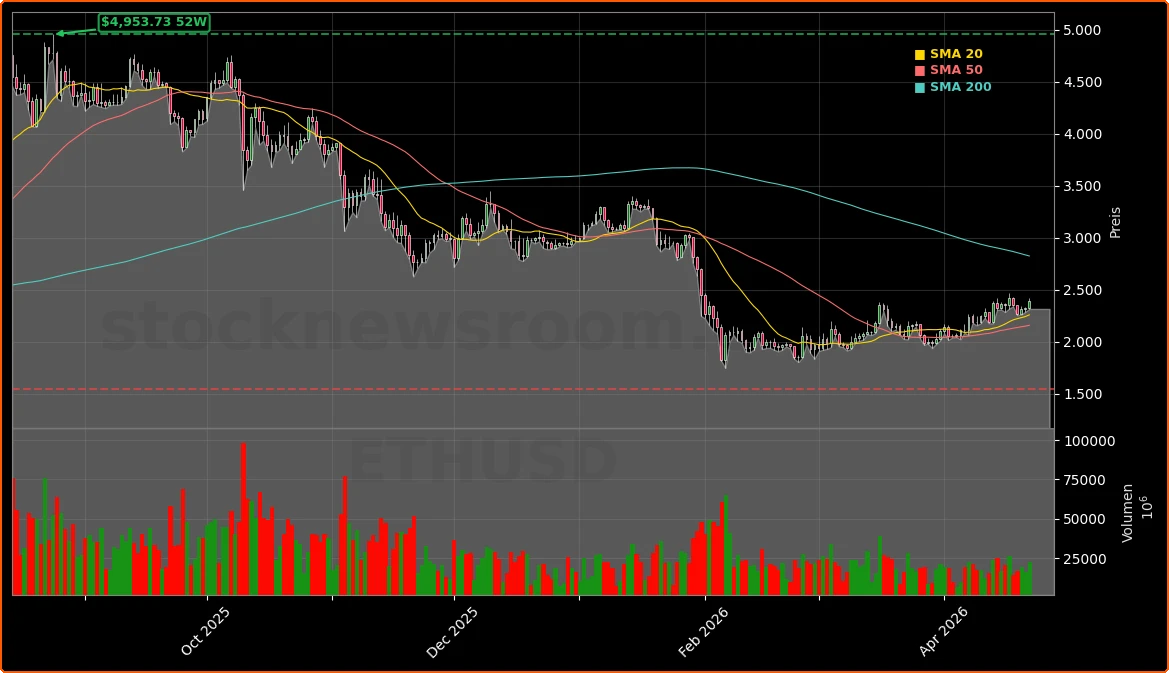
Ethereum (ETHUSD) traded at about $2,395 on Wednesday afternoon ET, up roughly 4.2% from the prior close near $2,328. Over the past month the token has gained around 12%, and on a 12‑month view it is ahead by more than 47%, handily outperforming the S&P 500. Since its early‑February lows, ETH has rallied roughly 40%, helping it reclaim ground lost during last year’s crypto volatility. Still, today’s price remains far below the all‑time high around $4,953 set in 2025, underscoring that this is a recovery phase rather than a blow‑off top.
Compared with Bitcoin, recent trading in Ethereum has been less volatile, with narrower intraday ranges and a steadier trend. Derivatives activity currently outweighs spot volumes, a sign that short‑term traders are dominant and that pullbacks toward psychological levels such as $2,000 remain possible. Technically, chart analysts are watching resistance near $2,400–$2,500: a sustained breakout could open room toward $3,300, while failure there might invite a consolidation phase.
For diversified US portfolios that already hold growth equities like NVIDIA or Apple, the recent stabilization of ETHUSD is important. Correlations between mega‑cap tech and major crypto assets have risen at times, meaning allocation decisions in one risk bucket can affect the other. As crypto slowly institutionalizes via regulated products, Ethereum’s behavior increasingly matters alongside NASDAQ heavyweights.
What makes the Glamsterdam Ethereum Upgrade critical?
The coming Glamsterdam Ethereum Upgrade is widely viewed as the next major technical milestone for the network. It centers on two changes: “enshrined proposer‑builder separation” (ePBS) and “block‑level access lists” (BALs). Today, 80–90% of Ethereum blocks are assembled via off‑chain relay systems such as MEV‑Boost, which introduces centralization and trust risks. ePBS moves that separation directly into the protocol, enabling trustless on‑chain payments between block builders and proposers and reducing the role of external intermediaries.
Block‑level access lists, meanwhile, define in advance which accounts and storage slots a block will touch. That transparency allows for more parallel execution of transactions on Ethereum’s base layer, with long‑term ambitions of scaling Layer‑1 throughput toward the five‑figure transactions‑per‑second range. For use cases such as tokenized Treasurys, stablecoins and decentralized finance, this kind of performance and predictability is a prerequisite for broader institutional adoption.
However, the Ethereum Upgrade is far from trivial. Coordinating two distinct roles inside the consensus mechanism remains the main bottleneck flagged by core developers, and Glamsterdam’s H1 2026 target is ambitious. Any material delay or design rollback could dent market confidence, particularly if competing smart‑contract chains or Layer‑2 networks manage to scale faster. For US investors used to evaluating software roadmaps at firms like Tesla or large cloud providers, this upgrade carries similar execution risk, but in a public, open‑source setting.
How strong are ETF inflows and institutional demand?
While developers focus on the protocol, Wall Street is watching flows. Spot Ethereum ETFs have attracted more than $11 billion in cumulative inflows through March, signaling that pension funds, RIAs and family offices are gradually adding ETH exposure via regulated wrappers rather than direct token custody. In recent weeks, those products have booked multiple consecutive days of net inflows, even as price action remained choppy.
Strategists such as Tom Lee highlight that Ethereum has outperformed the S&P 500 by more than 2,000 basis points since the onset of the latest geopolitical tensions, arguing that it behaves increasingly like a high‑beta growth asset with distinct secular drivers. Among those drivers: the tokenization of real‑world assets, where Ethereum reportedly hosts more than 60% of on‑chain tokenized securities, funds and money‑market instruments, as well as the potential use of public blockchains as settlement layers for autonomous AI agents.
So far, large US banks such as Citigroup, Goldman Sachs and Morgan Stanley have focused their published crypto research primarily on Bitcoin, but they increasingly reference Ethereum when discussing tokenization and smart‑contract infrastructure. Where rating language appears, it tends to frame ETH as a higher‑risk satellite allocation rather than a core holding, analogous to an early‑stage growth stock in a diversified equity portfolio.
What are the key risks and upside scenarios for ETHUSD?
From a risk perspective, traders highlight the dominance of derivatives over spot activity, suggesting that liquidations can amplify short‑term moves in ETHUSD. A failure of the Glamsterdam Ethereum Upgrade to ship on time, or any security incident around the new ePBS design, would likely weigh heavily on sentiment. Regulatory setbacks around US‑listed Ethereum ETFs could also slow institutional inflows, particularly if the SEC revisits its stance on staking or classification questions.
On the upside, technical analysts see a constructive base forming above $2,000. A clear break and hold above the $2,400–$2,500 band could pave the way toward $3,300 and, in a more optimistic scenario, the $5,000 area over the medium term. Longer‑term bulls point to potential five‑digit prices if tokenization and on‑chain finance grow into multi‑trillion‑dollar markets, though such projections involve substantial uncertainty.
For US investors already exposed to high‑growth tech via NVIDIA and Apple, small Ethereum positions via spot ETFs or regulated funds can act as a targeted bet on the broader smart‑contract and tokenization theme. Position sizing and risk controls remain crucial: crypto is still far more volatile than blue‑chip equities, and sharp drawdowns are part of the asset class.
In sum, the Glamsterdam Ethereum Upgrade and persistent ETF inflows are pulling Ethereum back into focus just as the network’s real‑world use cases expand. For diversified portfolios, ETH is evolving from a purely speculative token into a programmable infrastructure play with clear execution risks. The next few quarters, and the successful rollout of the Ethereum Upgrade, will be decisive in showing whether ETHUSD can convert its technological lead into sustained price performance.