

Is Bitcoin’s latest consolidation just a pause before another institutional-driven surge, or the calm before a painful reset?

Is Bitcoin’s latest rally running out of steam?
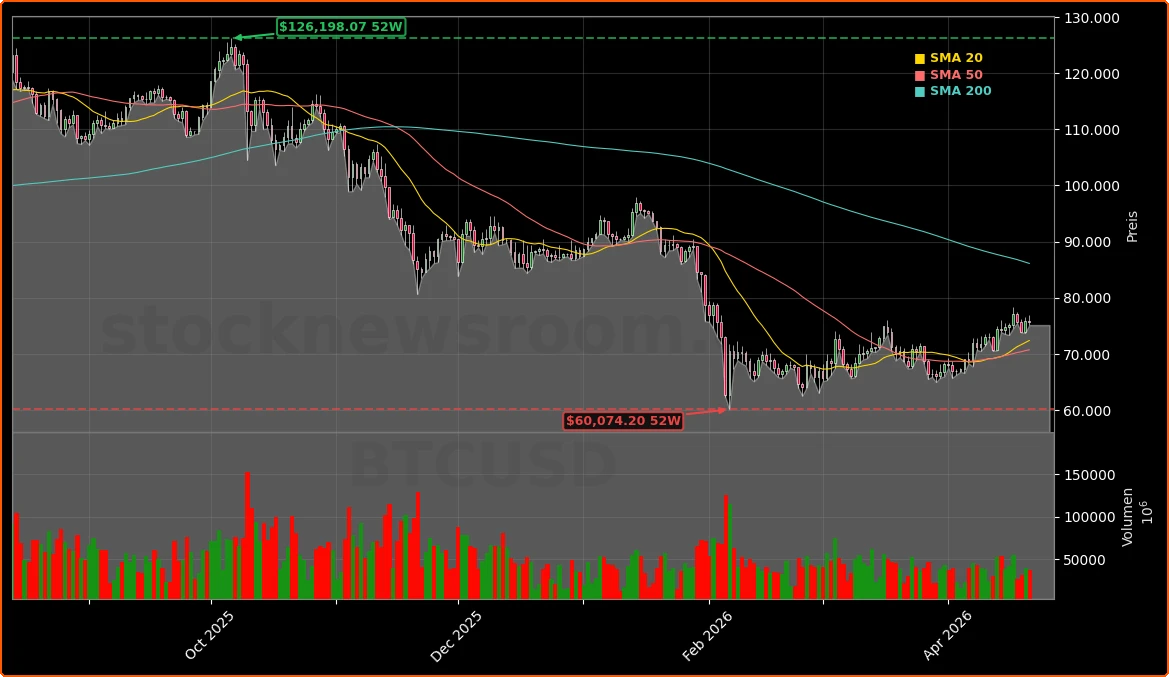
Bitcoin (BTC-USD) trades near $75,584, down about 1.15% from the previous close of $75,886, after a sharp rebound of roughly 17% off its March 20 low. Price action has been locked for more than two months in a wide range between roughly $60,000 and $75,000, echoing earlier consolidation phases that preceded major upside legs. Technically, several on-chain and momentum indicators point to the early stages of a new advance rather than a topping pattern.
A key focus of this Bitcoin Market Analysis is profitability metrics. The Spent Output Profit Ratio (SOPR) recently rebounded from depressed levels near 0.62 in February to roughly 2.9, historically a sign that capitulation has passed and profitable coins are again changing hands. Net Unrealized Profit/Loss (NUPL) has flipped back into positive territory for the first time since early January, a structure that previously aligned with the early innings of Bitcoin bull markets. However, cost-basis data shows a dense cluster of holdings around $84,000, suggesting heavy overhead supply if the price retests that zone.
Short term, resistance resides first in the $76,000–$78,000 band, where the market’s true mean price sits, and then near $84,000, which also coincides with an open CME futures gap. A decisive daily close above $78,000 would strengthen the case that buyers are firmly in control and could open a path toward filling that $84,000 gap. For now, the spot price remains about 12–15% below those potential resistance levels, leaving room for both trend continuation and sharp pullbacks.
How are BlackRock and Strategy Inc. reshaping supply?
Institutional accumulation is at the core of the current Bitcoin Market Analysis. Strategy Inc., the software firm formerly known as MicroStrategy, has become the largest single corporate holder of Bitcoin, amassing around 815,061 coins after aggressive April purchases. That stash now exceeds the roughly 806,000 Bitcoin held across BlackRock’s spot ETF products. Strategy has financed these acquisitions with about $8.25 billion of convertible bonds, carrying an unusually low weighted average interest rate near 0.42% and maturities out to 2032, effectively transforming the company into a leveraged Bitcoin proxy.
BlackRock, meanwhile, has added more than 3,300 Bitcoin recently, bringing its ETF holdings to around $61 billion at current prices. Farside Investors data shows nine consecutive days of inflows into BlackRock’s products this month, part of a broader tide that saw U.S. spot Bitcoin ETFs pull in over $1 billion just last week. Cumulatively, these funds rank among the most successful ETF launches in Wall Street history, and their steady demand has become a key driver of market structure.
When combined with Strategy’s hoard, long-dormant holdings such as Satoshi Nakamoto’s estimated 1 million coins and several million lost coins, the free float available to new investors is shrinking. In Q1 2026 alone, corporations bought roughly 69,000 Bitcoin, governments added 25,000 and funds and ETFs accumulated about 3,000, while mainly retail wallets were on the sell side. That classic transfer from “weak hands” to “strong hands” is typically associated with late bear-market or early bull-market phases.
What does this mean for U.S. portfolios and tech correlation?
For American investors, Bitcoin is now firmly treated as an established asset class rather than a fringe speculation. Major Wall Street firms including BlackRock, Morgan Stanley and JPMorgan are reportedly comfortable with allocations of up to 7% for aggressive clients, a striking jump from the once-standard 1% starter position. Charles Schwab is preparing to offer spot Bitcoin and Ethereum trading, and has floated allocation bands of about 2–3% for moderate-risk and up to roughly 6–7% for more aggressive profiles.
Yet Bitcoin has lost much of its former diversification appeal. Correlations with high-growth tech stocks on the NASDAQ and megacap names such as NVIDIA, Tesla and Apple have risen, turning the coin into what some traders call a “levered NASDAQ.” In risk-off episodes driven by geopolitics or higher rates, Bitcoin can now behave more like a high-beta tech stock than a pure macro hedge. Even so, performance in recent crises has been notable: the asset posted double-digit percentage gains around the U.S.–Iran confrontations, the COVID shock and the 2023 U.S. regional banking turmoil, often outpacing gold.
For portfolio construction, the key question is whether Bitcoin can still improve risk-adjusted returns. With spot ETFs offering simple access inside brokerage and retirement accounts, the barrier to entry has dropped significantly. If correlations stay elevated, investors may treat Bitcoin less as an uncorrelated hedge and more as a tactical growth satellite alongside high-conviction tech positions.
How do regulation and scandals affect risk?
Regulatory momentum is another pillar of this Bitcoin Market Analysis. On Capitol Hill, stablecoins and yield distribution are hot topics; the proposed GENIUS Act would effectively ban yield-bearing stablecoins from paying interest directly to retail users, forcing that income to remain with institutions. At the same time, candidates for critical posts, including potential Fed chair Kevin Warsh, openly hold significant crypto stakes, signaling that digital assets are already woven into the fabric of U.S. finance and will likely receive more nuanced oversight rather than blanket hostility.
However, the sector’s growing legitimacy has not eliminated old vulnerabilities. In Poland, crypto exchange Zonda Crypto is under intense scrutiny after on-chain data indicated nearly empty hot wallets and the CEO admitted that about 4,500 Bitcoin allegedly held in cold storage are controlled by a vanished former owner. Separately, a U.S. investor recently lost around $424,000 (6 Bitcoin) by entering private keys into a fake hardware-wallet app distributed via a mainstream app store, highlighting that even sophisticated users remain exposed to phishing and wallet-drain attacks.
Digital assets are already part of the fabric of the U.S. financial services industry, and policy now has to catch up with that reality.— Kevin Warsh, Federal Reserve chair nominee
Cyber risk is escalating further as advanced AI tools emerge that can automatically scan for and exploit software vulnerabilities, a threat that hits smaller crypto firms and decentralized apps especially hard. For U.S. investors, these episodes underscore the importance of counterparty selection, hardware security and basic hygiene such as never entering seed phrases into browsers or unverified apps.