
Will UniCredit’s escalating stake force a Commerzbank Merger, or can Berlin and management hold the line on independence?

Is UniCredit tightening its grip on Commerzbank?
UniCredit has lifted its direct equity stake in Commerzbank AG to about 26.77%, up from roughly 26%. When financial instruments such as total return swaps are included, the Italian group now controls access to around 32.64% of voting rights, effectively pushing it over the 30% threshold that normally triggers a mandatory takeover offer in Germany. UniCredit plans a shareholder vote in early May on a capital increase designed to finance a formal bid, underlining that it is prepared to commit serious firepower to a potential Commerzbank Merger.
Despite the rising ownership, the German government and Commerzbank’s board have repeatedly rejected the idea of losing independence to an Italian acquirer. Berlin remains a key player with a significant stake following the financial crisis, and any Commerzbank Merger would be politically sensitive given the bank’s role in financing Germany’s Mittelstand. For now, the official line from both the federal government and the current management is clear: they want a stand‑alone strategy, not a sale.
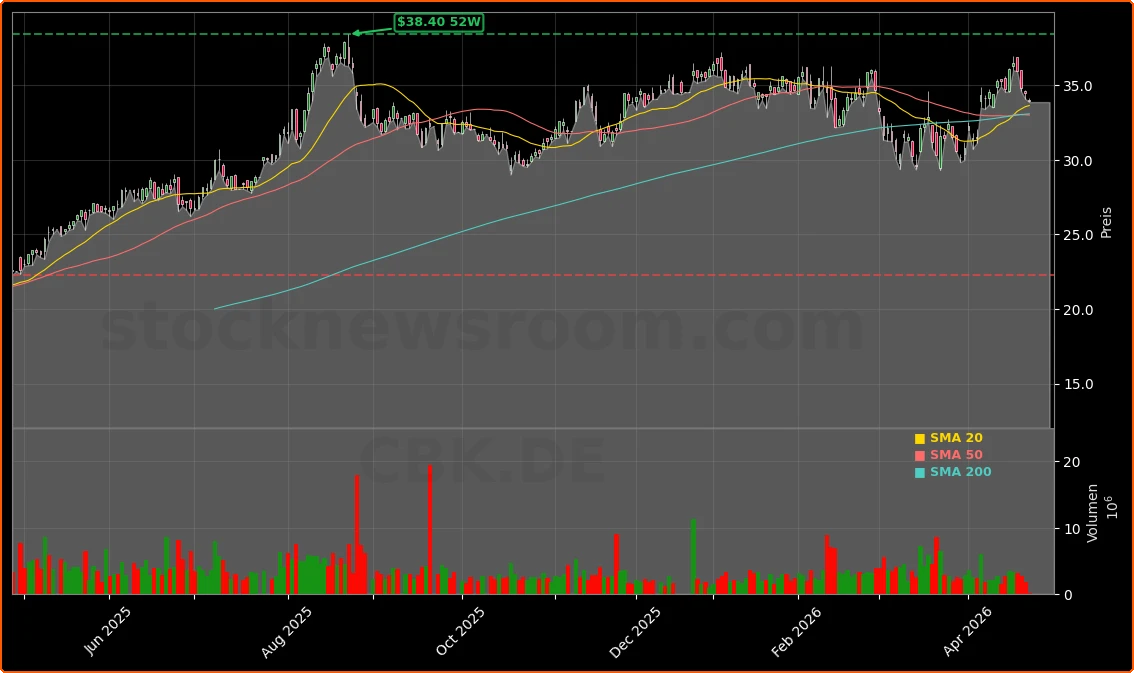
In the market, Commerzbank shares trade around EUR 33.90, off about 1.65% from the previous close of EUR 34.52. The stock has already priced in a substantial takeover premium over pre‑UniCredit levels, which leaves less margin for error if the Commerzbank Merger thesis stalls or regulators slow the process.
How is Commerzbank positioning against UniCredit?
New CEO Bettina Orlopp is trying to convince shareholders that an independent Commerzbank can deliver higher long‑term value than a tie‑up with UniCredit. As part of an updated strategy through 2030, management has flagged additional cost cuts and a likely further reduction in headcount on top of previously announced measures. Earlier, the bank outlined plans to cut about 3,900 full‑time positions, largely in Germany, while adding roles abroad to keep total staff roughly stable at around 36,700.
Labor representatives acknowledge that more savings and some extra job cuts are likely if Commerzbank remains stand‑alone, but they argue the scale would be considerably smaller than under UniCredit ownership. UniCredit CEO Andrea Orcel has sketched out a restructuring plan that aims to slash Commerzbank’s cost base by EUR 1.3 billion by 2028, implying around 7,000 full‑time job losses in Germany alone. Works council head Sascha Uebel warns that, once foreign branches and subsidiaries such as ComTS and CDS are included, more than 10,000 roles could ultimately be at risk.
For US investors familiar with aggressive integration stories at banks like NVIDIA’s acquisition targets in tech or post‑merger cost programs at large US lenders, UniCredit’s playbook looks familiar: front‑loaded restructuring, heavy job cuts, and a push for higher returns on equity. But German unions and politicians are already signaling that they will fight a Commerzbank Merger that repeats the deep cuts seen after UniCredit acquired HypoVereinsbank in 2005, when the German workforce shrank far beyond the initial promises.
What does the Commerzbank Merger battle mean for global investors?
For international portfolios, the Commerzbank Merger saga is part of a broader theme: Europe’s fragmented banking market is under pressure to consolidate, even as regulators remain cautious and national governments defend domestic champions. Unlike large US banks, many European lenders still operate with sub‑scale national footprints and overlapping branch networks. A UniCredit‑Commerzbank combination could, in theory, create a stronger pan‑European competitor and unlock efficiency gains, similar to rationalizations seen after mergers in the US regional banking space.
Yet the path is far from clear. The German state’s influence, the power of labor councils, and the European Central Bank’s supervisory role all inject uncertainty. Investors holding diversified financials exposure via ETFs alongside large US names like Apple or Tesla should view Commerzbank as a high‑beta satellite bet on European banking reform rather than a core holding. Volatility is likely to remain elevated as UniCredit presses its case and Berlin works to defend its industrial policy priorities.
Valuation is another open question. With the stock already reflecting a sizable control premium, incremental upside from here may depend on UniCredit either improving the terms of any voluntary offer or demonstrating that synergies could justify a richer price without eroding capital ratios. On the downside, a failed Commerzbank Merger could lead to a derating back toward standalone fundamentals if investors lose faith in the 2030 strategy or if cost reductions fall short.
How does Commerzbank stack up against US and EU peers?
From a US perspective, Commerzbank sits well outside the S&P 500 and NASDAQ megacap universe dominated by NVIDIA and other growth names, but the bank is relevant for investors seeking diversification into European financials. While major US banks have largely completed their post‑crisis restructuring, continental European lenders are still catching up on digitalization, cost efficiency, and capital return. A successful Commerzbank Merger could accelerate this process and potentially raise sector valuations, particularly if it leads to higher payout ratios or share buybacks over time.
So far, large Wall Street houses such as Goldman Sachs, Morgan Stanley, and Citigroup have not issued fresh, high‑profile rating changes specifically on the latest takeover moves, but the stock has generally sat in a mixed analyst camp with both buy and hold recommendations across the Street. For investors used to clear US‑style guidance and capital return frameworks, the key risk is less about near‑term earnings and more about regulatory and political intervention that can abruptly change the trajectory of any deal.
For now, the market is trading the situation like a live event: each new filing from UniCredit, each comment from Berlin, and every update from Orlopp’s team on job cuts or strategic targets can move the share price quickly. That makes timing and position sizing critical for US investors looking to play the Commerzbank Merger story from abroad.
We are preparing for further savings as an independent institution, but I am firmly convinced these will be far lower than under a UniCredit takeover.— Sascha Uebel, Commerzbank works council chief
In conclusion, the Commerzbank Merger showdown has become a rare, high‑profile cross‑border banking drama in the eurozone, pitting UniCredit’s consolidation push against German political and labor resistance. For investors, the stock offers potential upside if a value‑creating deal emerges, but it also carries meaningful headline and execution risk. The next strategic updates in early May and any formal offer terms from UniCredit will be key catalysts to watch for those considering exposure to Commerzbank now.