
Is the Arm Holdings Chip Selloff just a temporary semiconductor wobble, or a warning that AI valuations have finally gone too far?

What triggered the Arm Holdings Chip Selloff?
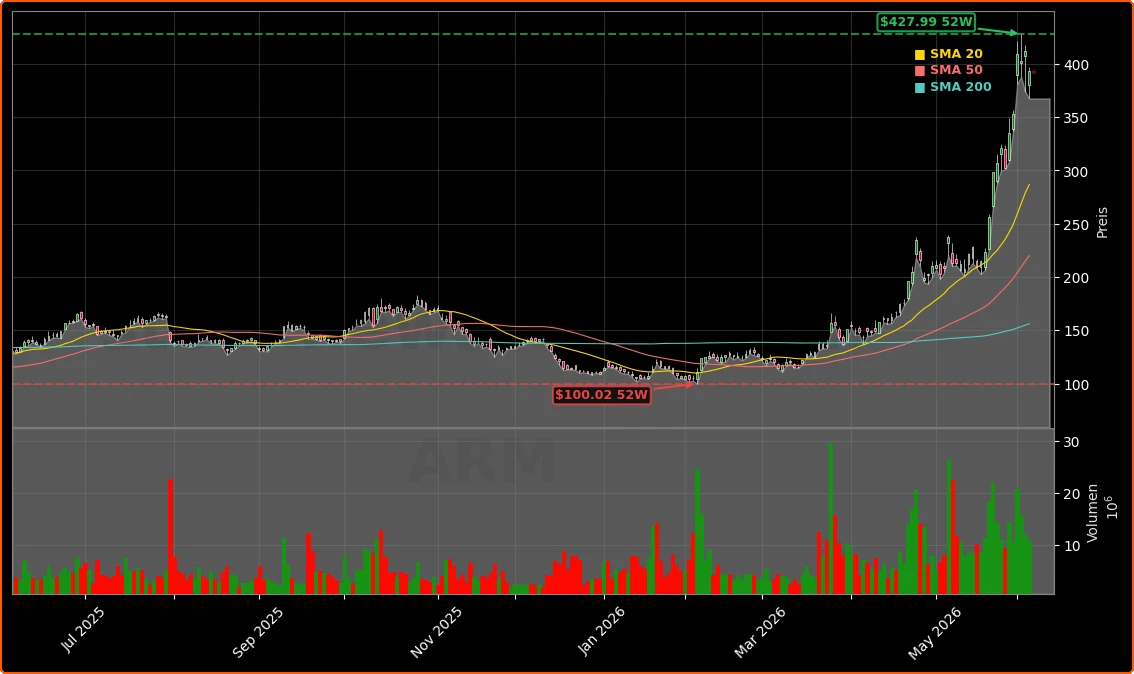
Arm Holdings plc fell sharply in after-hours trading Thursday, down 4.47% to $390.95 — its steepest single-session decline since March. The move followed a broader semiconductor sell-off ignited by weakness in Broadcom, whose shares declined more than 5% premarket. Arm Holdings plc, Marvell Technology, Micron Technology, and Advanced Micro Devices all slid more than 4% in tandem. Analysts at RBC Capital Markets noted the episode reflects ‘contagion risk in the AI infrastructure stack,’ where valuation sensitivity now outweighs near-term catalysts. The selloff occurred despite Arm’s continued leadership in AI-optimized Armv9 licensing and its recently announced role in Nvidia’s new Windows PC AI chip — a design built on Arm’s architecture and expected to boost royalty revenue starting in late 2026.
How does this compare to peers like NVIDIA and Intel?
While NVIDIA rose 2.67% on its Computex AI chip announcement, Arm Holdings plc’s reaction highlights the divergent risk profiles across the AI hardware chain. NVIDIA trades at 23x forward earnings and 13x sales — multiples far below Arm Holdings plc’s 337x forward earnings and 74x forward sales. Intel and Advanced Micro Devices face mounting competitive pressure not just from Arm Holdings plc’s data center gains, but from its expanding footprint in Windows PCs — a market historically dominated by x86 architecture. Citigroup analysts recently downgraded Arm Holdings plc to ‘Neutral’ citing ‘unsustainable multiple expansion,’ while maintaining ‘Buy’ ratings on both Intel and AMD given their improving AI chip roadmaps and more attractive valuations.
Is Arm’s growth story still intact?
Yes — but growth alone no longer shields Arm Holdings plc from market discipline. Fiscal 2026 revenue rose 23% year-over-year, and data center revenue more than doubled in Q4 — evidence of accelerating adoption among hyperscalers. Arm’s royalty model remains exceptionally resilient: over 99% of smartphones use Arm-based chips, and its licensing agreements with Apple, Qualcomm, and MediaTek now include AI-specific royalty clauses. Yet the Arm Holdings Chip Selloff signals that Wall Street is recalibrating expectations. Morgan Stanley analysts emphasized that ‘Arm’s structural advantage is unchallenged, but its current valuation demands flawless execution across multiple new markets — including PCs, automotive, and sovereign AI infrastructure — all within the next 12 months.’
What do earnings and guidance say about sustainability?
Fiscal 2026 results — which concluded in March 2026 — showed net income growth of 14% and revenue growth of 23%. While strong, that marked a deceleration from fiscal 2025’s 159% net income surge. Analysts project 28% revenue CAGR and 49% net income CAGR from fiscal 2026 to fiscal 2029 — but those forecasts assume continued hyperscaler adoption and successful expansion into Windows PCs. The Arm Holdings Chip Selloff suggests investors may be pricing in increasing execution risk. Bloomberg reports indicate that several large-cap mutual funds trimmed positions in Arm Holdings plc during May, citing ‘crowded trade dynamics’ and ‘limited margin for error in guidance delivery.’
What’s next for Arm Holdings plc on Wall Street?
Arm Holdings plc now faces a pivotal test: proving it can convert architectural dominance into consistent earnings growth — not just licensing spikes. Its next catalyst arrives in late July with Q1 2026 earnings, where data center royalty metrics and PC-related design wins will be closely watched. The Arm Holdings Chip Selloff may present a tactical entry point for long-term investors, but only if the company reaffirms its 2027 licensing pipeline and delivers clarity on Windows PC ramp timing. For now, the selloff serves as a stark reminder that even the most foundational AI enablers are not immune to valuation corrections — especially when trading at multiples dwarfing those of NVIDIA and Tesla.
Arm’s structural advantage is unchallenged, but its current valuation demands flawless execution across multiple new markets — including PCs, automotive, and sovereign AI infrastructure — all within the next 12 months.— Morgan Stanley analysts
Related Coverage: For deeper analysis of how Arm Holdings plc is navigating the agentic AI wave while balancing investor expectations, see Arm Holdings AI Strategy: $15B AI Boom Meets Stock Volatility.