
Is the AMD Plunge just overdue profit-taking after a massive AI run, or the first real warning sign for chip investors?

What triggered the AMD Plunge?
The AMD Plunge was part of a coordinated unwind of the so-called ‘Parabolic 7’ — a high-flying semiconductor basket identified by Highline Asset Management and spotlighted by Bloomberg. Advanced Micro Devices joined Micron, Broadcom, Intel, and Marvell in steep declines, with the Philadelphia Semiconductor Index plunging 5.6%. Rising Treasury yields and profit-taking after outsized gains were the dominant catalysts — not earnings revisions or product setbacks. Futures for the S&P 500 and NASDAQ both dipped ahead of the open, confirming a macro-driven pullback rather than a fundamental reversal.
How does AMD compare to NVIDIA and peers?
While NVIDIA fell 5.27% and Intel dropped 6.1%, AMD’s 9.34% loss was among the steepest — underscoring its higher beta and stretched valuation. At 57.24x forward P/E, AMD trades well above the sector average of 26.69 and significantly higher than NVIDIA (23.75x) and Broadcom (31.56x). Barclays recently raised AMD’s price target to $665 and reiterated its Overweight rating, citing agentic AI’s demand for server CPUs — a $200 billion market by 2030. TD Cowen lifted its target to $600, and Mizuho to $615. Still, Citigroup analysts caution that current valuations imply peak-cycle expectations through 2030.
Is the AI narrative still intact for AMD?
Yes — but the emphasis is shifting. While NVIDIA dominated the LLM training phase, AMD is now gaining traction in AI inference and agentic workloads, where memory bandwidth and chiplet architecture matter more than raw tensor throughput. Its ROCm software stack has matured, and the company holds two $100+ billion GPU purchase commitments. Crucially, server CPU demand is surging: inference-heavy AI deployments require far more CPUs per GPU than training clusters. CEO Lisa Su’s leadership has propelled AMD past $500 billion in market cap — a milestone reflecting structural gains, not just momentum.
What do technical indicators say?
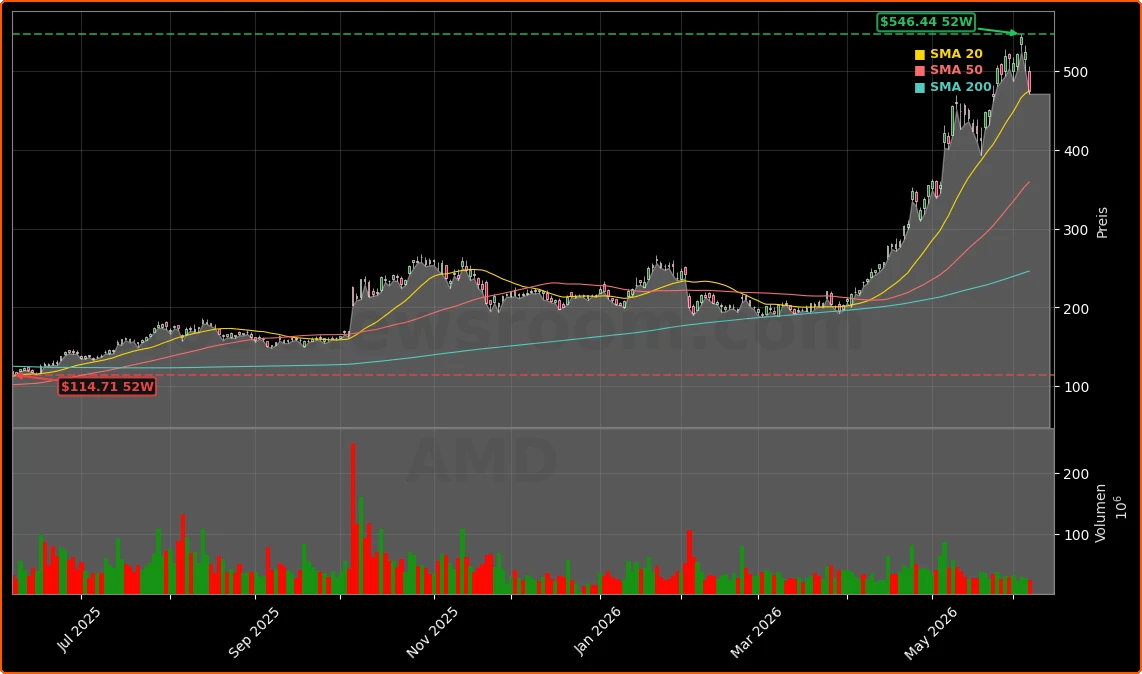
Despite Friday’s sharp drop, AMD remains in a powerful long-term uptrend: it trades 108% above its 200-day moving average ($244.47) and 8% above its 20-day SMA ($471.04). However, the relative strength index at 70.63 signals overbought conditions — consistent with a healthy consolidation after a parabolic run. Key support now sits at $471.04, while resistance remains at the 52-week high of $546.44. The stock gapped down from $514.15, and early intraday weakness suggests follow-through selling pressure may test the $460–$465 zone.
What’s next for AMD investors?
Wall Street expects AMD to report Q2 2026 earnings around August 4, forecasting $1.55 per share on $11.28 billion in revenue — up sharply from $0.48 and $7.68 billion a year ago. With the iShares Semiconductor ETF (SOXX) up 99% year-to-date and AMD representing 9.33% of its weight, any sustained semiconductor weakness could pressure broader tech indices. Yet the AI infrastructure buildout remains in early innings: hyperscalers are actively diversifying away from NVIDIA-only stacks, and AMD’s CPU+GPU combo is gaining real traction with cloud providers and AI startups alike.
The emergence of agentic AI could significantly increase demand for server CPUs alongside GPUs, as increasingly complex AI workloads require greater processing power.— Tom O’Malley, Barclays analyst
Related Coverage: Analysts are closely watching whether AMD’s AI demand momentum holds amid supply-chain signals — read AMD AI Demand Falls 5% as TSMC Warning Hits AI Chip Outlook, published just one day prior, which details how a fresh TSMC capacity warning is already reshaping near-term chip delivery expectations. The article underscores how execution risk — not demand — is becoming the focal point for investors assessing AMD’s next leg higher.