Is the latest AMD Record just another AI-fueled spike, or the start of a new phase in the chip supercycle?

Is Advanced Micro Devices redefining the AI trade?
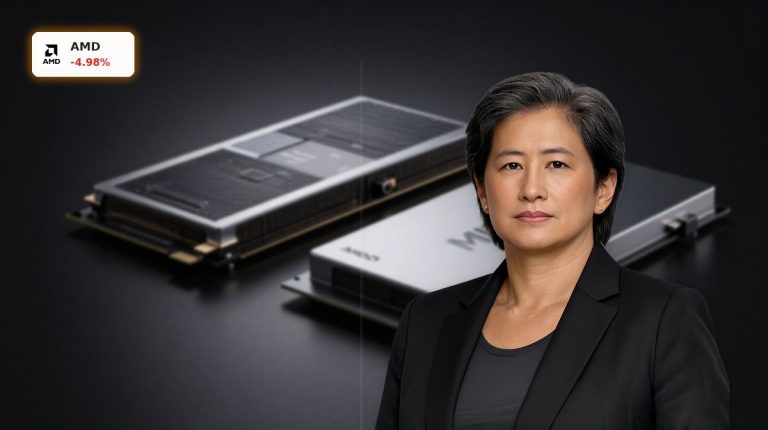
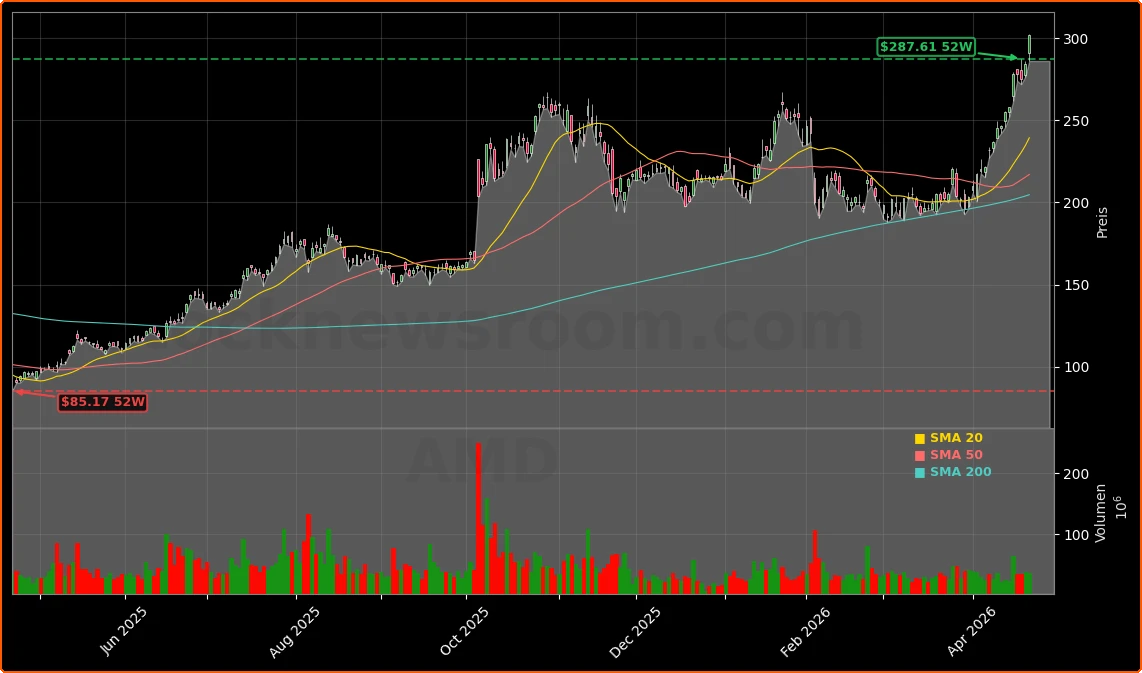
Advanced Micro Devices, Inc. (AMD) is extending its leadership role in the AI-driven chip rally, with shares sitting at $301.90 on Wednesday afternoon ET, up 6.12% from the prior close of $287.67. The move cements a fresh AMD Record in regular trading after the stock had already touched new all-time highs around $290.47 in premarket action. On a 12‑month view, AMD is now up more than 200%, outpacing even some of the strongest names on the NASDAQ and adding meaningful weight to the technology components of U.S. growth portfolios.
The momentum is underpinned by a sector-wide investment cycle in AI infrastructure. Hyperscale cloud providers are committing well over $200 billion to data center and accelerator capacity, and while NVIDIA still commands roughly 80% share in high-end AI GPUs, AMD is increasingly seen as a credible challenger. That growing perception is one reason Wall Street is rushing to raise targets just as the stock prints another AMD Record on the charts.
Why are analysts chasing the AMD Record?
Stifel on Monday reiterated its Buy rating on AMD and lifted its price target to $320, signaling confidence that the stock can sustain and even extend gains from current levels. Bernstein followed recently with a target hike to $265, highlighting not only robust AI demand but also a valuation gap that has opened between AMD and some semiconductor peers. Analyst Stacy Rasgon at Bernstein pointed to powerful inflows into names like AMD and Intel, contrasted with more mixed performance for NVIDIA and Broadcom in certain recent windows.
Rasgon also warned of mounting supply imbalances across the AI value chain, from chips and optics to CPUs, where demand for compute clearly exceeds available capacity. For AMD, that imbalance cuts both ways: it supports strong pricing and utilization in the near term, but it also raises execution risk if hardware or ecosystem bottlenecks slow deployments. Still, as long as AI demand remains this tight, Wall Street appears willing to reward AMD with a premium multiple, especially as each new AMD Record print reinforces bullish technical sentiment.
How strong is AMD’s AI and data center momentum?
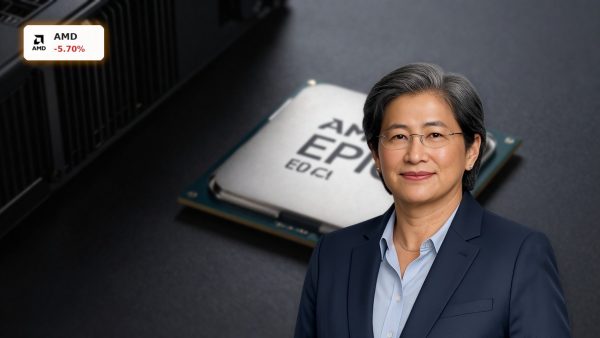
Fundamentals are helping justify the latest AMD Record rally. In its most recent reported quarter (Q4 2025), AMD delivered revenue of $10.27 billion, up 34.1% year over year, with its Data Center segment hitting a record $5.38 billion, up 39%. EPYC server CPUs continue to gain share against Intel in cloud and enterprise workloads, while Ryzen AI-enabled PCs pushed the Client segment to $3.10 billion, also up 34% from a year ago. Free cash flow reached a record $2.08 billion, giving AMD more firepower to invest in R&D and capacity.
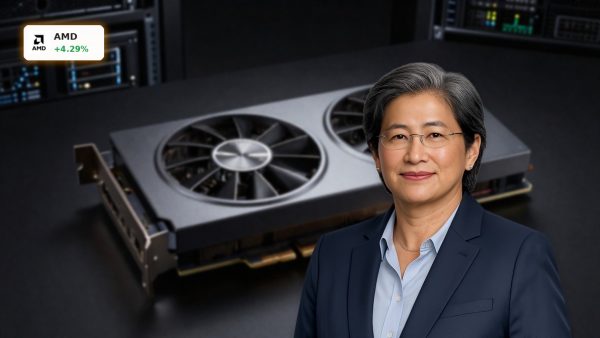
That said, AMD’s 57% non‑GAAP gross margin still trails far behind NVIDIA at 75.2%, reflecting both product mix and AMD’s position as a price‑aggressive challenger. While NVIDIA is locking in roughly $95.2 billion in AI supply commitments and owning the software stack via CUDA and NVLink, AMD is relying on partnerships and open software frameworks. Its Instinct accelerators are being deployed with players like OpenAI and Oracle, targeting around 50,000 GPUs by Q3 2026. For U.S. investors, the question is whether this challenger strategy can steadily close the profitability gap without sacrificing AMD’s growth trajectory that underpins each AMD Record move in the stock.
How does AMD compare to other chip and AI plays?
The current AI rally is broad-based. ARM Holdings, Micron, Western Digital, Seagate, and Marvell Technology all traded higher on Wednesday, while AMD, Analog Devices, Microchip Technology, Broadcom, NXP Semiconductors, and Texas Instruments each posted gains of more than 1% at various points in the session. For NASDAQ and S&P 500 investors, that breadth confirms that AI is no longer a single‑stock story centered solely on NVIDIA, but a wider theme spanning memory, storage, networking, and compute.
Even outside semiconductors, large-cap technology leaders such as Apple and Tesla are increasingly tied to AI narratives, whether through edge AI devices, autonomous driving, or cloud services that rely on data center accelerators from NVIDIA and AMD. That ecosystem effect means the AMD Record rally can influence sentiment far beyond one ticker, shaping flows into growth and tech ETFs and altering risk appetite across Wall Street. With AMD trading 24.2% above its 20‑day simple moving average and 33.4% above its 100‑day SMA, and its relative strength index near 80, momentum traders remain firmly in control for now.
Related Coverage: What comes after the AMD Record?
For readers looking to dive deeper into valuation risks after the AMD Record surge, stocknewsroom.com recently examined whether the latest AI boom can justify current multiples. The analysis in Advanced Micro Devices Forecast: +3.5% AI Boom Rally Tests Valuation explores scenarios for revenue growth, margins, and potential downside if AI spending normalizes. Together with today’s market reaction, that piece can help investors frame risk‑reward as AMD trades at new highs.
The AMD Record breakout underscores how central Advanced Micro Devices has become to the global AI build‑out, with Wall Street upgrades and hyperscaler spending pushing the stock into uncharted territory. For U.S. investors, the move reinforces AMD as a core high‑beta way to play the AI infrastructure theme, but also elevates the importance of monitoring margins and competitive dynamics against NVIDIA. The next quarters will show whether AMD can turn today’s AMD Record price action into a sustained leadership role in AI compute.