
Is Micron’s latest record-breaking surge the start of an AI memory super‑cycle or just another peak in a brutal chip cycle?

Is Micron Technology reshaping the AI trade?
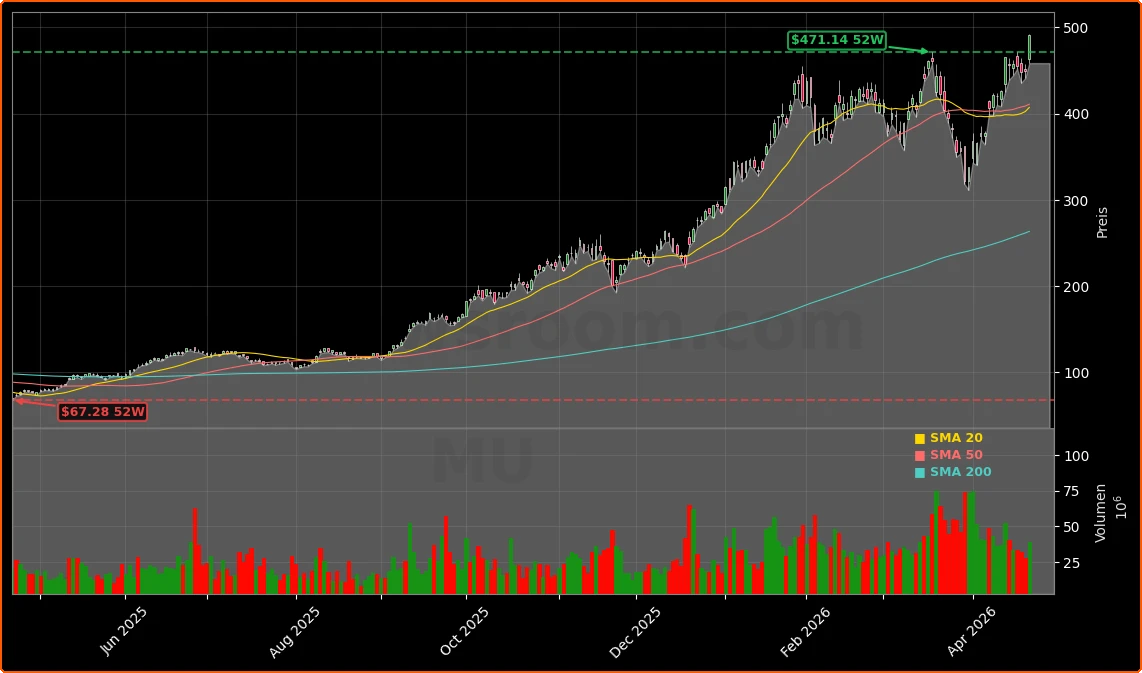
The surge in Micron Technology, Inc. shares is reverberating across the NASDAQ and S&P 500 as investors double down on the AI hardware stack. At $491.23, up from a prior close of $453.50, Micron is breaking out from a months-long sideways zone between roughly $310 and $465, a classic pattern of trend, consolidation, and renewed trend continuation. Technical traders point to a completed consolidation after a 700% rally since April 2025, arguing that a decisive move above resistance confirms the next leg in the uptrend.
On the weekly chart, the stock has formed a broadening, or “megaphone,” pattern, with some technicians eyeing upside potential toward the mid-$500s. A frequently cited chart target sits around $515, which would mark a fresh Micron Record high if achieved. Against that backdrop, today’s 9% spike is being interpreted less as a blow-off top and more as a possible start of a new momentum phase within the AI infrastructure theme.
How strong is Micron's AI memory position?
Fundamentally, Micron designs and manufactures key memory and storage products that are increasingly critical for AI workloads: DRAM, NAND flash, solid-state drives (SSDs), and High Bandwidth Memory (HBM). These components sit alongside GPUs from players like NVIDIA and CPUs from Advanced Micro Devices in AI data centers, enabling faster model training and inference. As AI models grow more complex, demand for high-capacity, high-bandwidth memory is rising sharply, which helps explain the current Micron Record enthusiasm.
Wall Street is responding. About 92% of the 48 analysts covering the stock rate it a Buy, reflecting a broadly bullish view that AI-driven demand for DRAM, NAND, and HBM can persist for years. The average 12‑month price target implies more than 20% upside from current levels, suggesting that even after the recent surge, many professionals see room for further gains. This positioning places Micron alongside other AI infrastructure beneficiaries such as NVIDIA and storage players like Western Digital and Seagate, all of which participated in today’s sector rally.
What do UBS and Citi expect from Micron?
Analyst commentary has sharpened around the idea of a memory upcycle. On April 7, Timothy Arcuri at UBS raised his Micron price target from $510 to $535 while reiterating a Buy rating. UBS highlighted stronger DRAM and NAND pricing and argued that a potential memory super‑cycle could offset ongoing concerns around gross margin volatility. A target in the mid‑$500s would effectively cement a new Micron Record zone for the stock, aligning with bullish technical projections.
The view is not uniformly aggressive, but still broadly positive. On March 31, Atif Malik at Citigroup maintained a Buy rating but trimmed his price target from $512.05 to $425. Malik cited weaker DRAM spot prices linked to so‑called TurboQuant concerns in the short term, but emphasized that medium‑term demand trends for DRAM and NAND remain intact. The divergence between a cautious Citi target and a more optimistic UBS forecast underscores the cyclical risk embedded in memory, even as AI secular trends strengthen.
How sensitive is Micron to chip cycles?
Despite the upbeat sentiment, veteran investors know that memory producers are among the most cyclical names in semiconductors. Following a 35–40% move in a short period, some portfolio managers are reluctant to add aggressively above $490, arguing that Micron and peers like Samsung remain highly sensitive to pricing swings and capital spending cycles. The company is currently discussed as trading at a forward P/E in the 5–6 range, which appears inexpensive relative to many AI hardware peers, but that valuation assumes earnings hold near elevated levels.
At the same time, the broader chip complex is supportive. ARM Holdings, Western Digital, Seagate, Marvell, AMD, Analog Devices, Texas Instruments, NXP and Broadcom all traded higher alongside Micron, signaling a risk‑on backdrop for semiconductors on Wall Street. For U.S. investors with exposure to NASDAQ leaders such as Apple and other tech giants, Micron’s breakout adds another pillar to the AI ecosystem beyond CPUs and GPUs, increasing diversification within the hardware portion of AI‑focused portfolios.
Related Coverage
Investors seeking a deeper dive into the company's recent volatility and earnings backdrop can review the detailed analysis in Micron AI Demand Record Meets -2% Stock Plunge Warning. That piece examines how Micron's AI-fueled record quarter interacted with a short-term share price pullback and what that means for risk management around a potential Micron Record earnings trajectory.
In conclusion, today’s move toward a fresh Micron Record price underscores how central Micron has become to the AI infrastructure trade on Wall Street. For U.S. investors, the combination of strong analyst support, improving memory pricing, and a powerful technical breakout makes the stock a key barometer for the broader semiconductor cycle. The next few quarters of pricing data and AI-related orders will show whether Micron can convert this breakout into a durable leadership role in the NASDAQ's AI-driven advance.