
Is the latest NVIDIA Record and $5 trillion valuation a sustainable AI super-cycle or just the peak of market euphoria?

Is NVIDIA Record dominance driving the market?
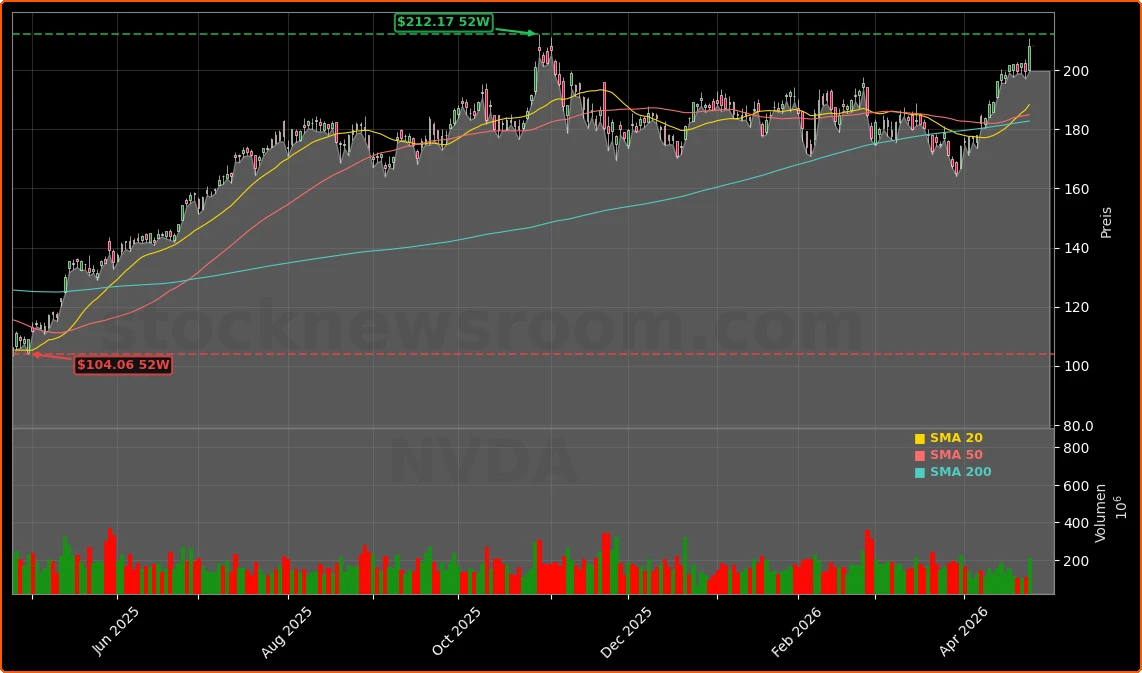
Friday’s 4.32% gain pushed NVIDIA back above the $5 trillion mark, making it, once again, the most valuable publicly traded company in the world and putting distance between it and fellow mega-caps like Apple and Alphabet. The stock closed at $208.27, with a modest slip to $208.10 in after-hours trading, and reached its first fresh all-time high since October as part of a powerful breakout in the semiconductor complex.
Bloomberg reported that the stock has decisively broken out of a year-long trading range, coinciding with a record 17-session win streak in chip indices and an 11% weekly surge in leading semiconductor ETFs. Benzinga highlighted that technical indicators for NVDA remain firmly bullish, with strong readings in growth, quality, and momentum factors, even as the valuation screens as premium versus the broader S&P 500 and NASDAQ-100.
At roughly 25 times forward earnings, some analysts argue that NVIDIA trades at a surprisingly modest multiple relative to its earnings trajectory, especially compared with legacy peers such as Intel, which has occasionally sported triple-digit P/E ratios. Yet after a multi-year run in which NVDA has repeatedly led the Magnificent Seven, many U.S. portfolio managers are increasingly focused on the durability of this latest NVIDIA Record phase.
How strong is AI demand behind NVIDIA Corporation?
The fundamental driver of the rally remains the AI data center investment super-cycle. Hyperscalers including Microsoft, Amazon, Meta Platforms, and Google are committing hundreds of billions of dollars to GPU-rich infrastructure, and NVIDIA still commands roughly 80–81% of the AI accelerator market according to recent industry estimates. Its H100, Blackwell, and upcoming Vera Rubin architectures are now the default engines for training and inference in large-scale AI workloads.
Management has laid out an aggressive roadmap, targeting around $1 trillion in chip sales across Blackwell and Vera Rubin in 2026–2027 alone. Recent quarterly results underscore that trajectory: NVIDIA delivered about $68.1 billion in revenue and $1.62 in EPS in its latest reported quarter, handily beating consensus expectations. TipRanks noted that the company crossed the $5 trillion valuation level after a roughly 5% surge on April 24, less than a year after first breaking the $4 trillion mark.
Wall Street is now looking ahead to the next earnings report, expected in late May, as the next major catalyst. Strategists at firms like Morgan Stanley and Goldman Sachs have pointed to ongoing upside risk if AI data center orders remain tight and NVIDIA can sustain its current pricing power on high-end GPUs and networking hardware.
Can NVIDIA Record momentum survive rising competition?
While the current NVIDIA Record run reflects extraordinary demand, competitive pressure is clearly mounting. AMD, Broadcom, Intel, and Taiwan Semiconductor Manufacturing are expanding their AI offerings, and Alphabet is increasingly marketing its in-house TPU accelerators to external customers. One December estimate suggested Google could eventually capture around 20% of the AI chip market if it fully commercializes TPUs, potentially eroding NVIDIA’s dominant share over time.
Still, NVIDIA’s ecosystem advantage is formidable. CUDA, its software stack, has become a de facto standard for AI developers, and the company is already shifting its product roadmap toward the next phase of AI, including agentic systems, inference at scale, and even quantum-accelerated workloads. NVIDIA has introduced GPU-based quantum simulators that allow developers to design applications for future quantum systems, acknowledging that energy efficiency could become a long-term differentiator as data center power usage surges.
Partnerships continue to deepen its moat. Cadence Design Systems is integrating AI features in collaboration with NVIDIA and TSMC, enhancing chip-design workflows. In autonomous driving, Pony.ai has selected the NVIDIA DRIVE Hyperion platform and DRIVE AGX Thor for its next-generation Level 4 robotaxi compute solution, targeting a fleet of over 3,000 vehicles across more than 20 cities by the end of 2026. These deals extend NVIDIA’s reach well beyond the data center into automotive, industrial, and energy sectors.
What does this mean for U.S. investors now?
For American investors, the latest NVIDIA Record has immediate portfolio implications. NVDA’s sheer size means it now exerts outsized influence on the S&P 500, NASDAQ-100, and a wide array of sector and thematic ETFs, from semiconductor funds to AI and climate-transition products. TipRanks recently flagged a 27x surge in volume for a climate-and-transition-focused ETF that counts NVIDIA among its top holdings, underscoring how AI exposure and sustainability themes are converging across Wall Street products.
At the same time, institutional positioning is heavy. Elm3 Financial Group trimmed its NVDA stake by 6.6% in Q4, yet the stock still ranks as its second-largest holding, highlighting both profit-taking and continued conviction. High institutional ownership above 65%, plus active options markets and targeted single-stock ETFs like GraniteShares YieldBOOST NVDA (NVDY), underline just how central the name has become to U.S. trading strategies.
Key risk factors remain: China export controls, potential normalization in AI infrastructure spending after this intense build-out phase, and broader macro shocks could all inject volatility. However, the recent 2022-style drawdowns in growth tech showed that, while NVIDIA can correct sharply, it has also been among the first to recover as AI demand re-accelerates.
Related Coverage: How does this fit the broader NVIDIA story?
For a deeper dive into how previous rallies set up the current move, readers can explore the analysis in “NVIDIA Record Rally: Stock Jumps 4.99% on AI Codex Boom”. That piece examines whether past surges were built on sustainable AI fundamentals or more fragile themes such as Codex hype and China risk, offering useful context for evaluating today’s NVIDIA Record valuation.
In sum, the latest NVIDIA Record at a $5 trillion-plus market cap reinforces the company’s status as the core hardware supplier for the AI age. For U.S. investors, NVDA remains a pivotal, high-conviction growth holding whose moves can sway entire indices. The next earnings release and ongoing AI spending updates will show whether this momentum can translate into another leg higher for both the stock and the broader semiconductor trade.