
Are the latest Intel Earnings and AI guidance the start of a lasting turnaround or just a spectacular one-day spike?

How did Intel shock the market?
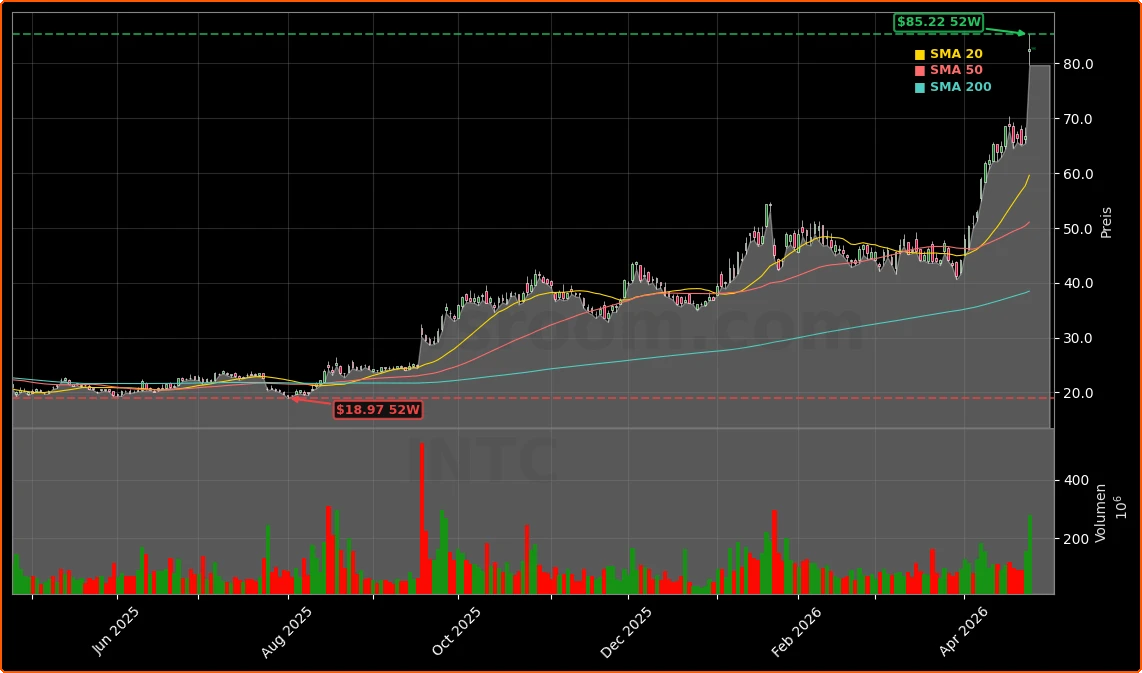
Intel Corporation (INTC) closed Friday’s regular session up 23.6% at $82.54, briefly touching $82.59 and marking both a new 52-week high and a record closing level above its dot-com era peaks. After-hours trading kept the momentum intact, nudging the stock to about $82.72. The move made Intel the single biggest gainer in both the S&P 500 and the Nasdaq 100 and powered a broader rally in chipmakers that pushed the Philadelphia Semiconductor Index to a record high and its 18th straight winning session.
The catalyst was a blowout Q1 2026 print and a powerful guidance hike. Revenue rose roughly 7% year over year to about $13.6 billion, far ahead of internal guidance and consensus expectations closer to $12.2–$12.3 billion. Adjusted earnings per share jumped to $0.29, crushing Wall Street’s expectation of about $0.01–$0.02 per share. Non-GAAP gross margin climbed into the low 40% range, around 650 basis points above what management had guided just three months ago, helped by improved yields and tight cost control.
Demand was strong enough that Intel even drew down previously written-off inventory, with CFO David Zinsner noting that the company had to tap finished-goods stock to keep up with orders. The surprise strength, combined with a sharply higher outlook, explains why the latest Intel Earnings release triggered the stock’s best single-day performance since October 1987.
What is driving Intel’s AI rebound?
The heart of the bullish narrative is AI. For much of the early AI cycle, investors focused on GPU leaders like NVIDIA and Advanced Micro Devices, while Intel lagged badly in data center share. That story is changing at the margin. Intel’s data center and AI division posted about 22% revenue growth to roughly $5.1 billion in Q1, evidence that AI-driven workloads are starting to pull more demand toward Intel’s CPUs.
Management argues that the rise of so-called agentic AI — autonomous systems that take actions rather than just generate outputs — is structurally increasing the importance of CPUs. These workloads still rely on GPUs for heavy math, but they require large fleets of CPUs to orchestrate data movement, memory access and workflow logic. Recent industry commentary suggests that the CPU-to-GPU ratio in AI servers could shift meaningfully in coming years, a scenario that would materially benefit Intel’s massive CPU installed base.
New partnerships underscore the shift. Intel highlighted collaborations with Alphabet’s Google and Tesla around advanced packaging and next-generation manufacturing nodes, and industry chatter points to potential use of Intel’s upcoming 14A and 18A process technologies in specialized AI and automotive applications. The U.S. government’s roughly $20 billion CHIPS Act support package — now worth an estimated $30–36 billion on paper as Intel’s share price has quadrupled from its lows — further underlines Washington’s bet that Intel can re-establish itself as a strategic AI and foundry player.
How strong is the new guidance?
The updated outlook was just as important as the headline Q1 beat. For Q2 2026, Intel now guides revenue to a range of $13.8 billion to $14.8 billion, well ahead of Wall Street’s prior consensus near $13.0–$13.1 billion. Management expects adjusted EPS around $0.20, a dramatic swing from an adjusted loss of about $0.10 per share in the year-ago quarter.
Intel also signaled improving profitability, with gross margin expected to grind higher through 2026 as advanced nodes ramp and utilization rises. The company’s foundry segment, anchored by its 18A process, is seeing better yields, and Intel plans to increase 18A wafer output six- to seven-fold from Q1 to Q2. While the foundry business still lacks a marquee third-party customer on the scale of a hyperscaler, even small wins could provide powerful operating leverage given the more than $100 billion Intel has already spent on capacity.
Beyond the quarter, several banks moved quickly to re-rate the stock. Evercore ISI upgraded Intel to “Outperform” and lifted its price target to about $105–$111, citing what it calls a “CPU renaissance” and upside from advanced packaging and government-backed capacity. Citi and Roth Capital also raised their ratings to “Buy,” highlighting AI-related CPU demand, improving margins and the potential for Intel’s factory network to secure external customers. Those moves helped validate the rally for many institutional investors who had been underweight the name.
What are the key risks after this Intel Earnings spike?
Despite the euphoria, some on Wall Street are urging caution. Even after analysts raised their estimates, Intel now trades at a forward P/E around 70, near the highest level in its history and well above semiconductor peers. Skeptics point out that even at the top end of Q2 guidance, trailing-12-month revenue would still sit roughly one-third below Intel’s 2021 peak, while gross profit would be about half its former level.
Competitive risk is also real. NVIDIA continues to dominate AI accelerators, while AMD has become far more credible in data center CPUs. ARM-based CPUs are gaining ground in the cloud, with hyperscalers such as Amazon, Microsoft and Apple designing their own chips and increasingly favoring in-house solutions. That dynamic could limit Intel’s long-term pricing power, even if near-term AI demand remains hot.
On the governance side, Intel disclosed that Chief Accounting Officer Scott Gawel resigned effective immediately, with CFO David Zinsner assuming the additional role of principal accounting officer. While framed as a move to pursue another opportunity, the consolidation of finance responsibilities in one executive will be closely watched by investors given the company’s complex capex and government-subsidy profile.
How does this reshape the chip sector?
Intel’s surge rippled through the entire semiconductor complex. Shares of AMD jumped around 14%, Qualcomm gained more than 11%, and GPU leader NVIDIA climbed about 4–5% as traders leaned back into the broader AI trade. Equipment and specialty names from Applied Materials to KLA and Lattice Semiconductor also moved higher as investors bet that Intel’s strong results and guidance signal a sustained upcycle in AI-related capex rather than a one-off spike.
For diversified U.S. portfolios, the reshaped narrative around Intel adds another large-cap AI lever alongside hyperscale cloud platforms and GPU champions. The question now is whether Intel can convert one blockbuster quarter and a bullish Intel Earnings outlook into multi-year execution on manufacturing, foundry customer wins and durable AI CPU share gains.
Related Coverage
For a deeper dive into how this turnaround began, including the initial market reaction to the Q1 print, read “Intel Earnings Q1 Beat Sparks 19% After-Hours Rally”. That analysis breaks down the early AI narrative shift and the first wave of investor repositioning that set up this week’s explosive move.
In recent months, we have seen clear signs that the CPU is reinserting itself as the indispensable foundation of the AI era.— Lip-Bu Tan, CEO of Intel Corporation
Intel’s latest Intel Earnings report confirms that the company’s AI-driven comeback story is gaining traction, with record highs and upgraded guidance validating the new strategy for now. For investors, the combination of accelerating CPU demand, improving margins and strong analyst support is compelling but comes with elevated valuation and execution risk. The next few quarters of Intel Earnings and foundry updates will show whether this former laggard can cement its place as a core AI holding on Wall Street.