Is the latest AMD Upgrade and Intel’s AI CPU surprise signaling a new phase in the chipmaker’s high‑stakes AI rally?

Is the AMD Upgrade justified by Friday’s surge?
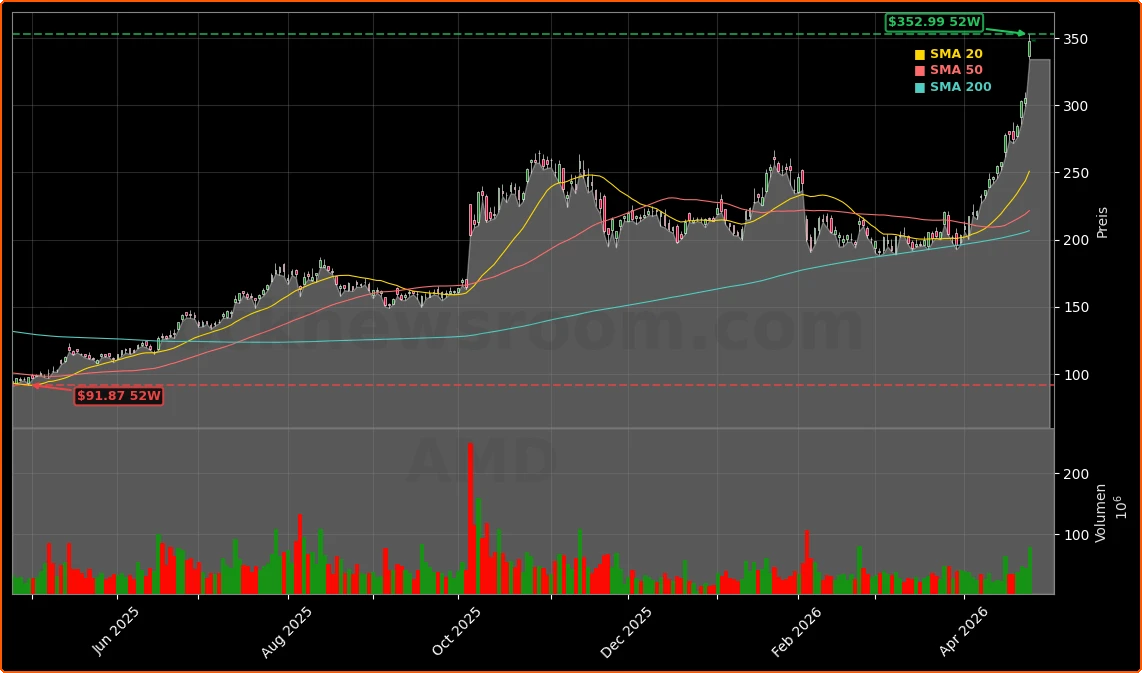
Advanced Micro Devices, Inc. closed Friday’s session on the NASDAQ at $347.81, up 13.91% on the day, with after-hours trading nudging the stock to $348.45. The move extended AMD’s winning streak to four sessions and pushed the shares well beyond the prior 52‑week high of $310.22 set just a day earlier. Trading volume more than doubled the 50‑day average, signaling institutional participation rather than a purely retail-driven spike.
The immediate catalyst was a powerful combination: Intel’s earnings shock and the high-profile AMD Upgrade from D.A. Davidson. Intel (INTC) reported Q1 revenue of roughly $13.6 billion and non‑GAAP EPS of $0.29, crushing expectations and showing more than 20% growth in Data Center and AI revenue. That print validated a thesis many large investors have been circling for months—that CPUs are re-emerging as a bottleneck in the AI build‑out, not just GPUs from leaders like NVIDIA.
A strong Intel report might normally pose competitive risk for AMD, but Wall Street read it differently this time. If demand for x86 CPUs in AI inference is this strong at Intel, then AMD’s EPYC franchise and upcoming Venice (Zen 6) server CPUs could be staring at an even larger opportunity as a high-performance, power-efficient alternative.
What did the AMD Upgrade change for Wall Street?
D.A. Davidson analyst Gil Luria moved AMD to Buy from Neutral and raised his price target sharply from $220 to $375, implying additional upside from Thursday’s close even after the big move. In his view, the CPU is “reinserting itself as an indispensable foundation of the AI era” as agentic workloads shift compute needs beyond GPUs. Luria argues that Intel’s results are a “precursor for a huge step-up for AMD’s CPU franchise” and expects CPUs to become the next major constraint in AI infrastructure.
The AMD Upgrade lands on top of an already bullish analyst backdrop. Goldman Sachs recently boosted its 2027 revenue forecast for AMD from $45.9 billion to $68.7 billion, citing massive AI GPU and CPU deployments at OpenAI, Meta Platforms, and Oracle Cloud, including a 50,000‑GPU Instinct cluster at Oracle. Stifel lifted its target to $320 with a Buy rating, while Bank of America’s Vivek Arya has a $310 target and describes AMD as a prime beneficiary of hyperscale AI capex. Wells Fargo, maintaining an Overweight and a $345 target, added AMD to its Q2 Tactical Ideas List, pointing to strong EPYC demand and upcoming GW‑scale AI GPU deals.
Even with Friday’s rally, AMD trades around 24x projected 2027 EPS—rich versus the broader S&P 500, but still seen as a relative discount to NVIDIA’s high‑teens revenue multiple. For investors who missed the early phase of the GPU trade, the AMD Upgrade wave reinforces the idea of AMD as the most liquid “second source” play in AI chips.
How does Intel’s AI CPU boom reshape AMD’s outlook?
Intel’s blowout quarter ignited a sector‑wide rally: Intel jumped more than 20%, while AMD, Arm Holdings and Qualcomm all posted double‑digit gains, helping the Nasdaq outperform the S&P 500. The Philadelphia Semiconductor Index (SOX) extended its record winning streak to 18 sessions and is up more than 40% month‑to‑date—moves some market watchers compare to dot‑com‑era extremes.
But under the surface, the fundamentals look more durable than the last bubble. AMD’s Data Center segment has already shown 39% year‑over‑year growth to a record $5.38 billion, powered by EPYC server CPUs and Instinct MI accelerators. Management expects revenue from the new MI450 AI GPU to kick in by Q3 2026, alongside the launch of the Helios AI rack and the Venice server CPU, which should trigger a major refresh cycle at hyperscalers and cloud providers.
Institutional demand appears to back that narrative. Hedge funds have been tracking large AI GPU orders from OpenAI, Meta and Oracle, while a multi‑gigawatt partnership with Meta and a multi‑year AI collaboration with the French government underscore AMD’s strategic role in national and corporate AI roadmaps. Some analysts now model AMD EPS climbing from roughly $5.93 in 2026 to more than $10 in 2027 as AI infrastructure spending normalizes at a much higher base.
Still, there are risks. Benzinga has flagged a cluster of “dot‑com‑style” warning signs across the chip space, including AMD’s best monthly gain in decades and price action that has sprinted ahead of consensus targets near $285. Competition from Intel and upcoming CPUs from Arm-based vendors, as well as export controls on advanced AI hardware, could also inject volatility into what has become a crowded long trade.
How does AMD stack up against AI rivals?
In the AI accelerator market, AMD is battling NVIDIA’s Blackwell platform with its MI450 GPUs, aiming for parity not only in raw performance but also via rapid improvements in the ROCm software ecosystem. On the CPU side, analysts at Jefferies argue that AMD is still the better play than Intel for high‑performance server workloads and see room for further share gains as Venice ramps.
Beyond the data center, AMD competes with names like Apple in client CPUs and custom silicon, and with automotive and edge‑AI players such as Tesla for specialized compute. For diversified tech investors, AMD now sits alongside these megacap peers as a core way to capture the AI hardware supercycle, with Friday’s AMD Upgrade cycle reinforcing that positioning across Wall Street research desks.
Related Coverage
For a deeper look at how AMD’s AI story has evolved over the past week, readers can revisit our recent analysis, “AMD Record Rally: Stock Soars +6.1% as AI Demand Explodes”, which examined whether the previous breakout was a one‑off spike or the start of a new multi‑year chip supercycle. Together with today’s AMD Upgrade and Intel‑driven CPU tailwind, that piece helps frame how dramatically sentiment has shifted in AMD’s favor.
“The CPU is reinserting itself as an indispensable foundation of the AI era, and the once sleepy CPU market has taken off as agentic workloads shift compute needs beyond GPUs.”— Gil Luria, D.A. Davidson
In conclusion, the latest AMD Upgrade, layered on top of Intel’s AI CPU surprise and a powerful sector rally, cements Advanced Micro Devices, Inc. as a central vehicle for investors betting on a long‑lasting AI infrastructure boom. For U.S. portfolios tilted toward growth and technology, AMD now sits at the intersection of CPU and GPU demand with multiple product catalysts ahead. The next key test will be AMD’s May 5 earnings report, which will show whether the optimism behind this AMD Upgrade is being matched by hard numbers in the data center and AI businesses.