Will the new NVIDIA Pentagon AI deal ignite a long defense boom for NVDA or get capped by China and valuation risks?

How does the NVIDIA Pentagon deal change the story?
The NVIDIA Pentagon arrangements place the chip designer alongside OpenAI, Google, Microsoft, Amazon Web Services, SpaceX, Oracle and Reflection AI as approved providers of advanced AI tools on top‑secret military networks. These tools will sit on secure infrastructure handling intelligence reports, satellite imagery, drone feeds, signals intelligence and battlefield logistics, making NVIDIA Corporation a core supplier for “AI‑first” defense operations.
Defense officials have framed the initiative as a way to give U.S. forces “decision superiority,” while stressing that humans, not algorithms, will make lethal decisions. For investors, the takeaway is that a new, relatively price‑insensitive buyer — the Pentagon — is being layered on top of hyperscaler and enterprise demand for NVIDIA’s GPUs and networking platforms. That reinforces the view of NVDA as a long‑cycle “picks and shovels” play in AI infrastructure rather than a short‑term hype trade.
The NVIDIA Pentagon link also sends a signal to global allies. As NATO members and Indo‑Pacific partners harden their own classified networks, they are likely to adopt similar AI architectures. That could turn today’s U.S. defense deal into a multi‑year sovereign AI revenue stream anchored on NVIDIA hardware and software.
Why is the stock stuck near $200?
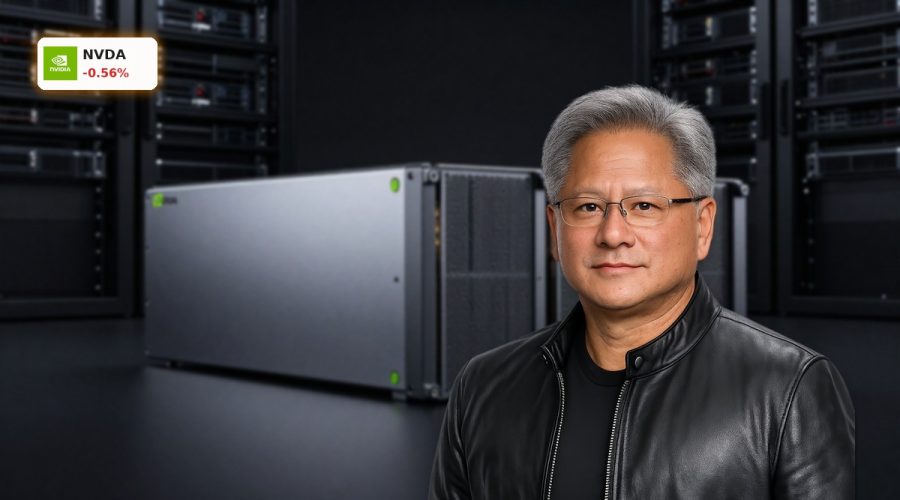
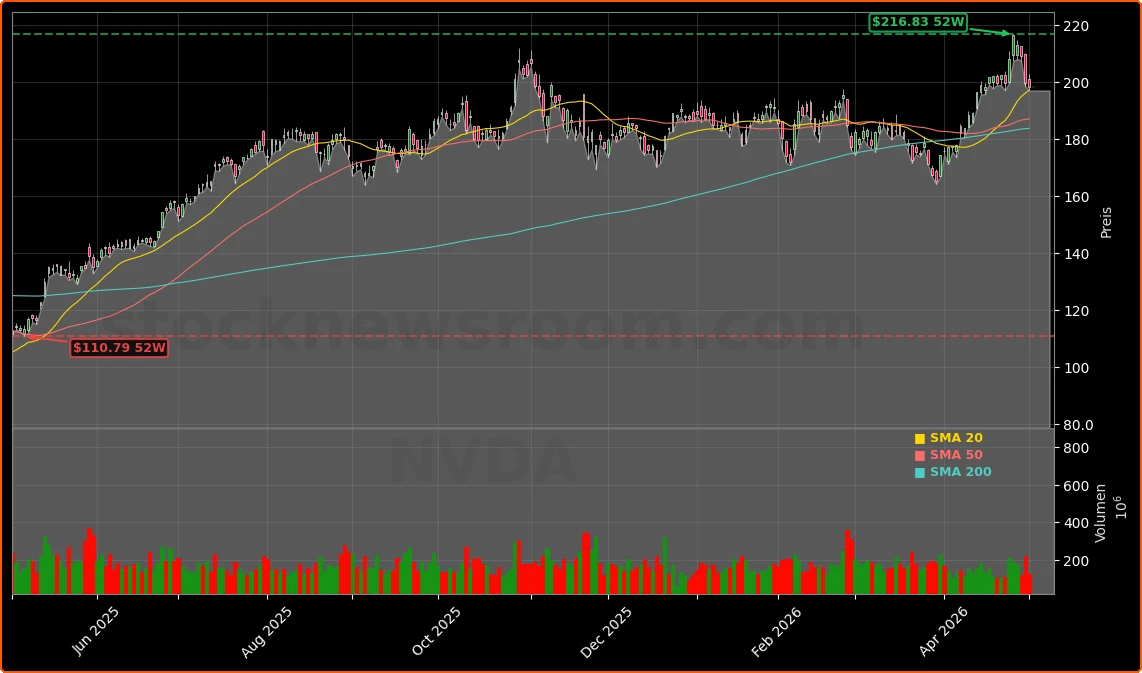
Despite the NVIDIA Pentagon tailwind, NVDA shares were changing hands around $198.45 on Friday, down 0.56% on the day, with the after‑hours quote barely higher at $198.49. The stock sits in the upper half of its 52‑week range between $104.08 and $216.82, but it has repeatedly struggled to hold above the psychologically important $200 mark. Technical traders are watching $212 as upside resistance and roughly $164.50 as key support.
The recent pullback follows one of the sharpest short‑term rallies in semiconductor history: the PHLX Semiconductor Index jumped nearly 50% from March lows in just 18 trading sessions before profit‑taking hit the group. NVDA itself had gained more than 14% in April, yet lagged higher‑beta peers. Advanced Micro Devices ripped 74.3% for the month, and Intel logged its best month ever, which has shifted some speculative capital away from NVIDIA toward perceived catch‑up plays.
Derivatives strategists at Schwab have warned clients that the parabolic move in chipmakers has created significant overhead supply near recent highs. With NVDA options implying volatility into the May 20 earnings report — and the stock historically dipping after four of the last five results — short‑term traders appear cautious even as longer‑term fundamentals remain robust.
How strong is NVIDIA versus Alphabet, AMD and others?
At around a $4.9 trillion market cap, NVIDIA Corporation is vying with Alphabet to remain the world’s most valuable public company. Options pricing currently implies that Alphabet has better than even odds of briefly overtaking NVIDIA if NVDA fails to rally into or after earnings. Yet by almost any operational metric, NVIDIA remains the center of the AI infrastructure build‑out.
Data‑center revenue recently surged to roughly $62 billion in the quarter, contributing to about $68.1 billion in total sales, up more than 73% year over year. Full‑year data‑center revenue reached an estimated $193.7 billion, driven by demand for Hopper and Blackwell accelerator platforms, NVLink networking and CUDA‑based software stacks. Free cash flow in a single quarter touched $34.9 billion, and management is guiding for about $78 billion in revenue in the upcoming quarter — even after excluding data‑center compute revenue from China.
By contrast, AMD’s MI‑series accelerators are now viewed as the higher‑beta alternative. AMD stock has soared 266.8% over 12 months versus roughly 78.8% for NVDA, as investors chase the catch‑up narrative in AI GPUs. Intel, meanwhile, is recovering from restructuring in its autonomous‑driving unit but has benefited from the broader chip rally. Still, when comparing 2025 estimates, NVIDIA is expected to deliver gross margins near 75% and revenue growth around the mid‑60s percentage range, while AMD’s forecast margins and growth remain meaningfully lower.
What risks offset the NVIDIA Pentagon upside?
China remains the biggest strategic overhang. U.S. export controls have already forced NVIDIA to strip China data‑center compute from its near‑term guidance and absorb an inventory charge of roughly $4.5 billion. Political pressure is intensifying: Senator Chris Coons has pressed the Commerce Department on whether H200 AI chips are being licensed into China, amid apparent contradictions between official statements and comments from CEO Jensen Huang. Any tightening of licensing rules could cap NVIDIA’s addressable market or force more rapid product segmentation.
Competition from in‑house chips at hyperscalers is also rising. Alphabet, Microsoft, Amazon and Meta are all developing custom AI accelerators designed to cut inference costs, and Google is already testing new TPU successors with partners such as Marvell. While NVIDIA argues that upcoming Vera Rubin processors can slash inference costs by up to 90% versus prior generations, investors know that cloud giants are highly motivated to reduce long‑term dependence on any single vendor.
Valuation is the third concern. Wall Street consensus compiled by multiple brokers pegs NVDA’s 12‑month price target around $268–$270, roughly 29% upside from recent levels, with firms like Bank of America Securities and Citigroup reiterating Buy ratings. Over 90% of analysts rate the stock Buy or Strong Buy, but several caution that the shares are still “priced for perfection.” Any setback in hyperscaler capex, a misstep in the Blackwell or Rubin ramp, or a geopolitical shock could quickly compress the multiple even if the NVIDIA Pentagon contracts and other wins continue to roll in.
Related Coverage
For readers tracking how NVIDIA is extending its reach beyond core silicon into software and vertical solutions, this deep dive on the NVIDIA Legora Investment and NVentures’ backing of a $5.6 billion AI legaltech platform shows how the company is moving up the value stack into high‑margin enterprise workflows. Together with the NVIDIA Pentagon deals, that piece illustrates how the company is trying to own not just the AI data center, but also the tools that run on top of it across regulated industries.
Computing demand is growing exponentially — the agentic AI inflection point has arrived.— Jensen Huang, CEO of NVIDIA
Ultimately, the NVIDIA Pentagon contracts highlight how indispensable the company has become to both Wall Street and Washington, even as export controls and fierce competition add complexity to the thesis. For U.S. investors, NVDA remains a core AI infrastructure holding whose risk‑reward now hinges on execution in defense, cloud and China all at once. The next earnings report and any follow‑on announcements around classified‑network deployments will show whether the NVIDIA Pentagon story can power the stock convincingly back through the $200 ceiling.