
Are Oracle AI Contracts turning a legacy database giant into one of Wall Street’s most powerful AI infrastructure plays?

How are Oracle AI Contracts moving the stock?
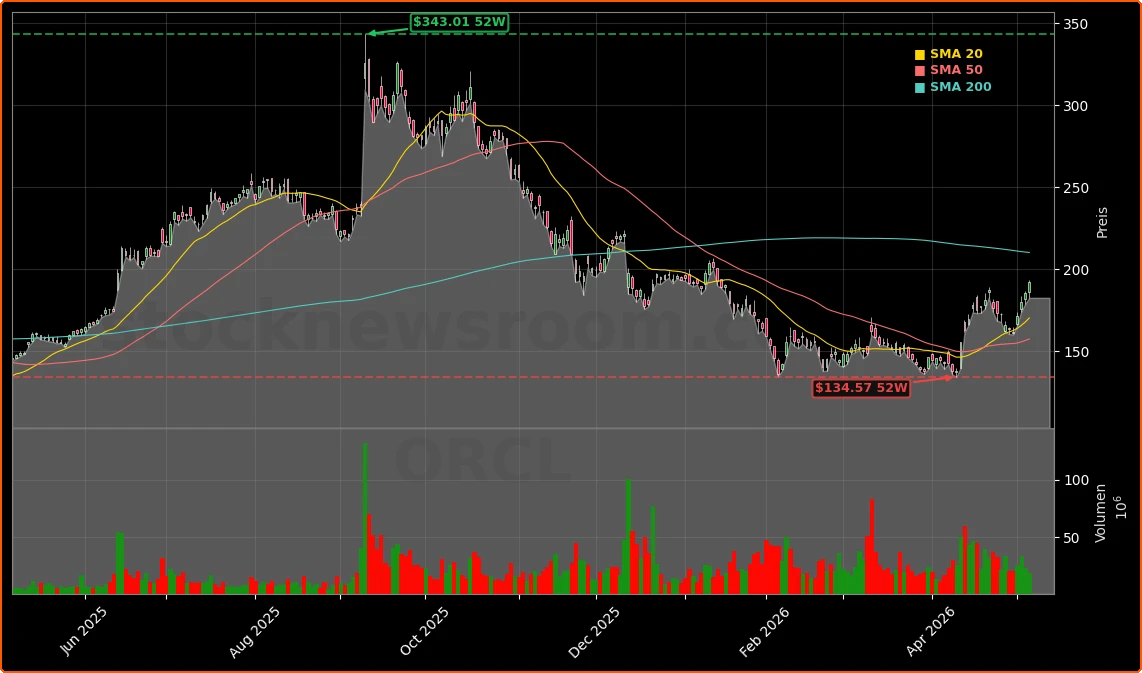
Oracle Corporation has rallied roughly 24% over the past month, climbing back from a post-earnings low near $138 to $192.38 in today’s trading, as investors reprice its role in the AI infrastructure cycle. A key catalyst was a newly secured classified AI deal with the U.S. Department of Defense to deploy models on secure military networks, which triggered a sharp move higher earlier this week. That defense win adds to a $1.65 billion, six-year supply agreement with Australian data center builder Datapod and a 1.4 gigawatt data center partnership with Michigan-based utility DTE Energy, all of which are anchored by long-dated Oracle AI Contracts.
Those agreements are feeding into a record Remaining Performance Obligations (RPO) balance of $553 billion, up 325% year over year. That figure represents contracted revenue already signed, giving unusual visibility into future cash flows compared with typical large-cap tech names in the S&P 500 and NASDAQ. For U.S. retirees and growth investors alike, the combination of accelerating share price momentum and locked-in Oracle AI Contracts is starting to look like a durable, not purely speculative, AI play.
What did the latest quarter reveal for Oracle?
In Q3 FY2026, Oracle Corporation delivered revenue of $17.19 billion and non-GAAP EPS of $1.79, marking the first quarter in more than 15 years where organic revenue and earnings both grew at least 20%. Cloud Infrastructure revenue jumped 84% to $4.888 billion, while multicloud database revenue surged 531% year over year as more enterprises standardize on Oracle databases running across multiple public clouds.
Management guided for Q4 FY2026 total revenue growth of 19%–21% and cloud revenue growth of 46%–50%, with non-GAAP EPS of $1.96–$2.00. Looking further ahead, Oracle raised its FY2027 revenue target to $90 billion and stated it can “comfortably meet and likely exceed” that level as AI customer balance sheets strengthen. A big driver is more than $29 billion of signed AI infrastructure contracts using a bring-your-own-hardware and upfront payment model, which helps expand capacity without putting the full burden of GPU purchases on Oracle’s balance sheet.
How unique is Oracle’s AI and cloud model?
Unlike hyperscalers such as NVIDIA’s closest cloud partners, Apple-style vertically integrated ecosystems, or EV-focused platforms like Tesla, Oracle positions itself as chip-neutral and cloud-neutral. Its database and infrastructure services now run across 33 Microsoft Azure regions, 14 Google Cloud regions and eight Amazon Web Services regions, embedding Oracle inside the core of competitors’ platforms. Co-CEO Clay Magouyrk highlighted that AI infrastructure revenue grew 243% year over year in Q3, with delivered AI capacity generating 32% gross margins, above guidance.
Oracle has secured more than 10 gigawatts of power and data capacity coming online over the next three years, a scale that puts it in direct competition with other AI campus builders and server vendors such as Super Micro Computer, which recently faced headlines about a reported contract loss with Oracle. For U.S. investors comparing Oracle to high-multiple AI beneficiaries like NVIDIA, the pitch is that Oracle AI Contracts turn its 50-year database moat into an infrastructure annuity paid for in part by customers themselves.
Does the debt load change the risk profile?
The flip side of Oracle’s rapid AI buildout is an aggressive funding strategy. Trailing capital expenditures reached $48.25 billion, driving free cash flow to negative $24.7 billion. Non-current debt has climbed to $124.7 billion from $85.3 billion, and interest expense rose 32% to $1.18 billion. Early in 2026, Oracle issued $25 billion in bonds and raised another $14 billion for data centers through a special purpose vehicle known as Project Mittens, which leases assets back to the company. It subsequently completed a $30 billion capital raise through investment-grade bonds and mandatory convertible preferreds, with the option to go higher as demand for AI capacity builds.
Bond markets initially pushed back, with wider credit spreads and a stock pullback as leverage concerns surfaced. However, the company emphasizes that many Oracle AI Contracts involve customer prepayments and customer-supplied GPUs, offsetting a meaningful portion of build costs. With RPO sitting at $553 billion and AI capacity largely spoken for before it is even constructed, bulls argue that this is leverage supported by signed customer paper rather than speculative expansion.
How is Wall Street reacting to Oracle AI Contracts?
Institutional interest is building. Alpha Cubed Investments recently boosted its Oracle stake by 156% in Q4, lifting its holdings to more than 114,000 shares, citing the Defense Department AI deal and large-scale data center financing as key catalysts. On the sell-side, sentiment is broadly positive: one recent analysis highlighted 35 Buy ratings versus eight Hold and just one Sell, with a consensus price target near $243. Morgan Stanley has called out Oracle as a prime beneficiary of massive 2026–2027 AI infrastructure capex by hyperscalers, even as it flags balance sheet risk.
Valuation remains reasonable in that context. Oracle trades at roughly 21x forward earnings, a discount to many high-growth AI leaders yet backed by 20%+ top- and bottom-line growth and its unprecedented backlog. For U.S. investors already exposed to megacap AI names such as NVIDIA and Apple, Oracle offers a different angle: infrastructure and mission-critical databases monetized via long-term Oracle AI Contracts rather than pure model or device sales.
Related Coverage
Investors who want a deeper dive into the Defense Department win and its immediate market reaction can read “Oracle Defense Contract: +2.9% AI Stock Surge Explained”, which breaks down how the classified AI deployment is reshaping expectations for Oracle’s cloud segment and near-term earnings power.
Oracle AI Contracts now sit at the center of the company’s strategy, tying together defense, utilities and enterprise software into a single, long-duration growth engine. For American portfolios, the stock offers a rare mix of visible contracted revenue and still-reasonable valuation, albeit with elevated leverage that demands monitoring. The next few quarters of execution on data center buildout and AI capacity delivery will show whether Oracle can fully convert its Oracle AI Contracts into sustained earnings power and shareholder returns.