Is the Oracle OpenAI partnership still a golden AI ticket, or the first big stress test of the AI infrastructure boom?

Why are Oracle and AI peers under pressure?
The latest Oracle OpenAI selloff was triggered by a Wall Street Journal report that OpenAI recently fell short of its own projections for sales and user growth. That raised doubts about whether the ChatGPT maker can keep pace with the massive financial commitments needed to secure long-term compute capacity and build new data centers.
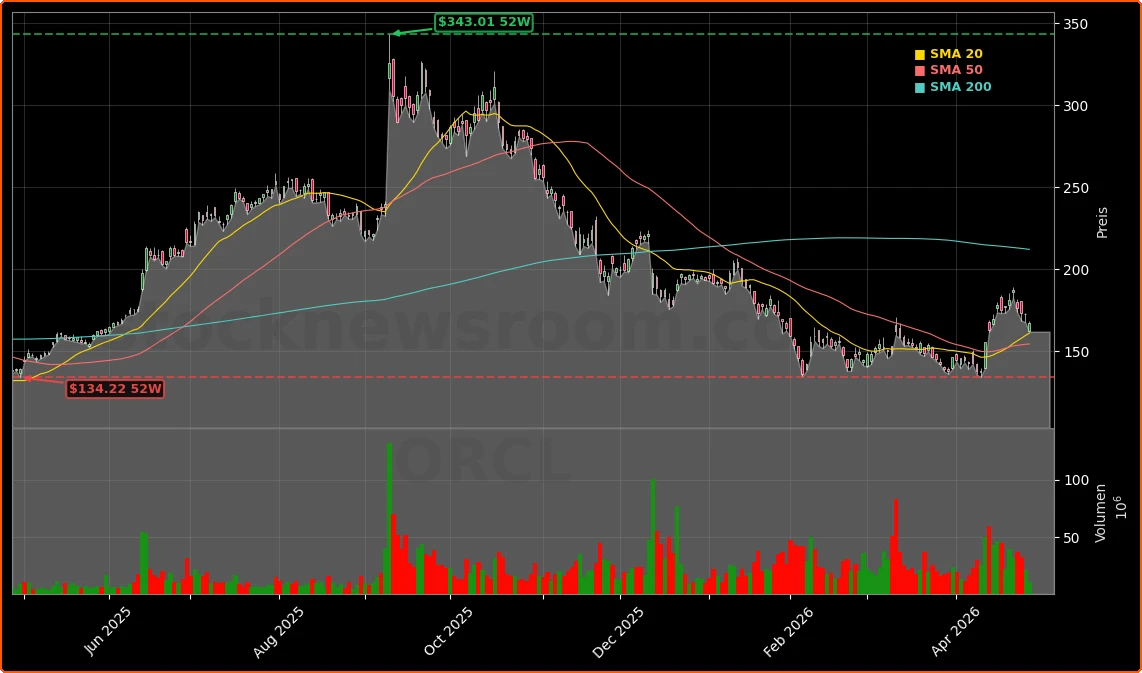
US-listed AI infrastructure names slumped in early Tuesday trading. Oracle Corporation at one point dropped more than 6% before paring losses to a 3.3% decline around midday. Chipmakers tied closely to the OpenAI ecosystem, including NVIDIA, Advanced Micro Devices (AMD), Broadcom and Qualcomm, also traded lower, with moves between roughly 2% and 5% earlier in the session. Levered AI cloud operator CoreWeave saw even steeper declines, while Japan’s SoftBank Group, a major OpenAI backer, fell sharply in Tokyo.
The market reaction reflects growing concern that AI demand, while strong, may not grow fast enough to justify the unprecedented capital spending cycle underway across cloud infrastructure and semiconductor supply chains.
How exposed is Oracle to OpenAI?
Oracle is viewed as one of the most exposed public companies to OpenAI’s infrastructure commitments. The company has signed a multi-year cloud agreement with OpenAI to supply computing power for training and running large language models, widely reported in markets as one of the largest AI infrastructure deals ever structured. Traders now worry that if OpenAI’s revenue trajectory slows, some of these obligations could be revisited, delayed or resized, directly impacting Oracle’s growth narrative.
Unlike hyperscale rivals Apple’s main cloud partners such as Amazon and Microsoft, Oracle is still in the process of scaling its AI-focused data center footprint and is heavily investing ahead of cash flow. Oracle OpenAI revenues are therefore seen as a critical pillar supporting the company’s capital-intensive expansion strategy.
Credit markets are reacting as well. Prices for credit default swaps on Oracle Corporation—insurance-like contracts that protect bondholders against default—have widened, signaling that fixed income investors are demanding a higher risk premium as Oracle ramps up debt to finance AI campuses in locations such as New Mexico and Michigan.
What does this mean for Oracle’s AI data center plans?
The Oracle OpenAI headlines arrive just as the company is accelerating its physical AI build-out. In New Mexico, Oracle has partnered with BorderPlex and Bloom Energy on “Project Jupiter,” a next-generation AI data center campus that plans to deploy up to 2.45 gigawatts of Bloom fuel cells instead of traditional gas turbines and diesel backup. The project is designed to slash NOₓ emissions and water consumption, but it also requires substantial upfront capital and long-term power commitments.
Separately, real estate group Related Digital and private equity giant Blackstone have arranged roughly $16 billion in financing for a massive Oracle-backed AI data center complex in Michigan. Banks including Bank of America are deeply involved in structuring these loans, underscoring how far Wall Street has leaned into the AI infrastructure theme. The OpenAI slowdown story is now casting a shadow over these projects, as investors question whether end-user demand can fully absorb the capacity being built.
Research houses remain divided. Some, like BMO Capital Markets in its latest work on Bloom Energy, still see Oracle-linked data center demand as a powerful multi-year driver. Others, including analysts at boutiques such as Melius Research, have recently flagged Oracle as more vulnerable than peers if AI workloads consolidate around a smaller set of hyperscale players.
How are investors and analysts positioning?
Despite the volatility, the broader selloff has not yet triggered a wholesale downgrade cycle. Zacks currently lists Oracle Corporation in the “buy range,” and a range of large institutions continue to add to positions. For example, Eagle Wealth Advisors disclosed a fresh stake in ORCL, signaling that some long-term investors still view pullbacks as opportunities to gain exposure to the AI infrastructure theme at lower prices.
At the same time, the OpenAI disappointment comes on top of an already choppy period for Oracle. The stock slid after its most recent earnings report, even though revenue and EPS topped expectations, as investors focused on rising capex and mixed guidance for AI-related margins. ETFs with heavy Oracle weightings, including major tech-focused funds on the NASDAQ and S&P 500, have been under review by portfolio managers assessing concentration risk in AI-heavy names.
The key question for the next few quarters is whether Oracle’s AI cloud business can diversify beyond the Oracle OpenAI relationship. Management has highlighted wins in industries ranging from financial services and healthcare to anti–money laundering software, but Tuesday’s price action shows that Wall Street still views OpenAI as the single biggest swing factor for the stock.
Related Coverage
The OpenAI miss will have an impact throughout the entire AI infrastructure ecosystem, with Oracle as the most exposed in terms of risk to its financial goals.— Anurag Rana, Technology Analyst at Bloomberg Intelligence
For a deeper dive into Oracle’s broader AI spending debate, including a recent hardware contract reversal, readers can review “Oracle Server Cancellation -4.8% Shock for AI Spend”. That analysis explores whether a major server order cut represents a healthy reset in AI capex or an early sign that the current boom may be losing momentum, providing important context for today’s Oracle OpenAI-driven volatility.