Can the new Oracle Defense Deal with the Pentagon turn today’s sharp stock surge into a lasting edge in the AI cloud wars?

How is Oracle reacting on Wall Street today?
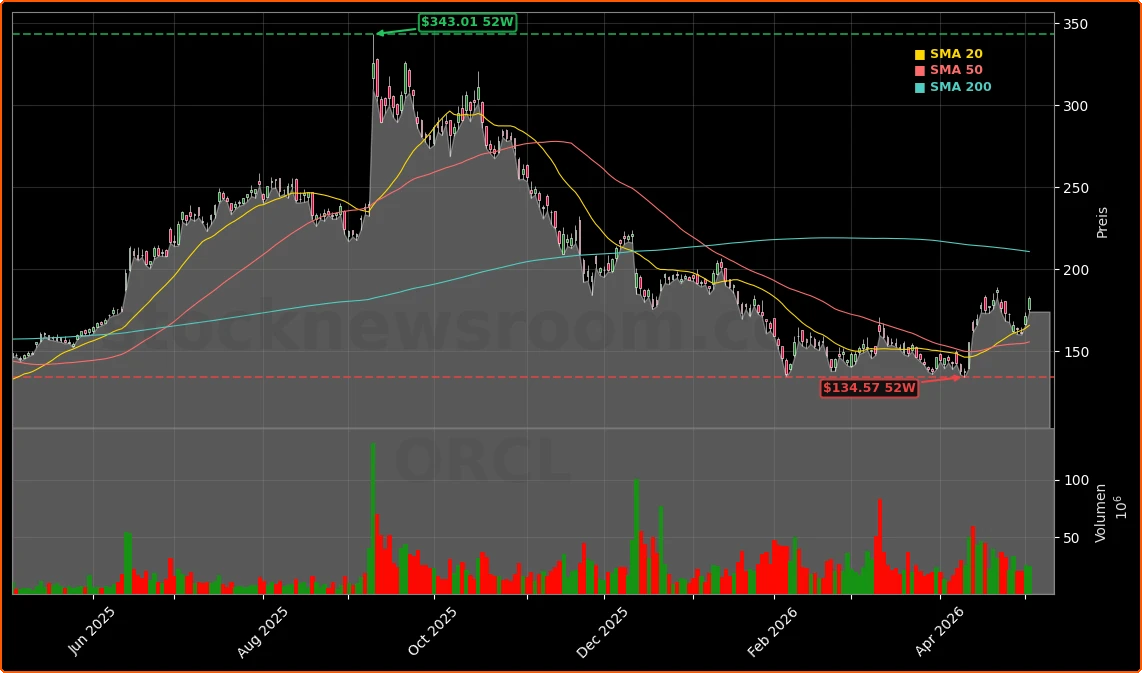
Oracle Corporation outperformed the broader technology space on Monday, with the stock climbing 6.25% to $182.56 versus a previous close of $171.61. The move comes as the company trades in the lower half of its 52-week range of $134.57 to $345.72, underscoring how far the shares had fallen before this rebound attempt. Technically, Oracle now sits about 8.9% above its 20-day simple moving average and 6.1% above its 100-day SMA, a constructive setup for short‑ to intermediate‑term traders.
Momentum indicators are more cautious. The MACD remains below its signal line with a negative histogram, signaling that while price is moving higher, upside momentum is not accelerating. Key resistance looms near $189, an area where previous rallies stalled, while support has been forming around $170.50. In that context, Monday’s push fueled by the Oracle Defense Deal looks like an important test of whether bulls can finally break out of the recent trading band.
What makes the Oracle Defense Deal significant?
The new Oracle Defense Deal gives the company a foothold in some of the most sensitive U.S. military systems. Oracle will deploy advanced AI capabilities on classified Defense Department networks to enhance decision‑making and operational effectiveness. The agreement highlights Oracle’s pitch as a secure, high‑performance cloud provider capable of handling sensitive workloads that rival offerings from NVIDIA-powered cloud platforms, Microsoft Azure, and Amazon Web Services.
Strategically, the contract validates Oracle’s effort to weave generative and so‑called agentic AI directly into its database, ERP, and industry applications stack. Management has framed national security as a core use case for its next‑generation cloud regions, and the Oracle Defense Deal signals that the Pentagon is willing to trust those claims in real‑world deployments. While financial terms were not disclosed, the reputational impact could be substantial, particularly as other government agencies and allied defense ministries evaluate their own AI modernization plans.
How does this reshape Oracle’s AI and cloud story?
For investors, the Oracle Defense Deal lands at a pivotal moment. Oracle has committed tens of billions of dollars to build out AI‑optimized data centers and GPU clusters, including capacity associated with its high‑profile partnership with OpenAI. Morgan Stanley estimates that major hyperscalers such as Oracle, Microsoft, and Alphabet could collectively spend about $805 billion on AI infrastructure in 2026, rising to roughly $1.1 trillion in 2027, providing a massive tailwind for cloud infrastructure providers. The Pentagon win reinforces the idea that Oracle can capture a slice of that spend outside of commercial internet workloads.
At the same time, the aggressive build‑out has raised financing and balance sheet concerns. Reports suggest Oracle is working to fund a huge data‑center expansion tied to OpenAI even as U.S. banks bump up against internal exposure limits. The company is reportedly exploring up to $50 billion in stock and bond issuance and may ultimately need significantly more. To preserve margins and cash flow, Oracle has already begun workforce reductions that could reach tens of thousands of employees. That mix—heavy capex, a leaner workforce, and now a marquee defense customer—defines the risk‑reward profile investors must weigh.
How are analysts and institutions reacting?
Despite recent volatility, Wall Street remains broadly constructive on Oracle’s AI trajectory. Morgan Stanley has been vocal about the scale of AI‑related capital spending, and its outlook indirectly supports Oracle’s long‑term narrative as a critical infrastructure player. On the ownership side, FSA Advisors recently increased its stake in Oracle by more than 700%, citing the company’s stronger‑than‑expected quarterly results, including $1.79 in EPS on $17.19 billion in revenue. The stock carries a “Moderate Buy” consensus rating and an average price target around $259.56 among major brokerages, including firms such as Citigroup and Goldman Sachs that have highlighted Oracle as a key AI and cloud beneficiary.
Not all institutional flows are one‑way. Peregrine Asset Advisers sharply cut its Oracle position, and some insiders have trimmed holdings after the stock’s recovery from its April lows. Other asset managers, including CENTRAL TRUST and Vanguard, have modestly adjusted positions but largely maintained Oracle as a core large‑cap technology exposure. For now, the Oracle Defense Deal appears to be tipping sentiment back toward the bulls, especially among investors looking for AI infrastructure plays that trade at a discount to mega‑cap leaders like Apple and Tesla.
Where does Oracle stand versus other AI leaders?
Oracle’s latest move puts it in closer strategic proximity to hyperscale peers that are already entrenched in defense and intelligence work. Microsoft and Amazon Web Services have long‑running cloud deals with the Pentagon, while NVIDIA dominates the AI chip layer that powers many of those platforms. Oracle’s differentiator is its integrated stack: databases, applications, and cloud infrastructure tailored for mission‑critical, high‑security environments. Being recognized as a leader in AI‑enabled customer experience platforms alongside Salesforce in recent industry research adds another proof point that the company can compete in next‑gen software categories, not just legacy databases.
From a sector perspective, technology is currently the top‑performing group in the S&P 500, up sharply over the past 30 and 90 days. Oracle’s outperformance versus the sector on Monday suggests investors are treating the Oracle Defense Deal as more than just a headline pop—rather, as a potential inflection point in the company’s multiyear transition from on‑premise software vendor to AI‑first cloud platform.
Related Coverage
Investors looking for deeper context on Oracle’s AI‑driven rally can review recent coverage such as “Oracle AI Infrastructure Soars 7.6% in Rally Shock”. That analysis dives into whether Oracle’s multibillion‑dollar AI infrastructure bet can justify sharp short‑term price moves after weeks of selling pressure. Taken together with today’s Oracle Defense Deal, the article helps frame how quickly sentiment can swing as the market digests new AI contracts and spending plans.
In summary, the Oracle Defense Deal cements Oracle’s status as a credible player in secure AI cloud infrastructure and has reignited interest in the stock after a deep pullback. For U.S. investors, the contract reinforces the view that Oracle offers differentiated AI exposure alongside, not instead of, the usual mega‑cap leaders. The next few quarters—especially updates on defense workloads, OpenAI‑related capacity, and financing plans—will show whether Monday’s surge marks the start of a more durable uptrend for Oracle’s AI transformation story.