Can blockbuster Apple Earnings and a surprise outlook justify the latest rally, or is investor optimism running too far ahead?

How did Apple Earnings move the stock and the indexes?
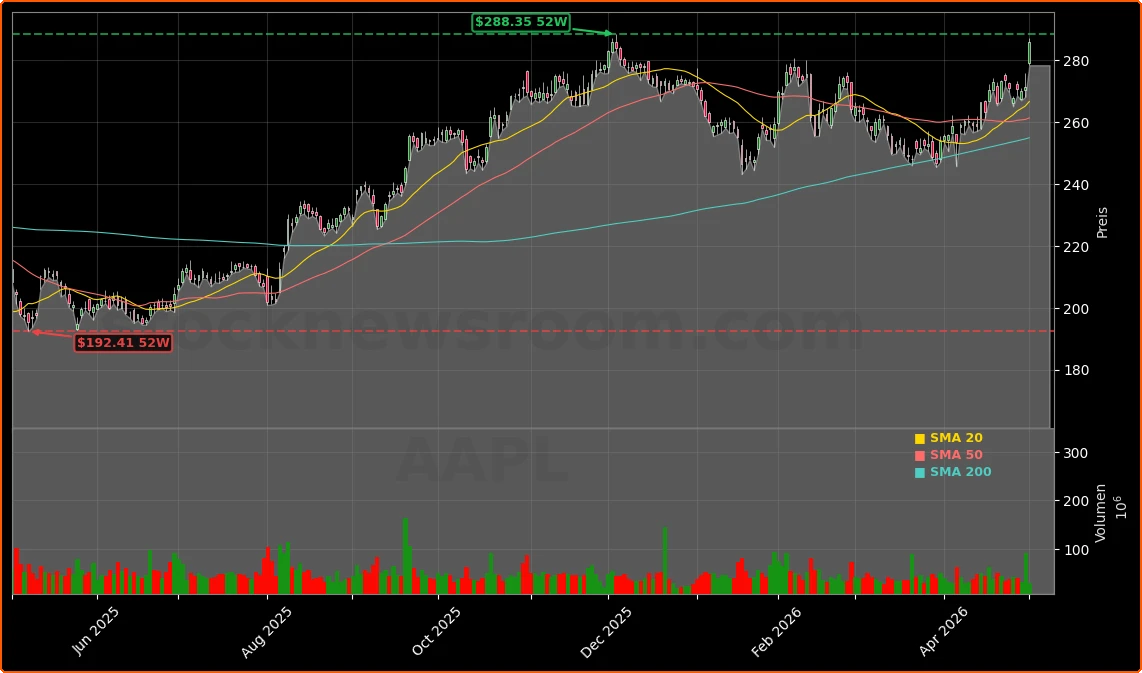
Shares of Apple (AAPL) traded around $285.80 on Friday afternoon ET, up more than 5% from the prior close of $276.54 and within a few dollars of the 52-week high near $288. The rally put the company on track for its highest close since late 2025 and helped lift the S&P 500 and Nasdaq toward new records. With a market cap near $4 trillion, Apple’s post-report jump was one of the main drivers of Friday’s positive tone on Wall Street.
Investors cheered a clean earnings beat and a stronger-than-expected revenue outlook for the June quarter, even as management highlighted rising component costs. The latest Apple Earnings reinforced the stock’s role as a bellwether for consumer tech demand at a time when peers like NVIDIA and other AI leaders are spending heavily on data centers rather than handing cash back to shareholders.
What is behind Apple’s record quarter?
For its fiscal second quarter, Apple Inc. reported revenue of about $111.2 billion, up 17% year over year and ahead of Wall Street estimates near $109.7 billion. EPS climbed 22% to $2.01, beating the roughly $1.95 consensus. Gross margin reached an iPhone-era record around 49.3%, showing that the company is still able to command premium pricing even as component costs rise.
iPhone revenue increased almost 22% to about $57 billion, fueled by strong demand for the iPhone 17 lineup, including the aggressively priced iPhone 17e. Tim Cook called demand “off the charts” and noted that Mac and the new MacBook Neo are supply constrained for “several months” as consumers and developers snap up AI-capable hardware. Services revenue hit roughly $31 billion, up 16% year over year, setting another all-time high and providing a high-margin buffer against hardware cost pressures.
Greater China was a standout. Revenue there climbed around 28% to $20.5 billion after a period of underperformance, helped by share gains against local Android rivals struggling more with soaring memory prices. Several analysts argued that China has flipped from a headwind to a tailwind in the near term, a key shift embedded in the new guidance.
How strong is Apple’s new guidance and capital return plan?
Looking ahead, management expects June-quarter revenue to grow between 14% and 17% year over year, implying sales of roughly $107.2 billion to $110.0 billion. That is well above Wall Street estimates around $103 billion and suggests the current iPhone super-cycle has more room to run even under chip-supply constraints. The company guided gross margin only modestly lower, to roughly 47.5%–48.5%, despite warning that memory costs will be “significantly higher” beyond the June quarter.
At the same time, the board authorized up to $100 billion in additional share repurchases and raised the quarterly dividend by 4% to $0.27. Several major firms responded by lifting price targets. Wedbush’s Dan Ives maintained an “Outperform” rating and a $350 target, calling this the start of a potential “golden era.” Goldman Sachs raised its target to $340 while keeping a “Buy” rating, citing robust iPhone, Mac and Services momentum and disciplined cost management. Morgan Stanley also remains overweight with a new target reportedly in the low $330s, highlighting what it called “remarkable” margin resilience.
Others are more cautious. Barclays kept an “Underweight” call and a $253 target, arguing that investors still need clearer detail on Apple’s long-term AI strategy. Nonetheless, the consensus on Wall Street remains a “Moderate Buy,” with many strategists pointing to the combination of double-digit growth, rich cash returns and relatively modest AI capex as attractive in a market obsessed with infrastructure spending.
What do rising memory costs and AI mean for Apple?
Despite the strong Apple Earnings, Cook spent considerable time warning about a global memory crunch. Surging demand from AI data centers—driven by advanced accelerators from companies like NVIDIA—has pushed up DRAM and NAND prices, making memory for smartphones and PCs more expensive and harder to source. Cook said Apple expects “significantly higher” memory costs after the June quarter and is evaluating a “range of options,” including longer-term supply deals and product-pricing adjustments.
Even so, Apple has so far avoided broad-based price hikes and continues to lean on its Services mix and premium positioning to preserve margins. Research firms expect the memory shock to hurt low-end Android manufacturers more severely, potentially allowing Apple and Samsung to gain share at the high end. Analysts at Goldman Sachs and others argue that Apple’s scale gives it negotiation leverage that smaller OEMs simply do not have.
On AI, Apple continues to lag the rhetoric of peers like Meta and Microsoft, but the latest quarter hinted at a strategic shift. R&D spending jumped roughly 34% year over year, and management emphasized upcoming AI-enabled features such as a smarter Siri and on-device “Apple Intelligence” enhancements, partly supported by partnerships with external model providers. Dan Ives at Wedbush estimates that consumer AI monetization across the ecosystem could add $10–$15 billion in annual revenue over time if Apple executes.
How does the CEO transition shape the outlook?
Beyond the headline Apple Earnings, investors are closely watching the leadership handoff from Tim Cook to hardware chief John Ternus, set for September 1. Cook framed his exit as coming from a position of strength, noting this was his 89th earnings call and that the company enters the transition with record device installed base, robust margins and a strong product roadmap.
Ternus, who led the development of key devices like recent iPhones and Macs, has signaled continuity on financial discipline while emphasizing product innovation. He is expected to oversee the launch of Apple’s first foldable iPhone and higher-end models like a potential iPhone Ultra, alongside a revamped AI-first Siri experience. For long-term shareholders, the combination of a still-powerful hardware cycle, growing Services cash flows and a more assertive AI push will be central to whether the stock can break sustainably above its prior all-time high near $286 and close the performance gap with AI leaders over the next few years.
Related Coverage
For a deeper dive into how this quarter fits into the company’s longer-term trajectory and buyback story, readers can review Apple Earnings Record: $111B Revenue Surge And Buybacks, which examines whether record revenue and massive capital returns can keep powering the stock as Apple heads into the post-Cook era.
Apple’s monster iPhone growth, robust Services and emerging AI strategy put this tech stalwart on the doorstep of a golden era.— Dan Ives, Wedbush Securities
In sum, the latest Apple Earnings show a company firing on most cylinders, using its balance sheet to reward shareholders while keeping AI spending measured. For U.S. investors, the story now hinges on whether iPhone 17 momentum, China’s renewed strength and an evolving AI roadmap can offset higher memory costs. The next few quarters under John Ternus will be crucial in determining if Apple’s “golden era” narrative becomes reality for long-term portfolios.