
Can Lucid’s latest earnings shock, billion‑dollar cash raise and Gravity delays still add up to a credible EV growth story?

How fragile is Lucid’s market standing?
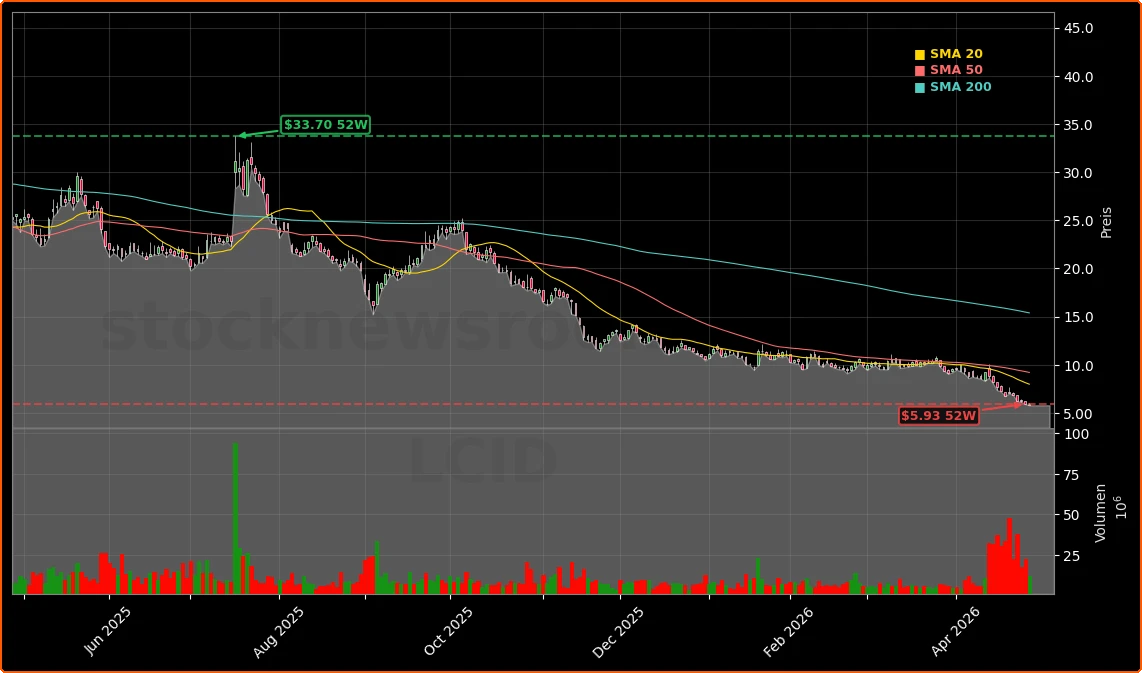
At a share price of $5.89 and a market capitalization near $2 billion, Lucid Group, Inc. sits far below the mega‑cap peers that dominate the NASDAQ and S&P 500. While established EV leader Tesla commands the bulk of investor attention and AI chip powerhouse NVIDIA drives much of the NASDAQ’s gains, Lucid’s stock has moved in the opposite direction after it telegraphed weak first‑quarter figures. The April pre‑announcement triggered a slide of roughly 36%, underlining how sensitive sentiment has become around dilution, cash burn and execution risk.
Unlike diversified tech giants such as Apple, Lucid remains a single‑product, loss‑making EV manufacturer, making each earnings update disproportionately important. That is why the next set of Lucid Earnings is not just about historical numbers, but about whether management can persuade Wall Street that the path to scale, margins and positive cash flow is still intact.
What do the pre-announced Lucid earnings show?
In mid‑April, Lucid shared preliminary Q1 figures that underscored the magnitude of its current challenges. Management indicated revenue in a narrow range of about $280 million to $284 million, dramatically below prior Wall Street expectations of roughly $434 million. On the profitability side, Lucid projected an operating loss between $985 million and just over $1 billion, a sharp deterioration from the roughly $692 million operating loss reported in the comparable quarter a year earlier.
For U.S. growth investors accustomed to high‑burn stories in their portfolios, the direction of travel matters as much as the level. The widening loss shows that Lucid is still in heavy investment mode and has yet to demonstrate operating leverage. At the same time, the revenue miss raises concerns about either demand, pricing power or the company’s ability to convert production into deliveries and recognized sales.
Why did Lucid raise more than $1 billion?
Alongside the preliminary Q1 numbers, Lucid announced a sizable financing package, securing $750 million from two existing investors and launching a $300 million secondary offering, for a total of $1.05 billion in fresh capital. The move extends the company’s cash runway, giving management more time to scale operations and complete the ramp‑up of new models like the Gravity SUV.
For existing shareholders, however, the raise also means dilution and a reminder that Lucid remains dependent on external funding. In a higher‑rate environment where many institutions are rotating toward profitable S&P 500 names, this trade‑off is critical. The bullish interpretation is that the company has secured the cash it needs before conditions worsen; the bearish take is that the need for capital at this stage confirms how far Lucid still is from self‑funding growth.
Is Gravity the key to future Lucid earnings?
Production data for the first quarter helps explain why the latest Lucid Earnings look weak on the surface. Lucid reported building 5,500 EVs in the period but delivering only 3,093, leaving more than 2,000 vehicles in limbo. Management attributed the gap primarily to a quality issue affecting the second‑row seats in the new Gravity SUV, which disrupted deliveries for 29 days.
The company has indicated that the seat issue has been resolved and reiterated full‑year production guidance of 25,000 to 27,000 vehicles. If those delayed Gravity units are handed over to customers by the end of June, much of the Q1 revenue shortfall could be a timing effect rather than a structural collapse in demand. For investors, the real test is whether the next couple of quarters show a clean conversion of production into deliveries, a stabilizing order book and steadily improving contribution margins on each vehicle sold.
How is Wall Street positioned on Lucid stock?
Major U.S. brokerages have grown increasingly cautious on high‑risk EV names, and Lucid is no exception. While specific price targets and ratings vary by firm, banks like Morgan Stanley, Goldman Sachs and RBC Capital Markets have generally emphasized the need for disciplined capital allocation, clearer visibility on volume ramp‑up and evidence of cost improvements before committing to more constructive stances. Some analysts continue to rate Lucid in neutral buckets such as “Equal Weight” or “Sector Perform,” signaling that the shares might trade more on company‑specific headlines than on broader NASDAQ trends.
For now, Lucid is not among the favored growth stories highlighted by large U.S. research teams in the way that NVIDIA or other AI beneficiaries are. That leaves the stock in a kind of limbo: too speculative for conservative income portfolios, but not yet a consensus high‑growth winner for aggressive investors. The next Lucid Earnings call will therefore be an important catalyst for any shift in institutional positioning.
Related Coverage
Investors looking for more background on the company’s strategic challenges can read a detailed breakdown of valuation risks and cash burn in Lucid Strategy -5.2% Plunge Tests Lofty Valuation. That analysis explores whether Lucid’s ultra‑premium focus is sustainable amid mounting losses, product issues and share‑price pressure, and it complements the earnings‑driven perspective in this article.
Overall, Lucid Earnings highlight a company at a crossroads: still burning large amounts of cash, but now backed by an expanded capital buffer and a potentially powerful Gravity ramp‑up. For investors in the U.S. and abroad, Lucid remains a high‑beta EV speculation rather than a core holding, yet the next few quarters could offer outsized upside if execution finally catches up with the technology. The upcoming results and guidance will show whether management can turn a one‑quarter timing setback into the first step toward a more sustainable growth trajectory.