
Will Munich’s new Uber Minimum Fares become a European template that reshapes ride-hailing margins and investor expectations for Uber?

How do Uber Minimum Fares work in Munich?
Munich’s city council has decided that app-based ride providers must now comply with a structured tariff that mirrors the local taxi framework, effectively creating Uber Minimum Fares in the Bavarian capital. For rides with Uber, Bolt and similar services, a base fare of 5.13 EUR will apply. For journeys up to seven kilometers, the per‑kilometer rate is set at 2.43 EUR, dropping slightly to 2.25 EUR beyond that distance. Importantly, mandatory taxi surcharges will not be added to these app-based rides, so the total remains somewhat below traditional cab prices.
The new Uber Minimum Fares are scheduled to take effect on July 1 and follow years of conflict between traditional taxi operators and app platforms. City officials argue that ride-hailing drivers have been transporting passengers at roughly 40% lower prices than taxis, undercutting incumbents and allegedly fueling widespread non-compliance with labor, social-security and minimum-wage rules. Local unions and taxi drivers had staged demonstrations and explicitly demanded minimum prices as a tool for what they describe as fair competition.
On the other side, Bolt has publicly attacked the move as a de facto “taxi tax,” calling it a politically mandated price hike for everyday mobility that primarily hurts consumers and shields one sector from competition. Bolt also emphasized that its talks with the city were, from its perspective, ongoing and not conclusively failed, signaling that operators may continue to push for modifications or carve-outs before or after implementation.
What does this mean for Uber in Europe?
For Uber Technologies, Inc., the Munich rules are another indication that European cities are willing to intervene directly in pricing, not just licensing. The Uber Minimum Fares framework undermines Uber’s ability to use aggressive discounting to gain share and could slow volume growth in Germany’s high-income markets. It also increases operational complexity, as the company has to localize pricing logic in each jurisdiction while keeping driver earnings compliant with local labor standards.
The regulatory risk is not new for Uber, which has already faced court battles over driver status in the U.K. and elsewhere in the EU. However, explicit fare regulation is particularly sensitive for investors because it directly impacts the company’s revenue per trip and elasticity of demand. While Munich is only one city, other European municipalities could see Uber Minimum Fares as a blueprint, especially where taxi lobbies remain politically influential.
In parallel, investors are watching how ride-hail regulation intersects with Uber’s broader strategy. The company is deepening its logistics arm, Uber Freight, which has flagged a tightening U.S.-Mexico trucking market driven more by compliant-driver scarcity and security requirements than by pure demand. That business relies less on consumer price sensitivity and more on contract logistics, which could partially offset margin pressure in regulated urban ride-hailing markets.
How are markets and analysts reacting to Uber?
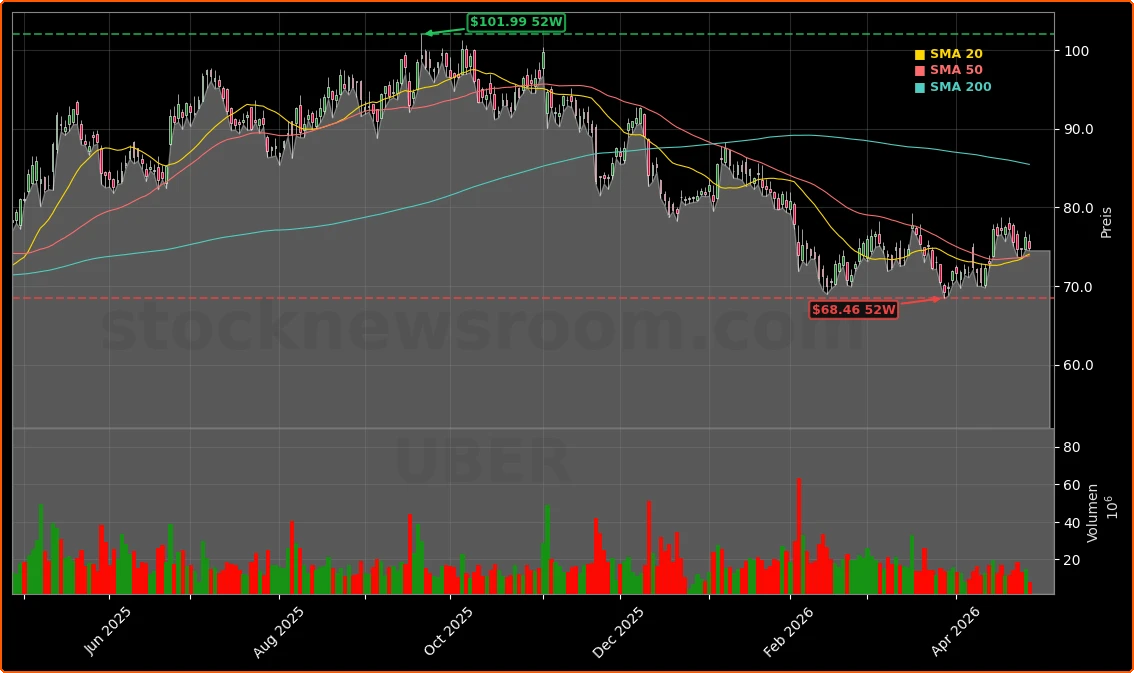
On Tuesday, Uber stock traded at $74.77, about 1.97% below the previous close of $76.50 in intraday New York trading. The move comes after a strong 12‑month run that has already priced in significant profitability improvements across mobility and delivery. The new Uber Minimum Fares debate in Europe may not yet be a primary driver of the share price, but it adds to a list of overhangs that includes macro uncertainty, fuel costs and evolving labor regulations.
Wall Street remains broadly constructive on the name. Analysts at Goldman Sachs have highlighted Uber’s diversified platform and improving free cash flow profile as key supports for a Buy rating and an above-market price target. Morgan Stanley similarly rates the stock Overweight, pointing to upside from higher-margin products like memberships and advertising within Uber Eats. Citi continues to see Uber as a core mobility play leveraged to urban recovery, though it has repeatedly warned that regulatory shocks in Europe can compress multiples if they accelerate.
Compared with other platform heavyweights like Apple or Tesla, Uber still trades more on growth and regulatory narratives than on dividends or buybacks. Unlike NVIDIA, which is currently driven by AI data center demand, Uber’s story remains tied to real-world infrastructure, driver compliance and local politics. The Uber Minimum Fares decision underscores that the company cannot fully escape city-level policymaking, even as it tries to automate parts of its network and expand into freight.
Can Uber offset pressure with automation and freight?
Investors are also weighing whether Uber’s long-term bets can blunt the impact of local tariffs such as Uber Minimum Fares. On the autonomous side, the company has struck major partnerships, including a multibillion-dollar robotaxi framework that involves thousands of electric vehicles and could reshape its cost structure over time. These efforts are designed to reduce reliance on human drivers, particularly in dense cities where labor rules and price regulations are tightening.
Meanwhile, Uber Freight is navigating what executives describe as “phantom capacity” in the U.S.-Mexico corridor. Capacity that appears available on paper is often unusable due to heightened security requirements and stricter compliance rules for cross-border drivers. Rather than a classic demand surge, the segment is experiencing a supply-driven tightening, pushing shippers toward mini-bids and shorter-term contracts. If Uber can position itself as a reliable orchestrator of compliant capacity there, the freight unit could become a more stable earnings contributor even as urban ride-hailing margins come under pressure.
Related Coverage
For investors interested in how Uber is trying to future-proof its business model beyond debates over Uber Minimum Fares, it is worth examining the company’s autonomous strategy. A recent deep dive looks at whether a large-scale electric robotaxi partnership could transform an ailing EV maker into a central pillar of Uber’s self-driving ambitions. The analysis, available at Uber Lucid Robotaxi Boom: $1.05B Bet on 35,000 EVs, discusses capital commitments, deployment timelines and the competitive landscape across U.S. cities.
Overall, Munich’s new Uber Minimum Fares signal that price regulation is becoming a tangible headwind for Uber Technologies, Inc. in key European markets. For U.S. investors, the move is a reminder to discount elevated regulatory risk into long-term models while still recognizing Uber’s progress in freight and automation. The next few quarters will show whether diversified growth can outpace city-level constraints and keep the stock’s upward trajectory intact.