Is the aggressive Microsoft AI Strategy a value-creating moonshot or an overbuilt capex gamble that could spook investors for years?

How is Microsoft trading after the rebound?
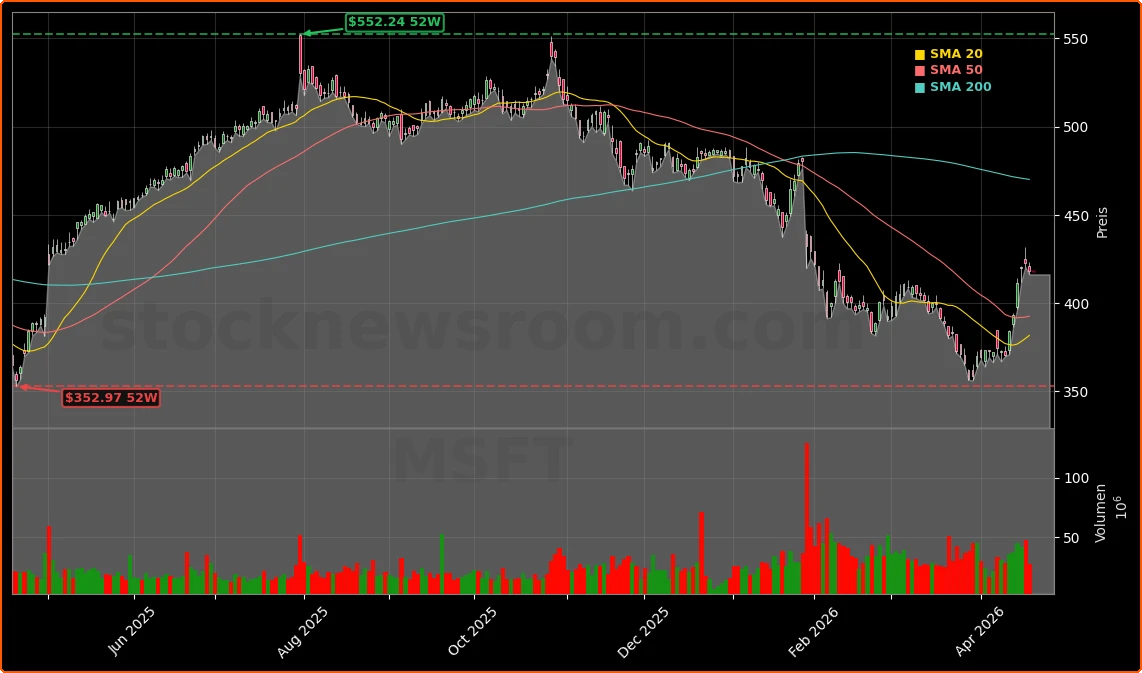
Microsoft (MSFT) ended regular trading on Monday at $418.07, down 1.12%, with after‑hours trading slipping another 0.14% to $417.50. The move comes after the stock logged its best week in over a decade, rallying nearly 14% from recent lows as software and AI names bounced across the NASDAQ and S&P 500. Despite the rebound, Microsoft remains more than 15% lower year to date and was close to 30% off its late‑2025 peak at the trough of the sell‑off, underscoring just how sharply sentiment turned on high‑multiple AI beneficiaries.
Valuation is still elevated by historical standards, and that leaves little room for disappointment as investors head into the next earnings catalyst. Wall Street will focus heavily on how fast AI‑driven cloud demand translates into revenue and whether management signals any moderation in the massive AI build‑out that has unnerved more conservative shareholders.
Why is AI capex spooking investors?
The core of current concern around the Microsoft AI Strategy is capital intensity. In the fiscal second quarter of 2026 (ended Dec. 31, 2025), Microsoft spent roughly $37.5 billion on capital expenditures, largely on advanced semiconductor hardware like GPUs and CPUs to power its AI and cloud infrastructure. Bears argue these chips have relatively short economic lifespans and could quickly be eclipsed by new generations from suppliers such as NVIDIA, raising the risk of overbuilding capacity that does not fully earn its cost of capital.
That spending wave weighs on free cash flow in the near term and raises questions about the timing of any margin rebound. Some portfolio managers now frame Microsoft as a test case for the broader hyperscaler group, including Amazon and Alphabet: if Microsoft over‑invests and returns lag, the whole AI infrastructure bull case for mega‑cap tech could come under pressure.
What upside do analysts still see in Microsoft?
Despite those jitters, several Wall Street firms remain constructive on the Microsoft AI Strategy. Benchmark analyst Yi Fu Lee recently reiterated a buy rating, calling the pullback an “attractive buying opportunity” and assigning a $450 price target, implying around 10% upside from current levels. Other strategists in Europe have floated medium‑term targets between $470 and $500, often combined with derivative structures such as conservative certificates that aim for roughly 50% maximum return if Microsoft trades above $410 by September.
From a fundamental standpoint, bulls argue that Microsoft’s software and cloud franchises give it unusual visibility. The Microsoft 365 productivity suite counts nearly 345 million paid seats and more than 321 million active users, providing a massive installed base into which AI features like Microsoft Copilot can be cross‑sold. In the latest reported quarter, revenue grew 17% year over year to $81.3 billion, with CEO Satya Nadella highlighting that Microsoft’s AI business is already larger than some of the company’s legacy franchises.
Is Azure still the engine of long‑term growth?
Cloud remains central to the Microsoft AI Strategy. Azure now holds roughly 21% global cloud infrastructure market share, second only to Amazon Web Services. Management has pointed to a cloud backlog of about $625 billion, reflecting multi‑year customer commitments as enterprises migrate workloads and deploy AI models on hyperscale platforms. Research firm Grand View Research recently estimated the cloud market at $945.65 billion, with expectations it could approach $3.35 trillion by 2033, implying a compound annual growth rate near 16%.
For U.S. investors, that backdrop supports the case that Microsoft can grow into its valuation if it continues to capture a disproportionate slice of AI‑driven cloud workloads. Nadella has drawn a direct parallel between today’s AI build‑out and the heavy cloud investments Microsoft made around 2014—spending that initially drew criticism but ultimately proved highly accretive as Azure scaled. If history rhymes, current margin pressure could set the stage for structurally higher earnings power later in the decade.
How does the hyperscaler race shape the risk?
Competitive dynamics are tightening. Microsoft’s partnership with OpenAI pits it directly against Amazon’s alliance with Anthropic, which recently expanded into a multibillion‑dollar commitment to run Anthropic’s large language models on AWS. That deal is meant to reignite AWS growth and could limit Microsoft’s pricing power in AI infrastructure if the three main hyperscalers—Amazon, Microsoft and Alphabet—enter a prolonged capacity arms race.
At the same time, software ecosystems are forming around these platforms. Adobe, for example, has been deepening collaborations with Microsoft, Anthropic, OpenAI and NVIDIA to embed generative AI into creative and enterprise tools. For Microsoft shareholders, such partnerships help validate Azure and Copilot as default choices for corporate IT buyers. But they also underscore how fiercely companies like Apple and Tesla are racing to infuse AI into hardware and services, raising the bar for differentiated offerings across the S&P 500’s mega‑cap cohort.
Related Coverage
Investors who want a closer look at the latest price action can review how a sharp short‑term rally has shifted sentiment in “Microsoft AI Strategy Soars +5.1% in Surprise Rally“, which examines whether Wall Street is beginning to re‑rate the stock after months of doubt. For a broader view of the hyperscaler race, “Amazon Anthropic Deal: $25B AI Boom Bet on AWS Growth” breaks down how Amazon’s alliance with Anthropic could reshape competitive dynamics in cloud AI and influence how investors value Microsoft, Amazon and Alphabet.
We are only at the beginning phases of AI diffusion and already Microsoft has built an AI business that is larger than some of our biggest franchises.— Satya Nadella, CEO of Microsoft
In summary, the Microsoft AI Strategy combines aggressive near‑term capex, a powerful software and cloud base, and intensifying competition across the AI landscape. For U.S. investors, the stock remains a high‑beta play on enterprise AI adoption, with upside tied to whether Azure and Copilot can monetize faster than spending grows. The next quarterly report on April 29 will be crucial in showing whether Microsoft is turning its AI bet into durable revenue and margin expansion, keeping the stock at the center of Wall Street’s AI narrative.