Are blockbuster Microsoft Earnings enough to offset Wall Street’s growing anxiety over an unprecedented AI capex boom?

How did the latest Microsoft Earnings land on Wall Street?
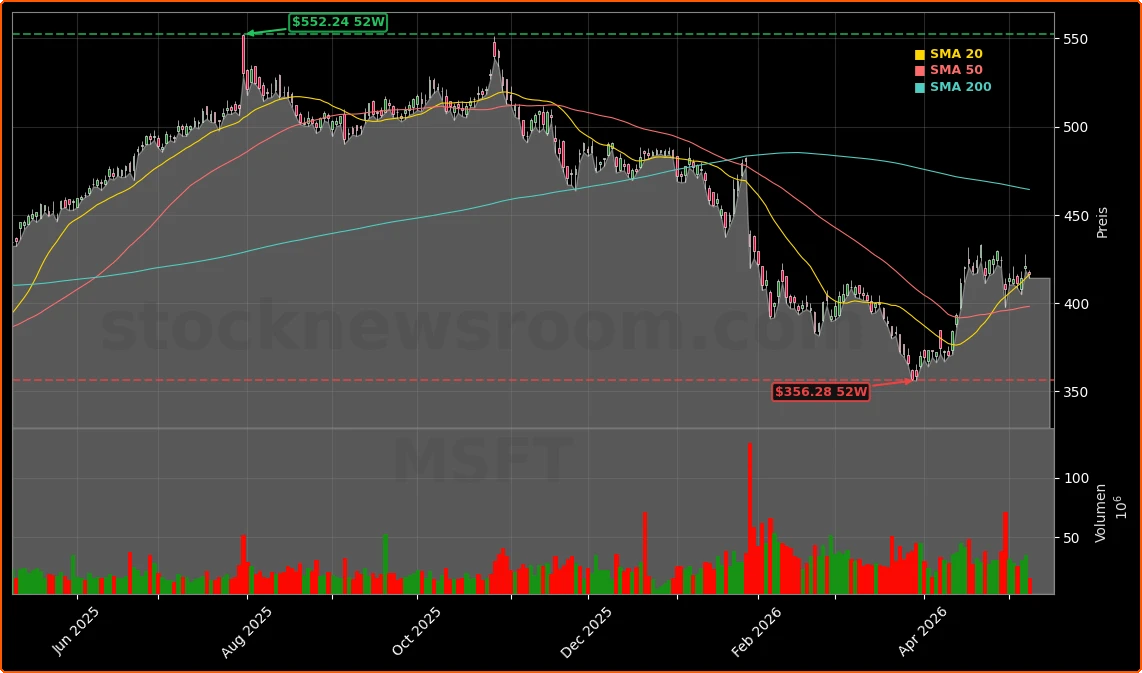
Microsoft Corporation closed at $416.76 on Friday, off its previous $420.93 close and still well below its 52-week peak, even after a powerful rebound in April and early May. The most recent Microsoft Earnings release, covering fiscal Q3 2026 (quarter ended March 31), delivered adjusted EPS of $4.27 on revenue of $82.89 billion, topping consensus forecasts of $4.06 EPS and $81.39 billion in sales. Revenue grew 18% year over year, while earnings expanded about 23%, underscoring how AI and cloud remain firm growth engines despite macro headwinds.
The headline beat, however, did not translate into sustained upside for the stock. After an initial pop, shares sold off as traders focused on guidance and the sheer scale of Microsoft’s AI infrastructure build-out. Management guided current-quarter revenue to a range of $86.7 billion to $87.8 billion, with the midpoint only marginally below prior Street estimates but still perceived as conservative given the AI hype embedded in the valuation.
The market reaction shows how sensitive mega-cap tech has become to even small guidance disappointments. In an S&P 500 that is being propelled by AI winners like NVIDIA and Apple, investors now demand not just beats, but accelerating momentum and capital discipline.
Why are AI capex and guidance rattling Microsoft investors?
The fulcrum of the latest Microsoft Earnings debate is capex. Management signaled more than $40 billion in capital spending this quarter alone and laid out a roadmap that could push AI and data-center investment to roughly $190 billion in calendar 2026. Q3 capex already clocked in at $30.9 billion, up 84% year over year, and more recent disclosures put total spending for a following quarter at $34.9 billion, highlighting how quickly the pace is accelerating.
These dollars are flowing into Azure data centers, GPUs, networking, and custom silicon to support a rapidly expanding AI run rate, including a reported $250 billion multiyear Azure commitment from OpenAI. The goal is to lock in leadership as AI workloads scale, but near-term free cash flow compression is unavoidable. Forecasts suggest the combined free cash flow of hyperscalers Microsoft, Amazon, Alphabet, and Meta could shrink to only about $4 billion in Q3, versus a pandemic-era average of $45 billion per quarter.
That backdrop has fueled warnings about a potential AI bubble reminiscent of the late-1990s fiber buildout. Like telecoms then, today’s cloud giants are building capacity ahead of fully proven demand. Some shareholders, including activist firm TCI, have trimmed Microsoft exposure to manage perceived AI risk, even as the long-term thesis remains intact.
How strong is Azure and Copilot demand after Microsoft Earnings?
Beneath the capex headlines, Microsoft Earnings still paint a picture of resilient core demand. Azure revenue grew around 40% year over year in the latest quarter, outpacing Amazon Web Services’ roughly 28% growth and keeping pace with accelerating cloud trends at Alphabet. Management suggested Azure could grow 39–40% in constant currency this quarter, a level many infrastructure providers would envy.
AI services are increasingly woven into that growth. Microsoft’s partnership with OpenAI remains central, powering AI features across Azure, GitHub, Office, and security products. Copilot, the company’s flagship generative AI assistant across Windows and Microsoft 365, has reached about 20 million paid users, a figure some on Wall Street viewed as underwhelming versus the hype but still indicative of a real, monetizable user base. Enterprise adoption is also reinforced by ecosystem moves: for example, CGI recently achieved Copilot specialization in the Microsoft AI Cloud Partner Program, underscoring growing integration of AI into corporate workflows.
At the same time, Microsoft is reshaping its workforce and supply chain around AI. The company is one of several tech giants announcing job cuts to offset rising AI infrastructure costs, even as it invests in training programs, such as a new partnership with North America’s Building Trades Unions to provide AI literacy and credentials for workers building next-generation data centers.
How does Microsoft compare with other Big Tech AI plays?
For US investors, the Microsoft Earnings story sits at the intersection of aggressive AI investment and relative valuation. While Alphabet and Amazon have posted accelerating cloud growth, Azure’s 40% expansion is steady rather than speeding up. Some analysts argue that investors are rewarding AI success only when it shows up clearly in the income statement, as with Google’s Gemini momentum, and punishing it when it is concentrated in the capex line, as with Microsoft.
Yet on earnings multiples, Microsoft now looks slightly cheaper than some peers. At about 24 times forward earnings, the stock trades below Alphabet at roughly 28 times and Amazon above 30 times, even though it remains a core holding in growth funds like the VUG ETF, alongside NVIDIA, Apple, Amazon, and Tesla. Institutional interest is still robust: wealth managers such as United Advisor Group LLC, Pursuit Wealth Management, Nations Financial Group, and Baxter Bros Inc. have all disclosed large positions, reflecting confidence that elevated AI spending will ultimately translate into durable cash flow.
Wall Street research remains largely constructive. Many firms maintain a “Moderate Buy” stance with average price targets around the mid-$500s; for instance, Stifel’s Brad Reback recently lifted his Microsoft target to $415 while sticking with a Hold rating, citing strong Azure trends but acknowledging capex as a key overhang.
Related Coverage
For a deeper dive into how investors are weighing blockbuster Microsoft Earnings against the shock of a $190 billion AI capex plan, see Microsoft Earnings Record Meets $190B AI Capex Shock. That analysis explores whether today’s massive infrastructure build-out can sustain long-term returns or risks echoing past tech bubbles.
In summary, the latest Microsoft Earnings confirm that AI and cloud demand remain powerful growth engines, even as unprecedented capital spending pressures short-term sentiment and free cash flow. For US investors, the stock now represents a high-quality but capital-intensive AI leader trading at a discount to some mega-cap peers. The next few quarters of Microsoft Earnings and Azure metrics will be crucial for proving that today’s record AI outlays can evolve into tomorrow’s cash-generation machine, keeping the long-term story firmly intact.